


Page 1331 - Hematology_ Basic Principles and Practice ( PDFDrive )
P. 1331
Chapter 72  Mast Cells and Mastocytosis  1177


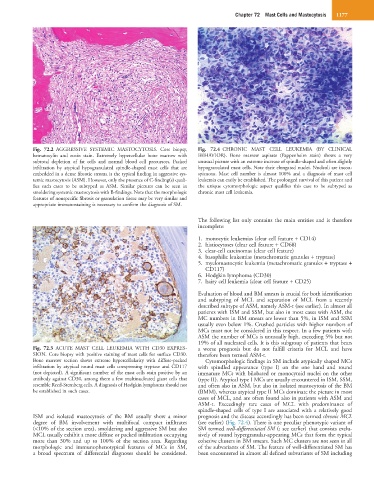
            Fig.  72.2  AGGRESSIVE  SYSTEMIC  MASTOCYTOSIS.  Core  biopsy,   Fig.  72.4  CHRONIC  MAST  CELL  LEUKEMIA  (BY  CLINICAL
            hematoxylin  and  eosin  stain.  Extremely  hypercellular  bone  marrow  with   BEHAVIOR).  Bone  marrow  aspirate  (Pappenheim  stain)  shows  a  very
            subtotal  depletion  of  fat  cells  and  normal  blood  cell  precursors.  Packed   unusual picture with an extreme increase of spindle-shaped and often slightly
            infiltration  by  atypical  hypogranulated  spindle-shaped  mast  cells  that  are   hypogranulated mast cells. Note their elongated nuclei. Nucleoli are incon-
            embedded in a dense fibrotic stroma is the typical finding in aggressive sys-  spicuous.  Mast  cell  number  is  almost  100%  and  a  diagnosis  of  mast  cell
            temic mastocytosis (ASM). However, only the presence of C-finding(s) quali-  leukemia can easily be established. The prolonged survival of this patient and
            fies  such  cases  to  be  subtyped  as  ASM.  Similar  pictures  can  be  seen  in   the  unique  cytomorphologic  aspect  qualifies  this  case  to  be  subtyped  as
            smoldering systemic mastocytosis with B-findings. Note that the morphologic   chronic mast cell leukemia.
            features of nonspecific fibrosis or granulation tissue may be very similar and
            appropriate immunostaining is necessary to confirm the diagnosis of SM.

                                                                  The following list only contains the main entities and is therefore
                                                                  incomplete:
                                                                  1.  monocytic leukemias (clear cell feature + CD14)
                                                                  2.  histiocytoses (clear cell feature + CD68)
                                                                  3.  clear-cell carcinomas (clear cell feature)
                                                                  4.  basophilic leukemias (metachromatic granules + tryptase)
                                                                  5.  myelomastocytic leukemia (metachromatic granules + tryptase +
                                                                    CD117)
                                                                  6.  Hodgkin lymphoma (CD30)
                                                                  7.  hairy cell leukemia (clear cell feature + CD25)
                                                                  Evaluation of blood and BM smears is crucial for both identification
                                                                  and  subtyping  of  MCL  and  separation  of  MCL  from  a  recently
                                                                  described subtype of ASM, namely ASM-t (see earlier). In almost all
                                                                  patients with ISM and SSM, but also in most cases with ASM, the
                                                                  MC numbers in BM smears are lower than 5%, in ISM and SSM
                                                                  usually even below 1%. Crushed particles with higher numbers of
                                                                  MCs must not be considered in this respect. In a few patients with
                                                                  ASM the number of MCs is unusually high, exceeding 5% but not
                                                                  19% of all nucleated cells. It is this subgroup of patients that bears
            Fig.  72.3  ACUTE  MAST  CELL  LEUKEMIA  WITH  CD30  EXPRES-  a  worse  prognosis  but  do  not  fulfill  criteria  for  MCL  and  have
            SION. Core biopsy with positive staining of mast cells for surface CD30.   therefore been termed ASM-t.
            Bone  marrow  section  shows  extreme  hypercellularity  with  diffuse-packed   Cytomorphologic findings in SM include atypically shaped MCs
            infiltration by atypical round mast cells coexpressing tryptase and CD117   with  spindled  appearance  (type  I)  on  the  one  hand  and  round
            (not depicted). A significant number of the mast cells stain positive by an   immature MCs with bilobated or monocytoid nuclei on the other
            antibody against CD30, among them a few multinucleated giant cells that   (type II). Atypical type I MCs are usually encountered in ISM, SSM,
            resemble Reed-Sternberg cells. A diagnosis of Hodgkin lymphoma should not   and often also in ASM, but also in isolated mastocytosis of the BM
            be established in such cases.                         (BMM), whereas atypical type II MCs dominate the picture in most
                                                                  cases of MCL, and are often found also in patients with ASM and
                                                                  ASM-t.  Exceedingly  rare  cases  of  MCL  with  predominance  of
                                                                  spindle-shaped cells of type I are associated with a relatively good
            ISM  and  isolated  mastocytosis  of  the  BM  usually  show  a  minor   prognosis and the disease accordingly has been termed chronic MCL
            degree  of  BM  involvement  with  multifocal  compact  infiltrates   (see earlier) (Fig. 72.4). There is one peculiar phenotypic variant of
            (<10% of the section area), smoldering and aggressive SM but also   SM termed well-differentiated SM (; see earlier) that consists exclu-
            MCL usually exhibit a more diffuse or packed infiltration occupying   sively of round hypergranular-appearing MCs that form the typical
            more  than  30%  and  up  to  100%  of  the  section  area.  Regarding   cohesive clusters in BM smears. Such MC clusters are not seen in all
            morphologic  and  immunophenotypical  features  of  MCs  in  SM,   of the subvariants of SM. The feature of well-differentiated SM has
            a  broad  spectrum  of  differential  diagnoses  should  be  considered.   been encountered in almost all defined subvariants of SM including

