


Page 1361 - Hematology_ Basic Principles and Practice ( PDFDrive )
P. 1361
Chapter 74  Origin of Hodgkin Lymphoma  1207


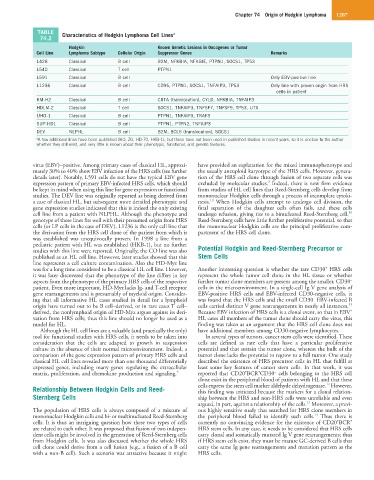
             TABLE   Characteristics of Hodgkin Lymphoma Cell Lines a
              74.2
                        Hodgkin                      Known Genetic Lesions in Oncogenes or Tumor
             Cell Line  Lymphoma Subtype  Cellular Origin  Suppressor Genes               Remarks
             L428       Classical       B cell       B2M, NFKBIA, NFKBIE, PTPN1, SOCS1, TP53
             L540       Classical       T cell       PTPN1
             L591       Classical       B cell                                            Only EBV-positive line
             L1236      Classical       B cell       CD95, PTPN1, SOCS1, TNFAIP3, TP53    Only line with proven origin from HRS
                                                                                           cells in patient
             KM-H2      Classical       B cell       CIITA (translocation), CYLD, NFKBIA, TNFAIP3
             HDLM-2     Classical       T cell       SOCS1, TNFAIP3, TNFSF7, TNFSF9, TP53, UTX
             UHO-1      Classical       B cell       PTPN1, TNFAIP3, TRAF3
             SUP-HD1    Classical       B cell       PTPN1, PTPN2, TNFAIP3
             DEV        NLPHL           B cell       B2M, BCL6 (translocation), SOCS1
             a A few additional lines have been published (HO, ZO, HD-70, HKB-1), but these have not been used in published studies in recent years, so it is unclear to the author
             whether they still exist, and very little is known about their phenotypic, functional, and genetic features.


            virus (EBV)–positive. Among primary cases of classical HL, approxi-  have provided an explanation for the mixed immunophenotype and
            mately 30% to 40% show EBV infection of the HRS cells (see further   the usually aneuploid karyotype of the HRS cells. However, genera-
            details later). Notably, L591 cells do not have the typical EBV gene   tion of the HRS cell clone through fusion of two separate cells was
                                                                                         9
            expression pattern of primary EBV-infected HRS cells, which should   excluded by molecular studies.  Indeed, there is now firm evidence
            be kept in mind when using this line for gene expression or functional   from studies of HL cell lines that Reed-Sternberg cells develop from
            studies. The DEV line was originally reported as being derived from   mononuclear Hodgkin cells through a process of incomplete cytoki-
                                                                      10
            a case of classical HL, but subsequent more detailed phenotypic and   nesis.  When Hodgkin cells attempt to undergo cell division, the
            gene expression studies indicated that this is indeed the only existing   final  separation  of  the  daughter  cells  often  fails,  and  these  cells
                                                                                                                   10
            cell line from a patient with NLPHL. Although the phenotype and   undergo refusion, giving rise to a binucleated Reed-Sternberg cell.
            genotype of these lines fits well with their presumed origin from HRS   Reed-Sternberg cells have little further proliferative potential, so that
            cells (or LP cells in the case of DEV), L1236 is the only cell line that   the mononuclear Hodgkin cells are the principal proliferative com-
            the derivation from the HRS cell clone of the patient from which it   partment of the HRS cell clone.
            was  established  was  unequivocally  proven.  In  1998  a  line  from  a
            pediatric patient with HL was established (HKB-1), but no further
            studies with this line were reported. Originally, the CO line was also   Potential Hodgkin and Reed-Sternberg Precursor or
            published as an HL cell line. However, later studies showed that this   Stem Cells
            line represents a cell culture contamination. Also the HD-Myz line
                                                                                                           +
            was for a long time considered to be a classical HL cell line. However,   Another interesting question is whether the rare CD30  HRS cells
            it was later discovered that the phenotype of the line differs in key   represent the whole tumor cell clone in the HL tissue or whether
                                                                                                                    –
            aspects from the phenotype of the primary HRS cells of the respective   further tumor clone members are present among the smaller, CD30
            patient. Even more important, HD-Myz lacks Ig- and T-cell receptor   cells in the microenvironment. In a single-cell Ig V gene analysis of
            gene rearrangements and is presumably of myeloid origin. Consider-  EBV-positive  HRS  cells  and  EBV-infected  CD30-negative  cells,  it
                                                                                                       –
            ing that all informative HL cases studied in detail for a lymphoid   was found that the HRS cells and the small CD30  EBV-infected B
                                                                                                                   11
            origin have turned out to be B cell–derived, or in rare cases T cell–  cells carried distinct V gene rearrangements in nearly all instances.
                                                                                                                    +
            derived, the nonlymphoid origin of HD-Myz argues against its deri-  Because EBV infection of HRS cells is a clonal event, so that in EBV
            vation from HRS cells; thus this line should no longer be used as a   HL cases all members of the tumor clone should carry the virus, this
            model for HL.                                         finding was taken as an argument that the HRS cell clone does not
              Although the HL cell lines are a valuable (and practically the only)   have additional members among CD30-negative lymphocytes.
            tool for functional studies with HRS cells, it needs to be taken into   In several types of tumors, cancer stem cells were identified. These
            consideration  that  the  cells  are  adapted  to  growth  in  suspension   cells  are  defined  as  rare  cells  that  have  a  particular  proliferative
            culture in the absence of their normal microenvironment. Indeed, a   potential and that sustain the tumor clone, whereas the bulk of the
            comparison of the gene expression pattern of primary HRS cells and   tumor clone lacks the potential to regrow to a full tumor. One study
            classical HL cell lines revealed more than one thousand differentially   described the existence of HRS precursor cells in HL that fulfill at
            expressed  genes,  including  many  genes  regulating  the  extracellular   least  some  key  features  of  cancer  stem  cells.  In  that  work,  it  was
                                                                                 +
                                                                                     +
                                                                                           –
            matrix, proliferation, and chemokine production and signaling. 8  reported that CD20 BCR CD30  cells belonging to the HRS cell
                                                                  clone exist in the peripheral blood of patients with HL and that these
                                                                                                            12
            Relationship Between Hodgkin Cells and Reed-          cells express the stem cell marker aldehyde dehydrogenase.  However,
                                                                  this finding was criticized because the markers for a clonal relation-
            Sternberg Cells                                       ship between the HRS and non-HRS cells were unreliable and even
                                                                                                     13
                                                                  argued, in part, against a relationship of the cells.  Moreover, a previ-
            The  population  of  HRS  cells  is  always  composed  of  a  mixture  of   ous highly sensitive study that searched for HRS clone members in
                                                                                                        14
            mononuclear Hodgkin cells and bi- or multinucleated Reed-Sternberg   the  peripheral  blood  failed  to  identify  such  cells.   Thus  there  is
                                                                                                               +
                                                                                                                    +
            cells. It is thus an intriguing question how these two types of cells   currently no convincing evidence for the existence of CD20 BCR
            are related to each other. It was proposed that fusion of two indepen-  HRS stem cells. In any case, it needs to be considered that HRS cells
            dent cells might be involved in the generation of Reed-Sternberg cells   carry clonal and somatically mutated Ig V gene rearrangements; thus
            from Hodgkin cells. It was also discussed whether the whole HRS   if HRS stem cells exist, they must be mature GC-derived B cells that
            cell clone could derive from a cell fusion (e.g., a fusion of a B cell   carry the same Ig gene rearrangements and mutation pattern as the
            with a non-B cell). Such a scenario was attractive because it might   HRS cells.

