


Page 1362 - Hematology_ Basic Principles and Practice ( PDFDrive )
P. 1362
1208   Part VII  Hematologic Malignancies


                                                                                         HRS cell


                          Naive              GC        Common
                           B cell           B cell     lymphoma         Separate additional
                                                       precursor
                                                                        transforming events?


                                                First
                                             transforming
                                              event(s)?
                                                                              B-NHL
                                                                                cell
                                                               Germinal
                                                                center

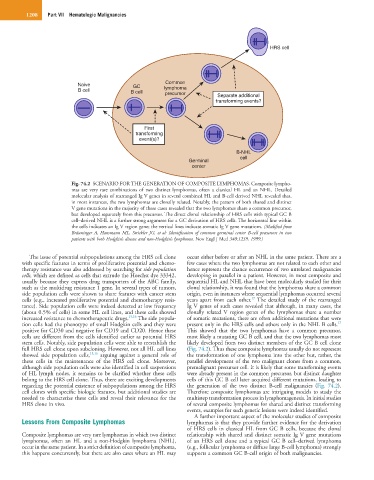
                        Fig. 74.2  SCENARIO FOR THE GENERATION OF COMPOSITE LYMPHOMAS. Composite lympho-
                        mas  are  very  rare  combinations  of  two  distinct  lymphomas,  often  a  classical  HL  and  an  NHL.  Detailed
                        molecular analysis of rearranged Ig V genes in several combined HL and B-cell derived NHL revealed that,
                        in most instances, the two lymphomas are clonally related. Notably, the pattern of both shared and distinct
                        V gene mutations in the majority of these cases revealed that the two lymphomas share a common precursor,
                        but developed separately from this precursor. The direct clonal relationship of HRS cells with typical GC B
                        cell–derived NHL is a further strong argument for a GC derivation of HRS cells. The horizontal line within
                        the cells indicates an Ig V region gene; the vertical lines indicate somatic Ig V gene mutations. (Modified from
                        Bräuninger A, Hansmann ML, Strickler JG, et al: Identification of common germinal center B-cell precursors in two
                        patients with both Hodgkin’s disease and non-Hodgkin’s lymphoma. New Engl J Med 340:1239, 1999.)


           The issue of potential subpopulations among the HRS cell clone   occur either before or after an NHL in the same patient. There are a
        with specific features in terms of proliferative potential and chemo-  few cases where the two lymphomas are not related to each other and
        therapy resistance was also addressed by searching for side population   hence represent the chance occurrence of two unrelated malignancies
        cells, which are defined as cells that extrude the Hoechst dye 33342,   developing in parallel in a patient. However, in most composite and
        usually  because  they  express  drug  transporters  of  the  ABC  family,   sequential HL and NHL that have been molecularly studied for their
        such as the multidrug resistance 1 gene. In several types of tumors,   clonal relationship, it was found that the lymphomas share a common
        side population cells were shown to share features with cancer stem   origin, even in instances where sequential lymphomas occurred several
                                                                                   17
        cells (e.g., increased proliferative potential and chemotherapy resis-  years  apart  from  each  other.  The  detailed  study  of  the  rearranged
        tance). Side population cells were indeed detected at low frequency   Ig V genes of such cases revealed that although, in many cases, the
        (about 0.5% of cells) in some HL cell lines, and these cells showed   clonally  related  V  region  genes  of  the  lymphomas  share  a  number
        increased resistance to chemotherapeutic drugs. 15,16  The side popula-  of somatic mutations, there are often additional mutations that were
                                                                                                               17
        tion cells had the phenotype of small Hodgkin cells and they were   present only in the HRS cells and others only in the NHL B cells.
        positive for CD30 and negative for CD19 and CD20. Hence these   This  showed  that  the  two  lymphomas  have  a  common  precursor,
        cells are different from the cells identified earlier as potential HRS   most likely a mutating GC B cell, and that the two lymphomas most
        stem cells. Notably, side population cells were able to reestablish the   likely developed from two distinct members of the GC B cell clone
        full HRS cell clone upon subcloning. However, not all HL cell lines   (Fig. 74.2). Thus these composite lymphomas usually do not represent
        showed  side  population  cells, 15,16   arguing  against  a  general  role  of   the transformation of one lymphoma into the other but, rather, the
        these  cells  in  the  maintenance  of  the  HRS  cell  clone.  Moreover,   parallel development of the two malignant clones from a common,
        although side population cells were also identified in cell suspensions   premalignant precursor cell. It is likely that some transforming events
        of HL  lymph nodes, it remains  to be  clarified whether  these cells   were already present in the common precursor, but distinct daughter
        belong to the HRS cell clone. Thus, there are exciting developments   cells of this GC B cell later acquired different mutations, leading to
        regarding the potential existence of subpopulations among the HRS   the  generation  of  the  two  distinct  B-cell  malignancies  (Fig.  74.2).
        cell clones with specific biologic features, but additional studies are   Therefore composite lymphomas are intriguing models to study the
        needed to characterize these cells and reveal their relevance for the   multistep transformation process in lymphomagenesis. In initial studies
        HRS clone in vivo.                                    of several composite lymphomas for shared and distinct transforming
                                                              events, examples for such genetic lesions were indeed identified.
                                                                 A further important aspect of the molecular studies of composite
        Lessons From Composite Lymphomas                      lymphomas is that they provide further evidence for the derivation
                                                              of HRS cells in classical HL from GC B cells, because the clonal
        Composite lymphomas are very rare lymphomas in which two distinct   relationship with shared and distinct somatic Ig V gene mutations
        lymphomas,  often  an  HL  and  a  non-Hodgkin  lymphoma  (NHL),   of an HRS cell clone and a typical GC B cell–derived lymphoma
        occur in the same patient. In a strict definition of composite lymphoma,   (e.g., follicular lymphoma or diffuse large B-cell lymphoma) strongly
        this happens concurrently, but there are also cases where an HL may   supports a common GC B-cell origin of both malignancies.

