


Page 1364 - Hematology_ Basic Principles and Practice ( PDFDrive )
P. 1364
1210   Part VII  Hematologic Malignancies


                                                     EBV
                                                   infection
                                                    (40%)       CD40  BCMA  TACI
                                          RANK
                                    CD40            LMP1
                              CD30


                                                                                        TRAF3
                                         RIP  TRAF        NIK gains                    mutations
                        TNFAIP3                             (20%)   NIK         TRAF3
                        mutations  TNFAIP3         CYLD                                 (5%)
                          (40%)
                                                      CYLD
                              Classical    NEMO      mutations
                               NF-κB    IKKα  IKKβ    (5%)        IKKα  IKKα    Alternative
                              pathway                                            NF-κB
                                                                                pathway
                             NFKBIA and
                           NFKBIE mutations  IκBα/
                              (10–20%)      IκBε                  p100 RELB
                                          p50 p65  Proteasomal
                                                   degradation
                                  REL
                               amplification                                       Cytoplasm
                                 (40%)             BCL3 gains or
                                                   translocations
                                                      (rare)         p52 RELB    Nucleus
                                      p50  p65        BCL3
                                                     p50 p50

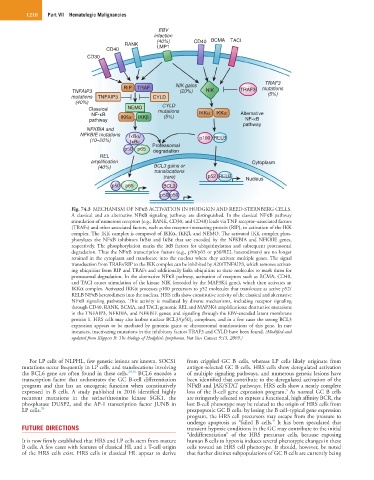
                        Fig. 74.3  MECHANISM OF NFκB ACTIVATION IN HODGKIN AND REED-STERNBERG CELLS.
                        A  classical  and  an  alternative  NFκB  signaling  pathway  are  distinguished.  In  the  classical  NFκB  pathway
                        stimulation of numerous receptors (e.g., RANK, CD30, and CD40) leads via TNF receptor–associated factors
                        (TRAFs) and other associated factors, such as the receptor-interacting protein (RIP), to activation of the IKK
                        complex. The IKK complex is composed of IKKα, IKKβ, and NEMO. The activated IKK complex phos-
                        phorylates  the  NFκB  inhibitors  IκBα  and  IκBε  that  are  encoded  by  the  NFKBIA  and  NFKBIE  genes,
                        respectively. The  phosphorylation  marks  the  IκB  factors  for  ubiquitinylation  and  subsequent  proteasomal
                        degradation. Thus the NFκB transcription factors (e.g., p50/p65 or p50/REL heterodimers) are no longer
                        retained in the cytoplasm and translocate into the nucleus where they activate multiple genes. The signal
                        transduction from TRAFs/RIP to the IKK complex can be inhibited by A20/TNFAIP3, which removes activat-
                        ing ubiquitins from RIP and TRAFs and additionally links ubiquitins to these molecules to mark them for
                        proteasomal degradation. In the alternative NFκB pathway, activation of receptors such as BCMA, CD40,
                        and TACI causes stimulation of the kinase NIK (encoded by the MAP3K4 gene), which then activates an
                        IKKα complex. Activated IKKα processes p100 precursors to p52 molecules that translocate as active p52/
                        RELB NFκB heterodimers into the nucleus. HRS cells show constitutive activity of the classical and alternative
                        NFκB  signaling  pathways. This  activity  is  mediated  by  diverse  mechanisms,  including  receptor  signaling
                        through CD40, RANK, BCMA, and TACI; genomic REL and MAP3K4 amplifications; destructive mutations
                        in the TNFAIP3, NFKBIA, and NFKBIE genes; and signaling through the EBV-encoded latent membrane
                        protein 1. HRS cells may also harbor nuclear BCL3/(p50) 2  complexes, and in a few cases the strong BCL3
                        expression  appears  to  be  mediated  by  genomic  gains  or  chromosomal  translocations  of  this  gene.  In  rare
                        instances, inactivating mutations in the inhibitory factors TRAF3 and CYLD have been found. (Modified and
                        updated from Küppers R: The biology of Hodgkin’s lymphoma. Nat Rev Cancer 9:15, 2009.)


           For LP cells of NLPHL, few genetic lesions are known. SOCS1   from  crippled  GC  B  cells,  whereas  LP  cells  likely  originate  from
        mutations occur frequently in LP cells, and translocations involving   antigen-selected GC B cells. HRS cells show deregulated activation
        the BCL6 gene are often found in these cells. 29,30  BCL6 encodes a   of multiple signaling pathways, and numerous genetic lesions have
        transcription  factor  that  orchestrates  the  GC  B-cell  differentiation   been identified that contribute to the deregulated activation of the
        program  and  that  has  an  oncogenic  function  when  constitutively   NFκB and JAK/STAT pathways. HRS cells show a nearly complete
                                                                                               3
        expressed  in  B  cells.  A  study  published  in  2016  identified  highly   loss of the B-cell gene expression program.  As normal GC B cells
        recurrent  mutations  in  the  serine/threonine  kinase  SGK1,  the   are stringently selected to express a functional, high affinity BCR, the
        phosphatase  DUSP2,  and  the  AP-1  transcription  factor  JUNB  in    lost B-cell phenotype may be related to the origin of HRS cells from
        LP cells. 29                                          preapoptotic GC B cells: by losing the B cell–typical gene expression
                                                              program, the HRS cell precursors may escape from the pressure to
                                                              undergo  apoptosis  as  “failed  B  cells.”  It  has  been  speculated  that
        FUTURE DIRECTIONS                                     transient hypoxic conditions in the GC may contribute to the initial
                                                              “dedifferentiation”  of  the  HRS  precursor  cells,  because  exposing
        It is now firmly established that HRS and LP cells stem from mature   human B cells to hypoxia induces several phenotypic changes in these
        B cells. A few cases with features of classical HL and a T-cell origin   cells toward an HRS cell phenotype. It should, however, be noted
        of the HRS cells exist. HRS cells in classical HL appear to derive   that further distinct subpopulations of GC B cells are currently being

