


Page 1359 - Hematology_ Basic Principles and Practice ( PDFDrive )
P. 1359
Chapter 74  Origin of Hodgkin Lymphoma  1205


                                                                       GC B
                                                                       cells
                                                          Proliferation

                                               Somatic
                                            hypermutation

                                                                           Advantagous
                                                                             V gene         Plasma
                                                                            mutations        cell
                                         Rescue from  Disadvantageous
                                          apoptosis  V gene mutations  Selection
                                  HRS
                                precursor
                                   cell
                                                                                  Differentiation
                                                    Apoptotic
                                Further              B cells
                               transforming                            Transforming   Memory
                                 events                                  events        B cell
                                                            LP
                                                            cell
                                          HRS
                                           cell

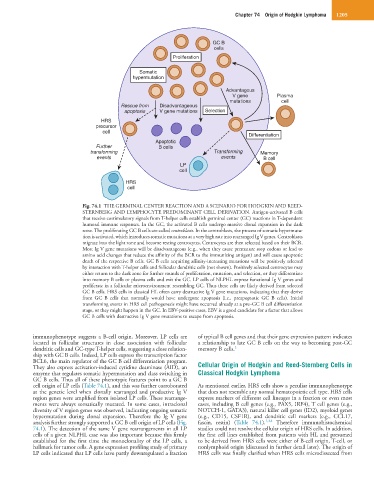
                            Fig. 74.1  THE GERMINAL CENTER REACTION AND A SCENARIO FOR HODGKIN AND REED-
                            STERNBERG AND LYMPHOCYTE PREDOMINANT CELL DERIVATION. Antigen-activated B cells
                            that receive costimulatory signals from T-helper cells establish germinal center (GC) reactions in T-dependent
                            humoral immune responses. In the GC, the activated B cells undergo massive clonal expansion in the dark
                            zone. The proliferating GC B cells are called centroblasts. In the centroblasts, the process of somatic hypermuta-
                            tion is activated, which introduces somatic mutations at a very high rate into rearranged Ig V genes. Centroblasts
                            migrate into the light zone and become resting centrocytes. Centrocytes are then selected based on their BCR.
                            Most Ig V gene mutations will be disadvantageous (e.g., when they cause premature stop codons or lead to
                            amino acid changes that reduce the affinity of the BCR to the immunizing antigen) and will cause apoptotic
                            death of the respective B cells. GC B cells acquiring affinity-increasing mutations will be positively selected
                            by interaction with T-helper cells and follicular dendritic cells (not shown). Positively selected centrocytes may
                            either return to the dark zone for further rounds of proliferation, mutation, and selection, or they differentiate
                            into memory B cells or plasma cells and exit the GC. LP cells of NLPHL express functional Ig V genes and
                            proliferate in a follicular microenvironment resembling GC. Thus these cells are likely derived from selected
                            GC B cells. HRS cells in classical HL often carry destructive Ig V gene mutations, indicating that they derive
                            from  GC  B  cells  that  normally  would  have  undergone  apoptosis  (i.e.,  preapoptotic  GC  B  cells).  Initial
                            transforming events in HRS cell pathogenesis might have occurred already at a pre–GC B cell differentiation
                            stage, or they might happen in the GC. In EBV-positive cases, EBV is a good candidate for a factor that allows
                            GC B cells with destructive Ig V gene mutations to escape from apoptosis.


            immunophenotype suggests a B-cell origin. Moreover, LP cells are   of typical B cell genes and that their gene expression pattern indicates
            located  in  follicular  structures  in  close  association  with  follicular   a relationship to late GC B cells on the way to becoming post-GC
            dendritic cells and GC-type T-helper cells, suggesting a close relation-  memory B cells. 2
            ship with GC B cells. Indeed, LP cells express the transcription factor
            BCL6, the main regulator of the GC B cell differentiation program.
            They also express activation-induced cytidine deaminase (AID), an   Cellular Origin of Hodgkin and Reed-Sternberg Cells in
            enzyme that regulates somatic hypermutation and class switching in   Classical Hodgkin Lymphoma
            GC B cells. Thus all of these phenotypic features point to a GC B
            cell origin of LP cells (Table 74.1), and this was further corroborated   As mentioned earlier, HRS cells show a peculiar immunophenotype
            at  the genetic  level  when  clonally  rearranged and  productive  Ig V   that does not resemble any normal hematopoietic cell type. HRS cells
            region genes were amplified from isolated LP cells. These rearrange-  express markers of different cell lineages in a fraction or even most
            ments were always somatically mutated. In some cases, intraclonal   cases, including B cell genes (e.g., PAX5, IRF4), T cell genes (e.g.,
            diversity of V region genes was observed, indicating ongoing somatic   NOTCH-1, GATA3), natural killer cell genes (ID2), myeloid genes
            hypermutation  during  clonal  expansion.  Therefore  the  Ig  V  gene   (e.g.,  CD15,  CSF1R),  and  dendritic  cell  markers  (e.g.,  CCL17,
            analysis further strongly supported a GC B cell origin of LP cells (Fig.   fascin,  restin)  (Table  74.1). 1,3,4   Therefore  immunohistochemical
            74.1). The detection of the same V gene rearrangements in all LP   studies could not resolve the cellular origin of HRS cells. In addition,
            cells of a given NLPHL case was also important because this firmly   the first cell lines established from patients with HL and presumed
            established  for  the  first  time  the  monoclonality  of  the  LP  cells,  a   to be derived from HRS cells were either of B-cell origin, T-cell, or
            hallmark for tumor cells. A gene expression profiling study of primary   nonlymphoid origin (discussed in further detail later). The origin of
            LP cells indicated that LP cells have partly downregulated a fraction   HRS cells was finally clarified when HRS cells microdissected from

