


Page 1360 - Hematology_ Basic Principles and Practice ( PDFDrive )
P. 1360
1206   Part VII  Hematologic Malignancies


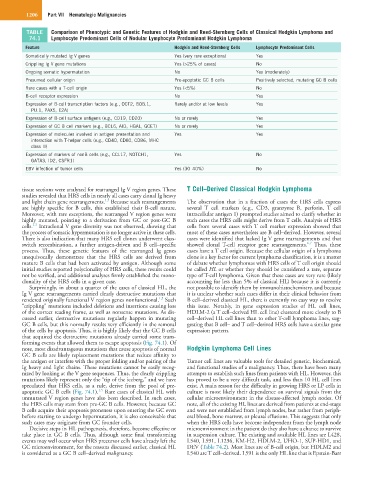
          TABLE   Comparison of Phenotypic and Genetic Features of Hodgkin and Reed-Sternberg Cells of Classical Hodgkin Lymphoma and
          74.1    Lymphocyte Predominant Cells of Nodular Lymphocyte Predominant Hodgkin Lymphoma
         Feature                                          Hodgkin and Reed-Sternberg Cells  Lymphocyte Predominant Cells
         Somatically mutated Ig V genes                   Yes (very rare exceptions)  Yes
         Crippling Ig V gene mutations                    Yes (>25% of cases)        No
         Ongoing somatic hypermutation                    No                         Yes (moderately)
         Presumed cellular origin                         Pre-apoptotic GC B cells   Positively selected, mutating GC B cells
         Rare cases with a T-cell origin                  Yes (<5%)                  No
         B-cell receptor expression                       No                         Yes
         Expression of B-cell transcription factors (e.g., OCT2, BOB.1,   Rarely and/or at low levels  Yes
           PU.1, PAX5, E2A)
         Expression of B-cell surface antigens (e.g., CD19, CD20)  No or rarely      Yes
         Expression of GC B cell markers (e.g., BCL6, AID, HGAL, GCET)  No or rarely  Yes
         Expression of molecules involved in antigen presentation and   Yes          Yes
           interaction with T-helper cells (e.g., CD40, CD80, CD86, MHC
           class II)
         Expression of markers of nonB cells (e.g., CCL17, NOTCH1,   Yes             No
           GATA3, ID2, CSFR1)
         EBV infection of tumor cells                     Yes (30–40%)               No


        tissue sections were analyzed for rearranged Ig V region genes. These   T Cell–Derived Classical Hodgkin Lymphoma
        studies revealed that HRS cells in nearly all cases carry clonal Ig heavy
                                   1,5
        and light chain gene rearrangements.  Because such rearrangements   The  observation  that  in  a  fraction  of  cases  the  HRS  cells  express
        are  highly  specific  for  B  cells,  this  established  their  B-cell  nature.   several  T  cell  markers  (e.g.,  CD3,  granzyme  B,  perforin,  T  cell
        Moreover, with rare exceptions, the rearranged V region genes were   intracellular antigen 1) prompted studies aimed to clarify whether in
        highly  mutated,  pointing  to  a  derivation  from  GC  or  post-GC  B   such cases the HRS cells might derive from T cells. Analysis of HRS
            1,5
        cells.  Intraclonal V gene diversity was not observed, showing that   cells from several cases with T cell marker expression showed that
        the process of somatic hypermutation is no longer active in these cells.   most of these cases nevertheless are B cell–derived. However, several
        There is also indication that many HRS cell clones underwent class-  cases were identified that lacked Ig V gene rearrangements and that
                                                                                                      6,7
        switch recombination, a  further antigen-driven  and  B  cell–specific   showed  clonal  T-cell  receptor  gene  rearrangements.   Thus,  these
        process.  Thus,  these  genetic  features  of  the  rearranged  Ig  genes   cases have a T cell origin. Because the cellular origin of a lymphoma
        unequivocally  demonstrate  that  the  HRS  cells  are  derived  from   clone is a key factor for current lymphoma classification, it is a matter
        mature B cells that had been activated by antigen. Although some   of debate whether lymphomas with HRS cells of T cell origin should
        initial studies reported polyclonality of HRS cells, these results could   be called HL or whether they should be considered a rare, separate
        not be verified, and additional analyses firmly established the mono-  type of T-cell lymphoma. Given that these cases are very rare (likely
        clonality of the HRS cells in a given case.           accounting for less than 5% of classical HL) because it is currently
           Surprisingly, in about a quarter of the cases of classical HL, the   not possible to identify them by immunohistochemistry, and because
        Ig V gene rearrangements carried clearly destructive mutations that   it is unclear whether such cases differ in their clinical behavior from
                                                     1,5
        rendered originally functional V region genes nonfunctional.  Such   B cell–derived classical HL, there is currently no easy way to resolve
        “crippling” mutations included deletions and insertions causing loss   this  issue.  Notably,  in  gene  expression  studies  of  HL  cell  lines,
        of the correct reading frame, as well as nonsense mutations. As dis-  HDLM-2 (a T cell–derived HL cell line) clustered more closely to B
        cussed  earlier,  destructive  mutations  regularly  happen  in  mutating   cell–derived HL cell lines than to other T-cell lymphoma lines, sug-
        GC B cells, but this normally results very efficiently in the removal   gesting that B cell– and T cell–derived HRS cells have a similar gene
        of the cells by apoptosis. Thus, it is highly likely that the GC B cells   expression pattern.
        that acquired the destructive mutations already carried some trans-
        forming events that allowed them to escape apoptosis (Fig. 74.1). Of
        note, most disadvantageous mutations that cause apoptosis of normal   Hodgkin Lymphoma Cell Lines
        GC B cells are likely replacement mutations that reduce affinity to
        the antigen or interfere with the proper folding and/or pairing of the   Tumor cell lines are valuable tools for detailed genetic, biochemical,
        Ig heavy and light chains. These mutations cannot be easily recog-  and functional studies of a malignancy. Thus, there have been many
        nized by looking at the V gene sequences. Thus, the clearly crippling   attempts to establish such lines from patients with HL. However, this
        mutations likely represent only the “tip of the iceberg,” and we have   has proved to be a very difficult task, and less than 10 HL cell lines
        speculated  that  HRS  cells,  as  a  rule,  derive  from  the  pool  of  pre-  exist. A main reason for the difficulty in growing HRS or LP cells in
                                 1,5
        apoptotic GC B cells (Fig. 74.1).  Rare cases of classical HL with   culture is most likely their dependence on survival signals from the
        unmutated V region genes have also been described. In such cases,   cellular microenvironment in the disease-affected lymph nodes. Of
        the HRS cells may stem from pre-GC B cells. However, because GC   note, all of the existing HL lines are derived from patients at end-stage
        B cells acquire their apoptosis proneness upon entering the GC even   and were not established from lymph nodes, but rather from periph-
        before starting to undergo hypermutation, it is also conceivable that   eral blood, bone marrow, or pleural effusions. This suggests that only
        such cases may originate from GC founder cells.       when the HRS cells have become independent from the lymph node
           Decisive steps in HL pathogenesis, therefore, become effective or   microenvironment in the patient do they also have a chance to survive
        take place in GC B cells. Thus, although some final transforming   in suspension culture. The existing and available HL lines are L428,
        events may well occur when HRS precursor cells have already left the   L540, L591, L1236, KM-H2, HDLM-2, UHO-1, SUP-HD1, and
        GC microenvironment, for the reasons discussed earlier, classical HL   DEV (Table 74.2). Most lines are of B-cell origin, but HDLM2 and
        is considered as a GC B cell–derived malignancy.      L540 are T cell–derived. L591 is the only HL line that is Epstein-Barr

