


Page 1367 - Hematology_ Basic Principles and Practice ( PDFDrive )
P. 1367
Chapter 75  Hodgkin Lymphoma  1213

            Nodular Lymphocyte-Predominant Hodgkin Lymphoma       and variably express IRF4/MUM1. EBV-encoded RNA (EBER) and
                                                                  latent membrane protein-1 (LMP1) are consistently negative.
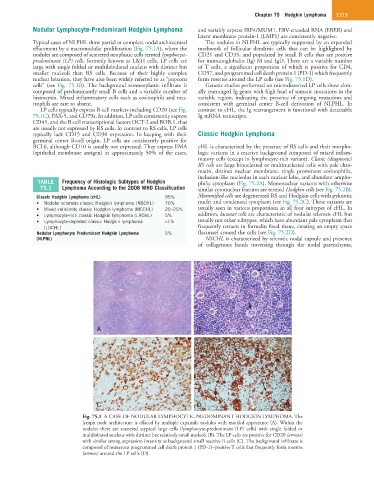
            Typical cases of NLPHL show partial or complete nodal architectural   The nodules in NLPHL are typically supported by an expanded
            effacement by a macronodular proliferation (Fig. 75.1A), where the   meshwork  of  follicular  dendritic  cells  that  can  be  highlighted  by
            nodules are composed of scattered neoplastic cells termed lymphocyte-  CD21 and CD35, and populated by small B cells that are positive
            predominant (LP) cells, formerly known as L&H cells. LP cells are   for immunoglobulin (Ig) M and IgD. There are a variable number
            large with single folded or multilobulated nucleus with distinct but   of T  cells,  a  significant  proportion  of  which  is  positive  for  CD4,
            smaller  nucleoli  than  RS  cells.  Because  of  their  highly  complex   CD57, and programmed cell death protein 1 (PD-1) which frequently
            nuclear lobation, they have also been widely referred to as “popcorn   form rosettes around the LP cells (see Fig. 75.1D).
            cells”  (see  Fig.  75.1B). The  background  nonneoplastic  infiltrate  is   Genetic studies performed on microdissected LP cells show clon-
            composed of predominantly small B cells and a variable number of   ally rearranged Ig genes with high load of somatic mutations in the
            histiocytes. Mixed inflammatory cells such as eosinophils and neu-  variable  region,  indicating  the  presence  of  ongoing  mutations  and
            trophils are rare to absent.                          consistent  with  germinal  center  B-cell  derivation  of  NLPHL.  In
              LP cells typically express B-cell markers including CD20 (see Fig.   contrast to cHL, the Ig rearrangement is functional with detectable
            75.1C), PAX-5, and CD79a. In addition, LP cells consistently express   Ig mRNA transcripts.
            CD45, and the B-cell transcriptional factors OCT-2 and BOB.1, that
            are usually not expressed by RS cells. In contrast to RS cells, LP cells
            typically  lack  CD15  and  CD30  expression.  In  keeping  with  their   Classic Hodgkin Lymphoma
            germinal center B-cell origin, LP cells are consistently positive for
            BCL6, although CD10 is usually not expressed. They express EMA   cHL is characterized by the presence of RS cells and their morpho-
            (epithelial membrane antigen) in approximately 50% of the cases,   logic variants in a reactive background composed of mixed inflam-
                                                                  matory cells (except in lymphocyte-rich variant). Classic (diagnostic)
                                                                  RS cells are large binucleated or multinucleated cells with pale chro-
                                                                  matin,  distinct  nuclear  membrane,  single  prominent  eosinophilic,
                                                                  inclusion-like nucleolus in each nuclear lobe, and abundant ampho-
             TABLE   Frequency of Histologic Subtypes of Hodgkin   philic cytoplasm (Fig. 75.2A). Mononuclear variants with otherwise
              75.1   Lymphoma According to the 2008 WHO Classification  similar cytonuclear features are termed Hodgkin cells (see Fig. 75.2B).
             Classic Hodgkin Lymphoma (cHL)            95%        Mummified cells are degenerated RS and Hodgkin cells with pyknotic
             •  Nodular sclerosis classic Hodgkin lymphoma (NSCHL)  70%  nuclei and condensed cytoplasm (see Fig. 75.2C). These variants are
             •  Mixed cellularity classic Hodgkin lymphoma (MCCHL)  20−25%  usually seen in various proportions in all four subtypes of cHL. In
             •  Lymphocyte-rich classic Hodgkin lymphoma (LRCHL)  5%  addition, lacunar cells are characteristic of nodular sclerosis cHL but
             •  Lymphocyte-depleted classic Hodgkin lymphoma   <1%  usually not other subtypes, which have abundant pale cytoplasm that
               (LDCHL)                                            frequently retracts in formalin fixed tissue, creating an empty space
             Nodular Lymphocyte Predominant Hodgkin Lymphoma   5%  (lacunae) around the cells (see Fig. 75.2D).
             (NLPHL)                                                NSCHL is characterized by sclerotic nodal capsule and presence
                                                                  of  collagenous  bands  traversing  through  the  nodal  parenchyma,


                                 A                               B


                                 C                               D
                            Fig. 75.1  A CASE OF NODULAR LYMPHOCYTE–PREDOMINANT HODGKIN LYMPHOMA. The
                            lymph node architecture is effaced by multiple expansile nodules with mottled appearance (A). Within the
                            nodules  there  are  scattered  atypical  large  cells  (lymphocyte-predominant  [LP]  cells)  with  single  folded  or
                            multilobated nucleus with distinct but relatively small nucleoli (B). The LP cells are positive for CD20 (arrows)
                            with similar strong expression intensity as background small reactive B cells (C). The background infiltrate is
                            composed of numerous programmed cell death protein 1 (PD-1)−positive T cells that frequently form rosettes
                            (arrows) around the LP cells (D).

