


Page 1368 - Hematology_ Basic Principles and Practice ( PDFDrive )
P. 1368
1214   Part VII  Hematologic Malignancies


                             A                                B


                             C                                D

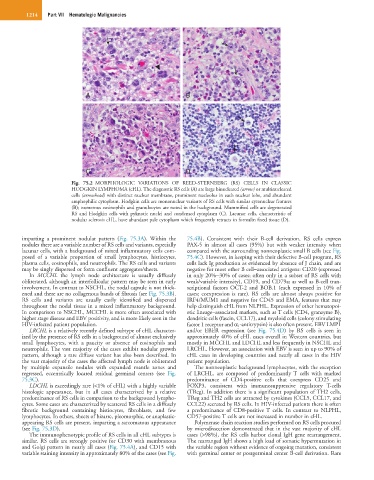
                        Fig.  75.2  MORPHOLOGIC  VARIATIONS  OF  REED-STERNBERG  (RS)  CELLS  IN  CLASSIC
                        HODGKIN LYMPHOMA (cHL). The diagnostic RS cells (A) are large binucleated (arrow) or multinucleated
                        cells (arrowhead) with distinct nuclear membrane, prominent nucleolus in each nuclear lobe, and abundant
                        amphophilic cytoplasm. Hodgkin cells are mononuclear variants of RS cells with similar cytonuclear features
                        (B); numerous eosinophils and granulocytes are noted in the background. Mummified cells are degenerated
                        RS and Hodgkin cells with pyknotic nuclei and condensed cytoplasm (C). Lacunar cells, characteristic of
                        nodular sclerosis cHL, have abundant pale cytoplasm which frequently retracts in formalin fixed tissue (D).


        imparting  a  prominent  nodular  pattern  (Fig.  75.3A).  Within  the   75.4B).  Consistent  with  their  B-cell  derivation,  RS  cells  express
        nodules there are a variable number of RS cells and variants, especially   PAX-5  in  almost  all  cases  (95%)  but  with  weaker  intensity  when
        lacunar cells, with a background of mixed inflammatory cells com-  compared with the surrounding nonneoplastic small B cells (see Fig.
        posed  of  a  variable  proportion  of  small  lymphocytes,  histiocytes,   75.4C). However, in keeping with their defective B-cell program, RS
        plasma cells, eosinophils, and neutrophils. The RS cells and variants   cells lack Ig production as evidenced by absence of J chain, and are
        may be singly dispersed or form confluent aggregates/sheets.  negative for most other B cell−associated antigens: CD20 (expressed
           In  MCCHL  the  lymph  node  architecture  is  usually  diffusely   in only 20%−30% of cases; often only in a subset of RS cells with
        obliterated, although an interfollicular pattern may be seen in early   weak/variable intensity), CD19, and CD79a; as well as B-cell tran-
        involvement. In contrast to NSCHL, the nodal capsule is not thick-  scriptional  factors  OCT-2  and  BOB.1  (each  expressed  in  10%  of
        ened and there are no collagenous bands of fibrosis (see Fig. 75.3B).   cases;  coexpression  is  rare).  RS  cells  are  almost  always  positive  for
        RS  cells  and  variants  are  usually  easily  identified  and  dispersed   IRF4/MUM1 and negative for CD45 and EMA, features that may
        throughout the nodal tissue in a mixed inflammatory background.   help distinguish cHL from NLPHL. Expression of other hematopoi-
        In comparison to NSCHL, MCCHL is more often associated with   etic lineage−associated markers, such as T cells (CD4, granzyme B),
        higher stage disease and EBV positivity, and is more likely seen in the   dendritic cells (fascin, CCL17), and myeloid cells (colony stimulating
        HIV-infected patient population.                      factor 1 receptor and α 1 -antitrypsin) is also often present. EBV LMP1
           LRCHL is a relatively recently defined subtype of cHL character-  and/or  EBER  expression  (see  Fig.  75.4D)  by  RS  cells  is  seen  in
        ized by the presence of RS cells in a background of almost exclusively   approximately 40% of cHL cases overall in Western countries, but
        small  lymphocytes,  with  a  paucity  or  absence  of  eosinophils  and   mostly in MCCHL and LDCHL and less frequently in NSCHL and
        neutrophils. The vast majority of the cases exhibit nodular growth   LRCHL. However, an association with EBV is seen in up to 90% of
        pattern, although a rare diffuse variant has also been described. In   cHL cases in developing countries and nearly all cases in the HIV
        the vast majority of the cases the affected lymph node is obliterated   patient population.
        by  multiple  expansile  nodules  with  expanded  mantle  zones  and   The nonneoplastic background lymphocytes, with the exception
        regressed,  eccentrically  located  residual  germinal  centers  (see  Fig.   of  LRCHL,  are  composed  of  predominantly T  cells  with  marked
        75.3C).                                               predominance  of  CD4-positive  cells  that  coexpress  CD25  and
           LDCHL is exceedingly rare (<1% of cHL) with a highly variable   FOXP3,  consistent  with  immunosuppressive  regulatory  T-cells
        histologic  appearance,  but  in  all  cases  characterized  by  a  relative   (TReg). In addition there is a significant population of TH2 cells.
        predominance of RS cells in comparison to the background lympho-  TReg and TH2 cells are attracted by cytokines (CCL5, CCL17, and
        cytes. Some cases are characterized by scattered RS cells in a diffusely   CCL22) secreted by RS cells. In HIV-infected patients there is often
        fibrotic  background  containing  histiocytes,  fibroblasts,  and  few   a  predominance  of  CD8-positive T  cells.  In  contrast  to  NLPHL,
        lymphocytes. In others, sheets of bizarre, pleomorphic, or anaplastic-  CD57-positive T cells are not increased in number in cHL.
        appearing RS cells are present, imparting a sarcomatous appearance   Polymerase chain reaction studies performed on RS cells procured
        (see Fig. 75.3D).                                     by microdissection demonstrated that in the vast majority of cHL
           The immunophenotypic profile of RS cells in all cHL subtypes is   cases (>98%), the RS cells harbor clonal IgH gene rearrangement.
        similar. RS cells are strongly positive for CD30 with membranous   The rearranged IgH shows a high load of somatic hypermutation in
        and Golgi pattern in nearly all cases (Fig. 75.4A), and CD15 with   the variable region without evidence of ongoing mutation, consistent
        variable staining intensity in approximately 80% of the cases (see Fig.   with germinal center or postgerminal center B-cell derivation. Rare

