


Page 1449 - Hematology_ Basic Principles and Practice ( PDFDrive )
P. 1449
Chapter 80  Clinical Manifestations, Staging, and Treatment of Follicular Lymphoma  1289


             TABLE   Incidence Rates Per 100,000 of the Indolent   TABLE   Mutations in Follicular Lymphoma
              80.1   Lymphomas (Ref)                                80.2
                                           All    Male   Female                                            Frequency
                                                                   Gene Name              Abbreviation  Location  at Diagnosis
             Non-hodgkin lymphoma          32.2   40.2   25.9
                                                                   Myeloid/lymphoid or    MLL2       12q      89%
             Follicular lymphoma            3.6    3.9    3.3
                                                                     mixed-lineage leukemia 2
             Small B lymphocytic lymphoma/Chronic   6.6  7.9  4.6
               lymphocytic leukemia/                               CREB binding protein   CREBBP     16p      33%
                                                                   Tumor necrosis factor receptor   TNFRSF14  1p  25%
             Lymphoplasmacytic lymphoma     0.6    0.8    0.5
                                                                     superfamily member 14
             Mantle cell lymphoma           0.8    1.3    0.4
                                                                   E1A binding protein p300  EP300   22q      15%
             Marginal zone lymphoma         2.0    2.1    1.9
                                                                   Myocyte enhancer factor 2B  MEF2B  19p     13%
             From SEER data base https://seer.cancer.gov/csr/1975_2013/browse_csr.php?s
             ectionSEL=19&pageSEL=sect_19_table.26.html (accessed January 29, 2017)  Enhancer of zeste homolog 2  EZH2  7q  11%


                          A
                                              BCL6    CD10        BCL2                 control BCL2


                          B                   C                   D                   E


                          F                   G                   H                   I
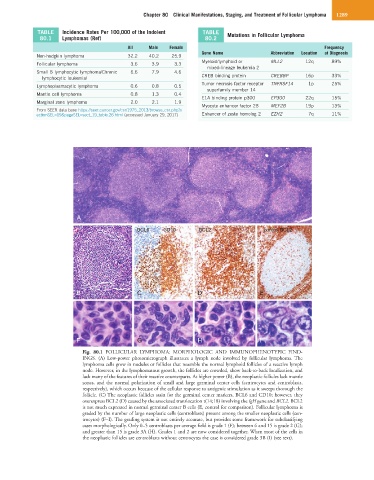
                            Fig.  80.1  FOLLICULAR  LYMPHOMA:  MORPHOLOGIC  AND  IMMUNOPHENOTYPIC  FIND-
                            INGS.  (A)  Low-power  photomicrograph  illustrates  a  lymph  node  involved  by  follicular  lymphoma. The
                            lymphoma cells grow in nodules or follicles that resemble the normal lymphoid follicles of a reactive lymph
                            node. However, in the lymphomatous growth, the follicles are crowded, show back-to-back localization, and
                            lack many of the features of their reactive counterparts. At higher power (B), the neoplastic follicles lack mantle
                            zones,  and  the  normal  polarization  of  small  and  large  germinal  center  cells  (centrocytes  and  centroblasts,
                            respectively), which occurs because of the cellular response to antigenic stimulation as it sweeps thorough the
                            follicle. (C) The neoplastic follicles stain for the germinal center markers, BCL6 and CD10; however, they
                            overexpress BCL2 (D) caused by the associated translocation t(14;18) involving the IgH gene and BCL2. BCL2
                            is not much expressed in normal germinal center B cells (E, control for comparison). Follicular lymphoma is
                            graded by the number of large neoplastic cells (centroblasts) present among the smaller neoplastic cells (cen-
                            trocytes) (F–I). The grading system is not entirely accurate, but provides some framework for subclassifying
                            cases morphologically. Only 0–5 centroblasts per average field is grade 1 (F); between 6 and 15 is grade 2 (G);
                            and greater than 15 is grade 3A (H). Grades 1 and 2 are now considered together. When most of the cells in
                            the neoplastic follicles are centroblasts without centrocytes the case is considered grade 3B (I) (see text).

