


Page 1452 - Hematology_ Basic Principles and Practice ( PDFDrive )
P. 1452
1292   Part VII  Hematologic Malignancies


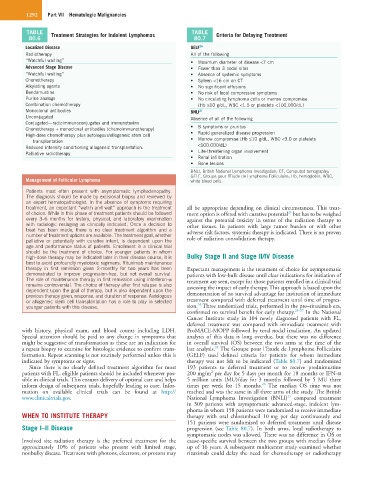
          TABLE   Treatment Strategies for Indolent Lymphomas   TABLE   Criteria for Delaying Treatment
          80.6                                                  80.7
         Localized Disease                                     GELF 26
         Radiotherapy                                          All of the following
         “Watchful waiting”                                    •  Maximum diameter of disease <7 cm
         Advanced Stage Disease                                •  Fewer than 3 nodal sites
         “Watchful waiting”                                    •  Absence of systemic symptoms
         Chemotherapy                                          •  Spleen <16 cm on CT
         Alkylating agents                                     •  No significant effusions
         Bendamustine                                          •  No risk of local compressive symptoms
         Purine analogs                                        •  No circulating lymphoma cells or marrow compromise
         Combination chemotherapy                                 (Hb ≤10 g/dL, WBC <1.5 or platelets <100,000/dL)
         Monoclonal antibodies                                 BNLI 27
         Unconjugated                                          Absence of all of the following
         Conjugated—radioimmunoconjugates and immunotoxins
         Chemotherapy + monoclonal antibodies (chemoimmunotherapy)  •  B symptoms or pruritus
         High-dose chemotherapy plus autologous/allogeneic stem cell   •  Rapid generalized disease progression
            transplantation                                    •  Marrow compromise (Hb ≤10 g/dL, WBC <3.0 or platelets
         Reduced intensity conditioning allogeneic transplantation.  <100,000/dL)
         Palliative radiotherapy                               •  Life-threatening organ involvement
                                                               •  Renal infiltration
                                                               •  Bone lesions
                                                               BNLI, British National Lymphoma Investigation; CT, Computed tomography;
                                                               GELF, Groupe pour l’Etude de Lymphome Folliculaire; Hb, hemoglobin; WBC,
         Management of Follicular Lymphoma                     white blood cells.
          Patients  most  often  present  with  asymptomatic  lymphadenopathy.
          The diagnosis should be made by excisional biopsy and reviewed by
          an  expert  hematopathologist.  In  the  absence  of  symptoms  requiring
          treatment, an expectant “watch and wait” approach is the treatment   all be appropriate depending on clinical circumstances. This treat-
          of choice. While in this phase of treatment patients should be followed   ment option is offered with curative potential  but has to be weighed
                                                                                               23
          every  3–6  months  for  history,  physical,  and  laboratory  examination   against  the  potential  toxicity  in  terms  of  the  radiation  therapy  to
          with  radiologic  restaging  as  clinically  indicated.  Once  a  decision  to   other  tissues.  In  patients  with  large  tumor  burden  or  with  other
          treat  has  been  made,  there  is  no  clear  treatment  algorithm  and  a   adverse risk factors, systemic therapy is indicated. There is no proven
          number of treatment options are available. The treatment goal, whether
          palliative  or  potentially  with  curative  intent,  is  dependent  upon  the   role of radiation consolidation therapy.
          age and performance status of patients. Enrollment in a clinical trial
          should  be  the  treatment  of  choice.  For  younger  patients  in  whom
          high-dose therapy may be indicated later in their disease course, it is   Bulky Stage II and Stage II/IV Disease
          best to avoid profoundly myelotoxic regimens. Rituximab maintenance
          therapy  in  first  remission  given  2-monthly  for  two  years  has  been   Expectant management is the treatment of choice for asymptomatic
          demonstrated  to  improve  progression-free,  but  not  overall  survival.   patients with low-bulk disease until clear indications for initiation of
          The role of maintenance therapy in first remission using interferon-α   treatment are seen, except for those patients enrolled in a clinical trial
          remains controversial. The choice of therapy after first relapse is also   assessing the impact of early therapy. This approach is based upon the
          dependent upon the goal of therapy, but is also dependent upon the
          previous therapy given, response, and duration of response. Autologous   demonstration of no survival advantage for institution of immediate
          or allogeneic stem cell transplantation has a role to play in selected   treatment compared with deferred treatment until time of progres-
                                                                  24
          younger patients with this disease.                 sion.  Three randomized trials, performed in the pre–rituximab era,
                                                              confirmed no survival benefit for early therapy. 25–27  In the National
                                                              Cancer  Institute  study  in  104  newly  diagnosed  patients  with  FL,
                                                              deferred  treatment  was  compared  with  immediate  treatment  with
        with  history,  physical  exam,  and  blood  counts  including  LDH.   ProMACE-MOPP followed by total nodal irradiation. An updated
        Special  attention  should  be  paid  to  any  change  in  symptoms  that   analysis  of  this  data  is  long  overdue,  but  there  was  no  difference
        might be suggestive of transformation as these are an indication for   in  overall  survival  (OS)  between  the  two  arms  at  the  time  of  the
                                                                       25
        a repeat biopsy to examine for histologic evidence to confirm trans-  last analysis.  The Groupe pour l’Etude de Lymphome Folliculaire
        formation. Repeat scanning is not routinely performed unless this is   (GELF)  used  defined  criteria  for  patients  for  whom  immediate
        indicated by symptoms or signs.                       therapy was not felt to be indicated (Table 80.7) and randomized
           Since  there  is  no  clearly  defined  treatment  algorithm  for  most   193  patients  to  deferred  treatment  or  to  receive  prednimustine
                                                                      2
        patients with FL, eligible patients should be included whenever pos-  200 mg/m  per day for 5 days per month for 18 months or IFN-α
        sible in clinical trials. This ensures delivery of optimal care and helps   5  million  units  (MU)/day  for  3  months  followed  by  5  MU  three
                                                                                       26
        inform design of subsequent trials, hopefully leading to cure. Infor-  times  per  week  for  15  months.   The  median  OS  time  was  not
        mation  on  available  clinical  trials  can  be  found  at  http://  reached and was the same in all three arms of the study. The British
                                                                                               27
        www.clinicaltrials.gov.                               National  Lymphoma  Investigation  (BNLI)   compared  treatment
                                                              in  309  patients  with  asymptomatic  advanced-stage,  indolent  lym-
                                                              phoma in whom 158 patients were randomized to receive immediate
        WHEN TO INSTITUTE THERAPY                             therapy  with  oral  chlorambucil  10 mg  per  day  continuously  and
                                                              151  patients  were  randomized  to  deferred  treatment  until  disease
        Stage I–II Disease                                    progression  (see  Table  80.7).  In  both  arms,  local  radiotherapy  to
                                                              symptomatic nodes was allowed. There was no difference in OS or
        Involved  site  radiation  therapy  is  the  preferred  treatment  for  the   cause-specific survival between the two groups with median follow
        approximately  10%  of  patients  who  present  with  limited  stage,   up of 16 years. A subsequent multicenter study examined whether
        nonbulky disease. Treatment with photons, electrons, or protons may   rituximab  could  delay  the  need  for  chemotherapy  or  radiotherapy

