


Page 1454 - Hematology_ Basic Principles and Practice ( PDFDrive )
P. 1454
1294   Part VII  Hematologic Malignancies


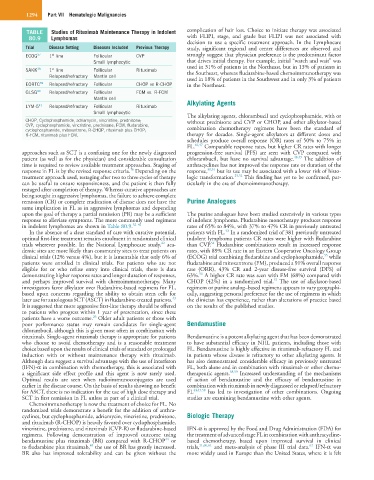
          TABLE   Studies of Rituximab Maintenance Therapy in Indolent   complication of hair loss. Choice to initiate therapy was associated
          80.9    Lymphomas                                   with  FLIPI,  stage,  and  grade  but  FLIPI  was  not  associated  with
                                                              decision  to  use  a  specific  treatment  approach.  In  the  Lymphocare
         Trial   Disease Setting  Diseases Included  Previous Therapy  study,  significant  regional  and  center  differences  are  observed  and
                  st
         ECOG 37  1  line       Follicular    CVP             strongly suggest that physician preference is the predominant factor
                                Small lymphocytic             that drives initial therapy. For example, initial “watch and wait” was
                                                              used in 31% of patients in the Northeast, but in 13% of patients in
                  st
         SAKK 38  1  line       Follicular    Rituximab       the Southeast, whereas fludarabine-based chemoimmunotherapy was
                 Relapsed/refractory  Mantle cell
                                                              used in 18% of patients in the Southwest and in only 3% of patients
         EORTC 39  Relapsed/refractory  Follicular  CHOP vs R-CHOP  in the Northeast.
         GLSG 40  Relapsed/refractory  Follicular  FCM vs. R-FCM
                                Mantle cell
         LYM-5 41  Relapsed/refractory  Follicular  Rituximab  Alkylating Agents
                                Small lymphocytic
                                                              The alkylating agents, chlorambucil and cyclophosphamide, with or
         CHOP, Cyclophosphamide, adriamycin, vincristine, prednisone;    without prednisone and CVP or CHOP, and other alkylator-based
         CVP, cyclophosphamide, vincristine, prednisone; FCM, fludarabine,   combination  chemotherapy  regimens  have  been  the  standard  of
         cyclophosphamide, mitoxantrone; R-CHOP, rituximab plus CHOP;
         R-FCM, rituximab plus FCM.                           therapy  for  decades.  Single-agent  alkylators  at  different  doses  and
                                                              schedules  produce  overall  response  (OR)  rates  of  50%  to  75%  in
                                                              FL. 46,47  Comparable response rates, but higher CR rates with longer
        approaches such as SCT is a confusing one for the newly diagnosed   progression-free  survival  (PFS)  are  seen  with  CVP  compared  with
        patient (as well as for the physician) and considerable consultation   chlorambucil, but have no survival advantage. 48,49  The addition of
        time is required to review available treatment approaches. Staging of   anthracyclines has not improved the response rate or duration of the
                                            16
        response in FL is by the revised response criteria.  Depending on the   response, 50,51  but its use may be associated with a lower risk of histo-
        treatment approach used, restaging after two to three cycles of therapy   logic transformation. 25,52  This finding has yet to be confirmed, par-
        can be useful to ensure responsiveness, and the patient is then fully   ticularly in the era of chemoimmunotherapy.
        restaged after completion of therapy. Whereas curative approaches are
        being sought in aggressive lymphomas, the failure to achieve complete
        remission (CR) or complete eradication of disease does not have the   Purine Analogues
        same implication in FL as in aggressive lymphomas and depending
        upon the goal of therapy a partial remission (PR) may be a sufficient   The purine analogues have been studied extensively in various types
        response to alleviate symptoms. The more commonly used regimens   of indolent lymphoma. Fludarabine monotherapy produces response
        in indolent lymphomas are shown in Table 80.9. 32–41  rates of 65% to 84%, with 37% to 47% CR in previously untreated
                                                                           53
           In the absence of a clear standard of care with curative potential,   patients with FL.  In a randomized trial of 381 previously untreated
        optimal first-line treatment remains enrolment in randomized clinical   indolent lymphoma patients CR rates were higher with fludarabine
                                                      42
                                                                      54
        trials  wherever  possible.  In  the  National  Lymphocare  study,   aca-  than CVP.  Fludarabine combinations result in increased response
        demic sites are more likely than community sites to treat patients on   rates, with 89% CR rate in an Eastern Cooperative Oncology Group
                                                                                                           55
        clinical trials (12% versus 4%), but it is lamentable that only 6% of   (ECOG) trial combining fludarabine and cyclophosphamide,  while
        patients  were  enrolled  in  clinical  trials.  For  patients  who  are  not   fludarabine and mitoxantrone (FM), produced a 91% overall response
        eligible  for  or  who  refuse  entry  into  clinical  trials,  there  is  data   rate  (ORR),  43%  CR  and  2-year  disease-free  survival  (DFS)  of
                                                                  56
        demonstrating higher response rates and longer duration of responses,   63%.  A higher CR rate was seen with FM (68%) compared with
                                                                                           57
        and  perhaps  improved  survival  with  chemoimmunotherapy.  Many   CHOP  (42%)  in  a  randomized  trial.  The  use  of  alkylator-based
        investigators favor alkylator over fludarabine-based regimens for FL,   regimens or purine analog–based regimens appears to vary geographi-
        based upon concerns regarding the ability to obtain stem cells for   cally, suggesting personal preference for the use of regimens in which
                                                         43
        later use for autologous SCT (ASCT) in fludarabine-treated patients.    the clinician has experience, rather than alterations of practice based
        It is suggested that more aggressive first-line therapy should be offered   on the results of the published studies.
        to patients who progress within 1 year of presentation, since these
                               26
        patients have a worse outcome.  Older adult patients or those with
        poor  performance  status  may  remain  candidates  for  single-agent   Bendamustine
        chlorambucil, although this is given most often in combination with
        rituximab. Single-agent rituximab therapy is appropriate for patients   Bendamustine is a potent alkylating agent that has been demonstrated
        who  choose  to  avoid  chemotherapy  and  is  a  reasonable  treatment   to have substantial efficacy in NHL patients, including those with
        choice based upon the results of clinical trials of standard or prolonged   FL. Bendamustine is highly effective in rituximab-refractory FL and
        induction  with  or  without  maintenance  therapy  with  rituximab.   in patients whose disease is refractory to other alkylating agents. It
        Although data suggest a survival advantage with the use of interferon   has also demonstrated considerable efficacy in previously untreated
        (IFN)-α in combination with chemotherapy, this is associated with   FL, both alone and in combination with rituximab or other chemo-
        a  significant  side  effect  profile  and  this  agent  is  now  rarely  used.   therapeutic agents. 58,59  Increased understanding of the mechanisms
        Optimal  results  are  seen  when  radioimmunoconjugates  are  used   of  action  of  bendamustine  and  the  efficacy  of  bendamustine  in
        earlier in the disease course. On the basis of results showing no benefit   combination with rituximab in newly diagnosed or relapsed/refractory
        for ASCT, there is no indication for the use of high dose therapy and   FL 44,45,58   has  led  to  investigation  of  other  combinations.  Ongoing
        SCT in first remission in FL unless as part of a clinical trial.  studies are examining bendamustine with other agents.
           Chemoimmunotherapy is now the treatment of choice for FL. No
        randomized trials demonstrate a benefit for the addition of anthra-
        cyclines, but cyclophosphamide, adriamycin, vincristine, prednisone,   Biologic Therapy
        and rituximab (R-CHOP) is heavily favored over cyclophosphamide,
        vincristine, prednisone, and rituximab (CVP-R) or fludarabine-based   IFN-α is approved by the Food and Drug Administration (FDA) for
        regimens.  Following  demonstration  of  improved  outcome  using   the treatment of advanced stage FL in combination with anthracycline-
                                                       44
        bendamustine  plus  rituximab  (BR)  compared  with  R-CHOP   or   based  chemotherapy,  based  upon  improved  survival  in  clinical
                              45
                                                                                                      62
        to fludarabine plus rituximab,  the use of BR has greatly increased.   trials, 21,60,61   and  meta-analysis  of  phase  III  trial  data.   IFN-α  was
        BR  also  has  improved  tolerability  and  can  be  given  without  the   more widely used in Europe than the United States, where it is felt

