


Page 1453 - Hematology_ Basic Principles and Practice ( PDFDrive )
P. 1453
Chapter 80  Clinical Manifestations, Staging, and Treatment of Follicular Lymphoma  1293


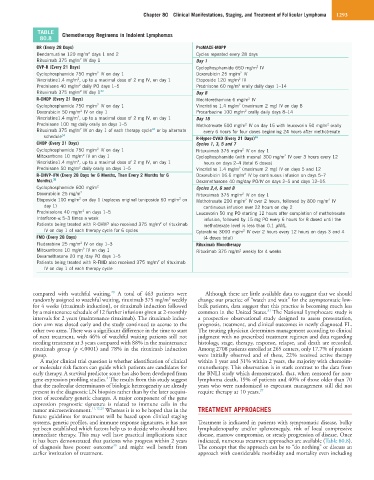
             TABLE   Chemotherapy Regimens in Indolent Lymphomas
              80.8
             BR (Every 28 Days)                                  ProMACE-MOPP
                              2
             Bendamustine 120 mg/m  days 1 and 2                 Cycles repeated every 28 days
                           2
             Rituximab 375 mg/m  IV day 1                        Day 1
             CVP-R (Every 21 Days)                               Cyclophosphamide 650 mg/m  IV
                                                                                     2
                                                                                2
             Cyclophosphamide 750 mg/m  IV on day 1              Doxorubicin 25 mg/m  IV
                                 2
                                                                               2
             Vincristine1.4 mg/m , up to a maximal dose of 2 mg IV, on day 1  Etoposide 120 mg/m  IV
                          2
                           2
             Prednisone 40 mg/m  daily PO days 1–5               Prednisone 60 mg/m  orally daily days 1–14
                                                                               2
             Rituximab 375 mg/m  IV day 1 32                     Day 8
                           2
             R-CHOP (Every 21 Days)                              Mechlorethamine 6 mg/m  IV
                                                                                  2
             Cyclophosphamide 750 mg/m  IV on day 1              Vincristine 1.4 mg/m  (maximum 2 mg) IV on day 8
                                 2
                                                                               2
             Doxorubicin 50 mg/m  IV on day 1                    Procarbazine 100 mg/m  orally daily days 8–14
                           2
                                                                                 2
             Vincristine1.4 mg/m , up to a maximal dose of 2 mg IV, on day 1  Day 15
                          2
             Prednisone 100 mg daily orally on days 1–5          Methotrexate 500 mg/m  IV on day 15 with leucovorin 50 mg/m  orally
                                                                                 2
                                                                                                            2
                           2
             Rituximab 375 mg/m  IV on day 1 of each therapy cycle  or by alternate   every 6 hours for four doses beginning 24 hours after methotrexate
                                                   33
               schedule 34                                       R-Hyper-CVAD (Every 21 Days) 36
             CNOP (Every 21 Days)                                Cycles 1, 3, 5 and 7
             Cyclophosphamide 750 mg/m  IV on day 1              Rituxuimab 375 mg/m  IV on day 1
                                 2
                                                                                2
                            2
             Mitoxantrone 10 mg/m  IV on day 1                   Cyclophosphamide (with mesna) 300 mg/m  IV over 3 hours every 12
                                                                                              2
                          2
             Vincristine1.4 mg/m , up to a maximal dose of 2 mg IV, on day 1  hours on days 2–4 (total 6 doses)
                           2
             Prednisone 50 mg/m  daily orally on days 1–5        Vincristine 1.4 mg/m  (maximum 2 mg) IV on days 5 and 12
                                                                               2
             R-CHVP-IFN (Every 28 Days for 6 Months, Then Every 2 Months for 6   Doxorubicin 16.6 mg/m  IV by continuous infusion on days 5–7
                                                                                 2
             Months). 35                                         Dexamethasone 40 mg/day PO/IV on days 2–5 and days 12–15.
             Cyclophosphamide 600 mg/m 2                         Cycles 2,4, 6 and 8
             Doxorubicin 25 mg/m 2                               Rituxuimab 375 mg/m  IV on day 1
                                                                                2
             Etoposide 100 mg/m  on day 1 (replaces original teniposide 60 mg/m  on   Methotrexate 200 mg/m  IV over 2 hours, followed by 800 mg/m  IV
                                                            2
                           2
                                                                                                            2
                                                                                 2
               day 1)                                               continuous infusion over 22 hours on day 2
                            2
             Prednisolone 40 mg/m  on days 1–5                   Leucovorin 50 mg PO starting 12 hours after completion of methotrexate
             Interferon-α 5–3 times a week                          infusion, followed by 15 mg PO every 6 hours for 8 dosed until the
             Patients being treated with R-CHVP also received 375 mg/m  of rituximab   methotrexate level is less than 0.1 µM/L.
                                                     2
               IV on day 1 of each therapy cycle for 6 cycles    Cytarabine 3000 mg/m  IV over 2 hours every 12 hours on days 3 and 4
                                                                                 2
             FMD (Every 28 Days)                                    (4 doses total)
                           2
             Fludarabine 25 mg/m  IV on day 1–3                  Rituximab Monotherapy
                            2
             Mitoxantrone 10 mg/m  IV on day 1                   Rituximab 375 mg/m  weekly for 4 weeks
                                                                               2
             Dexamethasone 20 mg /day PO days 1–5
                                                     2
             Patients being treated with R-FMD also received 375 mg/m  of rituximab
               IV on day 1 of each therapy cycle
                                     28
            compared  with  watchful  waiting.   A  total  of  463  patients  were   Although there are little available data to suggest that we should
                                                        2
            randomly assigned to watchful waiting, rituximab 375 mg/m  weekly   change our practice of “watch and wait” for the asymptomatic low-
            for 4 weeks (rituximab induction), or rituximab induction followed   bulk patients, data suggest that this practice is becoming much less
                                                                                        31
            by a maintenance schedule of 12 further infusions given at 2-monthly   common in the United States.  The National Lymphocare study is
            intervals for 2 years (maintenance rituximab). The rituximab induc-  a  prospective  observational  study  designed  to  assess  presentation,
            tion arm was closed early and the study continued to accrue to the   prognosis, treatment, and clinical outcomes in newly diagnosed FL.
            other two arms. There was a significant difference in the time to start   The treating physician determines management according to clinical
            of next treatment, with 46% of watchful waiting patients still not   judgment with no prescribed treatment regimen and data regarding
            needing treatment at 3 years compared with 88% in the maintenance   histology, stage, therapy, response, relapse, and death are recorded.
            rituximab  group  (p  <.0001)  and  78%  in  the  rituximab  induction   Among 2708 patients enrolled at 265 centers, only 17.7% of patients
            group.                                                were  initially  observed  and  of  these,  22%  received  active  therapy
              A major clinical trial question is whether identification of clinical   within 1 year and 31% within 2 years, the majority with chemoim-
            or molecular risk factors can guide which patients are candidates for   munotherapy. This observation is in stark contrast to the data from
            early therapy. A survival predictor score has also been developed from   the BNLI study which demonstrated, that, when censored for non-
                                    4
            gene expression profiling studies.  The results from this study suggest   lymphoma death, 19% of patients and 40% of those older than 70
            that the molecular determinants of biologic heterogeneity are already   years who were randomized to expectant management still did not
            present in the diagnostic LN biopsies rather than by the later acquisi-  require therapy at 10 years. 27
            tion of secondary genetic changes. A major component of the gene
            expression  prognostic  signature  is  related  to  immune  cells  in  the
            tumor microenvironment. 11,12,29  Whereas it is to be hoped that in the   TREATMENT APPROACHES
            future guidelines for treatment will be based upon clinical staging
            systems, genetic profiles, and immune response signatures, it has not   Treatment is indicated in patients with symptomatic disease, bulky
            yet been established which factors help us to decide who should have   lymphadenopathy  and/or  splenomegaly,  risk  of  local  compressive
            immediate therapy. This may well have practical implications since   disease, marrow compromise, or steady progression of disease. Once
            it has been demonstrated that patients who progress within 2 years   indicated, numerous treatment approaches are available (Table 80.8).
                                      30
            of  diagnosis  have  poorer  outcome   and  might  well  benefit  from   The concept that the approach can be to “do nothing” or discuss an
            earlier institution of treatment.                     approach with considerable morbidity and mortality even including

