


Page 1450 - Hematology_ Basic Principles and Practice ( PDFDrive )
P. 1450
1290   Part VII  Hematologic Malignancies


        is likely to result in reduced acetylation and enhanced methylation,   TABLE
        which will act as a driver event in the development of FL. Attention   80.3  Initial Evaluation of Follicular Lymphoma
        has also been paid recently to the complex interaction between the
                            10
        malignant B cell, the host,  and the tumor microenvironment. 4,11,12  Physical examination with attention to peripheral nodes, abdomen
                                                               Complete blood count, evaluation of peripheral blood
                                                               Liver function tests; LDH; β 2 -microglobulin
        CLINICAL PRESENTATION                                  CT scans of chest, abdomen, pelvis, (PET scan if indicated)
                                                               LN biopsy with review by an expert lymphoma histopathologist
        The majority of patients present with lymphadenopathy in one or   Bone marrow biopsy/aspirate
        more  sites.  Patients  with  FL  often  present  with  a  long  history  of   Other studies as indicated
        having noted painless increased lymph nodes (LN) over a number of   CT, Computed tomography; LDH, lactate dehydrogenase; LN, lymph node; PET,
        years before presentation. Lymphadenopathy may wax and wane and   positron emission tomography.
                                           13
        spontaneous remissions can occur, albeit rarely.  Disease transforma-
        tion  to  a  more  aggressive  histologic  type  is  a  common  terminal
        event. 14                                               TABLE
           Extranodal disease is relatively common and can affect any organ.   Ann Arbor Staging
        The most common sites of extranodal disease include the BM, skin,   80.4
        gastrointestinal  tract,  and  bone.  Symptoms  may  be  nonspecific  or   Stage  Criteria
        related to the site of disease involvement. Many patients are asymp-  I  Involvement of 1 lymph node (I) or 1 extralymphatic organ or
        tomatic, but some, particularly those with bulky disease may present   site (IE)
        with B symptoms defined as fever, drenching sweats, or weight loss
        of more than 10% of body weight. Patients may present with evidence   II  Involvement of ≥2 lymph nodes on same side of diaphragm
        of  bowel  obstruction  from  intraabdominal  lymphadenopathy,  and   (II) or localized extralymphatic organ or site and ≥1 involved
        retroperitoneal disease may manifest as obstructive uropathy. Inguinal   lymph node on same side of diaphragm (IIE)
        disease  may  cause  compression  of  the  venous  system  with  deep   III  Involvement of lymph nodes on both sides of diaphragm (III)
        venous thrombosis. Central nervous system involvement can occur,   or same side with localized involvement of extralymphatic
        but is uncommon in FL.                                         site (IIIE), spleen (IIIS), or both (IIIS+E)
                                                               IV    Diffuse or disseminated involvement of 1 extralymphatic organ
        DIAGNOSIS OF FOLLICULAR LYMPHOMA                               or tissues with or without lymph node enlargement

        Suggested  guidelines  for  the  diagnosis  of  lymphomas  have  been
        outlined by the National Comprehensive Cancer Network (guidelines   information and should be performed routinely as it is required for
        available at http://www.nccn.org/) and by the European Society for   staging  of  disease.  Although  the  yield  of  bilateral  BM  biopsy  is
                      15
        Medical Oncology.  In all cases possible, diagnosis should be con-  moderately higher (15%) than that of unilateral biopsy, this is not
        firmed by excisional biopsy of an accessible LN with review by an   now usually performed. Liver biopsy may be indicated based upon
        expert hematopathologist with expertise in lymphoma diagnosis. In   abnormal imaging or laboratory testing.
        patients without easily accessible peripheral nodes, computed tomog-
        raphy (CT) or ultrasound-guided biopsy are typically well tolerated.
        Fine-needle aspiration is not appropriate for diagnosis in these condi-  STAGING
        tions and sufficient material must be obtained for immunophenotyp-
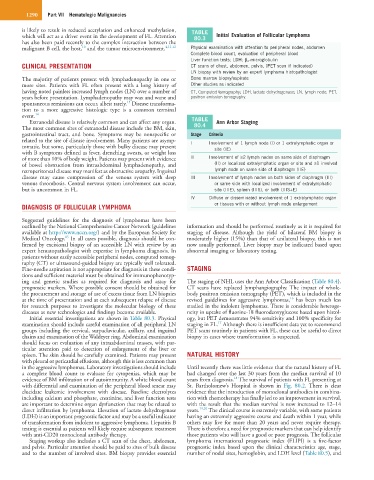
        ing  and  genetic  studies  as  required  for  diagnosis  and  assay  for   The staging of NHL uses the Ann Arbor Classification (Table 80.4).
        prognostic markers. Where possible consent should be obtained for   CT  scans  have  replaced  lymphangiography. The  impact  of  whole-
        the procurement and storage of use of excess tissue from LN biopsies   body positron emission tomography (PET), which is included in the
                                                                                                16
        at the time of presentation and at each subsequent relapse of disease   revised  guidelines  for  aggressive  lymphomas,   has  been  much  less
        for research purposes to investigate the molecular biology of these   studied in the indolent lymphomas. There is considerable heteroge-
        diseases as new technologies and findings become available.  neity in uptake of fluorine-18 fluorodeoxyglucose based upon histol-
           Initial  essential  investigations  are  shown  in Table  80.3.  Physical   ogy, but PET demonstrates 94% sensitivity and 100% specificity for
                                                                        17
        examination should include careful examination of all peripheral LN   staging in FL.  Although there is insufficient data yet to recommend
        groups including the cervical, surpaclavicular, axillary, and inguinal   PET scans routinely in patients with FL, these can be useful to direct
        chains and examination of the Waldeyer ring. Abdominal examination   biopsy in cases where transformation is suspected.
        should focus on evaluation of any intraabdominal masses, with par-
        ticular  attention  paid  to  detection  of  enlargement  of  the  liver  or
        spleen. The skin should be carefully examined. Patients may present   NATURAL HISTORY
        with pleural or pericardial effusions, although this is less common than
        in the aggressive lymphomas. Laboratory investigations should include   Until recently there was little evidence that the natural history of FL
        a  complete  blood  count  to  evaluate  for  cytopenias,  which  may  be   had changed over the last 30 years from the median survival of 10
                                                                              18
        evidence of BM infiltration or of autoimmunity. A white blood count   years from diagnosis.  The survival of patients with FL presenting at
        with differential and examination of the peripheral blood smear may   St.  Bartholomew’s  Hospital  is  shown  in  Fig.  80.2.  There  is  clear
        elucidate  leukemic  involvement  with  disease.  Baseline  electrolytes   evidence that the introduction of monoclonal antibodies in combina-
        including calcium and phosphate, creatinine, and liver function tests   tion with chemotherapy has finally led to an improvement in survival,
        are important to determine organ dysfunction that may be related to   with the result that the median survival is now increased to 12–14
        direct infiltration by lymphoma. Elevation of lactate dehydrogenase   years. 19,20  The clinical course is extremely variable, with some patients
        (LDH) is an important prognostic factor and may be a useful indicator   having an extremely aggressive course and death within 1 year, while
        of transformation from indolent to aggressive lymphoma. Hepatitis B   others may live for more than 20 years and never require therapy.
        testing is essential as patients will likely require subsequent treatment   There is therefore a need for prognostic markers that can help identify
        with anti-CD20 monoclonal antibody therapy.           those patients who will have a good or poor prognosis. The follicular
           Staging workup also includes a CT scan of the chest, abdomen,   lymphoma  international  prognostic  index  (FLIPI)  is  a  five-factor
        and pelvis. Particular attention should be paid to sites of bulk disease   prognostic  index  based  upon  the  clinical  characteristics  age,  stage,
        and to the number of involved sites. BM biopsy provides essential   number of nodal sites, hemoglobin, and LDH level (Table 80.5), and

