


Page 1455 - Hematology_ Basic Principles and Practice ( PDFDrive )
P. 1455
Chapter 80  Clinical Manifestations, Staging, and Treatment of Follicular Lymphoma  1295


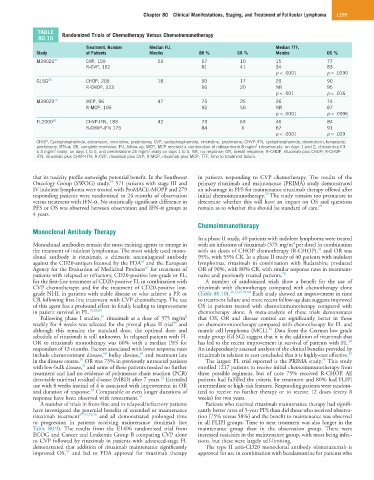
             TABLE   Randomized Trials of Chemotherapy Versus Chemoimmunotherapy
              80.10
                             Treatment, Number    Median FU,                               Median TTF,
             Study           of Patients          Months          OR %         CR %        Months           OS %
             M39021 32       CVP, 159                53            57           10         15               77
                             R-CVP, 162                            81           41         34               83
                                                                                           p < .0001        p = .0290
             GLSG 33         CHOP, 205               18            90           17         29               90
                             R-CHOP, 223                           96           20         NR               95
                                                                                           p < .001         p = .016
             M39023 79       MCP, 96                 47            75           25         26               74
                             R-MCP, 105                            92           50         NR               87
                                                                                           p < .0001        p = .0096
             FL2000 80       CHVP-IFN, 183           42            73           63         46               84
                             R-CHVP-IFN 175                        84           X          67               91
                                                                                           p < .0001        p = .029
             CHOP, Cyclophosphamide, adriamycin, vincristine, prednisone; CVP, cyclophosphamide, vincristine, prednisone; CHVP-IFN, cyclophosphamide, doxorubicin, teniposide,
             prednisone, IFN-α; CR, complete remission; FU, follow-up; MCP, MCP received a combination of mitoxantrone 8 mg/m  intravenously  on days 1 and 2, chlorambucil 3
                                                                                     2
                                                  2
                   2
             × 3 mg/m  orally  on days 1 to 5, and prednisolone 25 mg/m  orally on days 1 to 5; NR, no response; OR, overall response; R-CHOP, rituximab plus CHOP; R-CHVP-
             IFN, rituximab plus CHVP-IFN; R-CVP, rituximab plus CVP; R-MCP, rituximab plus MCP; TTF, time to treatment failure.
            that its toxicity profile outweighs potential benefit. In the Southwest   in  patients  responding  to  CVP  chemotherapy.  The  results  of  the
                                     63
            Oncology Group (SWOG) study,  571 patients with stage III and   primary rituximab and maintenance (PRIMA) study demonstrated
            IV indolent lymphoma were treated with ProMACE-MOPP and 279   an advantage in PFS for maintenance rituximab therapy offered after
                                                                                        76
            responding patients were randomized to 24 months of observation   initial chemoimmunotherapy.  The study remains too premature to
            versus treatment with IFN-α. No statistically significant difference in   determine whether this  will  have  an impact on  OS and questions
            PFS or OS was observed between observation and IFN-α groups at   remain as to whether this should be standard of care. 77
            4 years.
                                                                  Chemoimmunotherapy
            Monoclonal Antibody Therapy
                                                                  In a phase II study, 40 patients with indolent lymphoma were treated
                                                                                                 2
            Monoclonal antibodies remain the most exciting agents to emerge in   with six infusions of rituximab (375 mg/m  per dose) in combination
                                                                                                         34
            the treatment of indolent lymphomas. The most widely used mono-  with six doses of CHOP chemotherapy (R-CHOP),  and OR was
            clonal  antibody  is  rituximab,  a  chimeric  unconjugated  antibody   95%, with 55% CR. In a phase II study of 40 patients with indolent
                                               64
            against the CD20-antigen licensed by the FDA  and the European   lymphomas,  rituximab  in  combination  with  fludarabine  produced
                                                65
            Agency for the Evaluation of Medicinal Products  for treatment of   OR of 90%, with 80% CR, with similar response rates in treatment-
            patients with relapsed or refractory, CD20-positive low-grade or FL;   naive and previously treated patients. 78
            for the first-line treatment of CD20-positive FL in combination with   A  number  of  randomized  trials  show  a  benefit  for  the  use  of
            CVP chemotherapy; and for the treatment of CD20-positive low-  rituximab  with  chemotherapy  compared  with  chemotherapy  alone
            grade NHL in patients with stable disease or who achieve a PR or   (Table 80.10). 32,33,39,79,80  Each study showed an improvement in time
            CR following first-line treatment with CVP chemotherapy. The use   to treatment failure and more recent follow-up data suggests improved
            of this agent has a profound effect in finally leading to improvement   OS  in  patients  treated  with  chemoimmunotherapy  compared  with
            in patient survival in FL. 19,20,66                   chemotherapy  alone.  A  meta-analysis  of  these  trials  demonstrates
                                                              2
                                  67
              Following  phase  I  studies,   rituximab  at  a  dose  of  375 mg/m    that  OS,  OR  and  disease  control  are  significantly  better  in  those
                                                          68
            weekly for 4 weeks was selected for the pivotal phase II trial  and   on chemoimmunotherapy compared with chemotherapy for FL and
                                                                                         81
            although  this  remains  the  standard  dose,  the  optimal  dose  and   mantle cell lymphoma (MCL).  Data from the German low grade
            schedule of rituximab is still unknown. In relapsed patients with FL   study group (GLSG) suggest that it is the addition of rituximab that
                                                                                                                   20
            OR  to  rituximab  monotherapy  was  60%  with  a  median  PFS  for   has led to the recent improvement in survival of patients with FL.
            responders of 13 months. Factors associated with lower response rates   An independently assessed analysis of the clinical benefits provided by
                                   68
                                               69
            include chemoresistant disease,  bulky disease,  and treatment late   rituximab in relation to cost concluded that it is highly-cost effective. 82
                           70
                                                                                                          76
            in the disease course.  OR was 73% in previously untreated patients   The largest FL trial reported is the PRIMA study.  This study
                            71
            with low-bulk disease,  and some of these patients needed no further   enrolled 1217 patients to receive initial chemoimmunotherapy from
            treatment and had no evidence of polymerase chain reaction (PCR)   three  possible  regimens,  but  of  note  75%  received  R-CHOP.  All
                                                      72
            detectable minimal residual disease (MRD) after 7 years.  Extended   patients had fulfilled the criteria for treatment and 80% had FLIPI
            use with 8 weeks instead of 4 is associated with improvement in OR   intermediate or high-risk features. Responding patients were random-
                               73
            and duration of response.  Comparable or even longer durations of   ized  to  receive  no  further  therapy  or  to  receive  12  doses  (every  8
            response have been observed with retreatment. 74      weeks) for two years.
              A number of trials in front-line and in relapsed/refractory patients   Patients who received rituximab maintenance therapy had signifi-
            have investigated the potential benefits of extended or maintenance   cantly better rates of 3-year PFS than did those who received observa-
            rituximab  treatment 37–41,75,76   and  all  demonstrated  prolonged  time   tion (75% versus 58%) and the benefit to maintenance was observed
            to  progression  in  patients  receiving  maintenance  rituximab  (see   in all FLIPI groups. Time to next treatment was also longer in the
            Table  80.9).  The  results  from  the  E1496  randomized  trial  from   maintenance  group  than  in  the  observation  group.  There  were
            ECOG and Cancer and Leukemia Group B comparing CVP alone   increased toxicities in the maintenance group, with most being infec-
            to CVP followed by rituximab in patients with advanced-stage FL   tions, but these were largely self-limiting.
            demonstrated that addition of rituximab maintenance significantly   The type  II anti-CD20 monoclonal  antibody  obinutuzumab is
                       37
            improved  OS,   and  led  to  FDA  approval  for  rituximab  therapy   approved for use in combination with bendamustine for patients who

