


Page 1469 - Hematology_ Basic Principles and Practice ( PDFDrive )
P. 1469
1306   Part VII  Hematologic Malignancies


        versus ASCT resulted in a greater mortality at 100 days (19% vs. 0%,                   LR median not reached
        p < .01), numerically lower but statistically similar relapse rate (21%   1.0          IR median = 51
                                                         45
        vs. 56%, p = .11) and similar OS (49% vs. 47%, p = .51) at 5 years.
        Similarly, in a Center for International Blood and Marrow Transplant   0.9             HR median = 29
        Research  (CIBMTR)  study  of  chemosensitive  patients  with  MCL     0.8
        (n = 519), reduced intensity conditioning (RIC) alloSCT, compared   0.7
        with ASCT, resulted in lower relapse/progression, which was offset
        by a higher nonrelapse mortality (NRM); hence, the 5-year OS was   0.6
        similar between the two groups. ASCT in first complete remission   Probability of overall survival  0.5
        was associated with the highest OS and PFS confirming the results   0.4
                                      60
        of prior studies of upfront HDT/ASCT.  The comparable OS with
        alloSCT, compared with ASCT, in these studies also demonstrates   0.3
        the efficacy of disease control with alloSCT in patients with multiple   0.2
        relapses. In clinical practice, therefore, alloSCT may be utilized in   0.1
        heavily pretreated patients.                             0.0
           RIC has been explored with a hope to reduce TRM and expand
        alloSCT to older patients or patients with other comorbidities. In a   0  12  24  36  48  60  72  84   96
        study, 70 patients with relapsed and refractory MCL including prior      Months since registration
        ASCT  failures  (34%)  underwent  RIC  alloSCT,  mainly  with
        alemtuzumab-containing regimens. NRM, cumulative risk of relapse,   Numbers of patients at risk
        PFS, and OS were 21%, 65%, 14%, and 37%, respectively, at 5 years.   LR  180  153  131  99  69  39  15  4
                                                                         116
                                                                               83
                                                              IR
                                                                    145
                                                                                    57
                                                                                               19
                                                                                          37
                                                                                                     9
                                                                                                          5
        Among patients who relapsed, donor lymphocyte infusion (DLI) or   HR  84  58  29  19  8  5   1    0
                                                         61
        a second RIC alloSCT resulted in a complete remission rate of 73%.
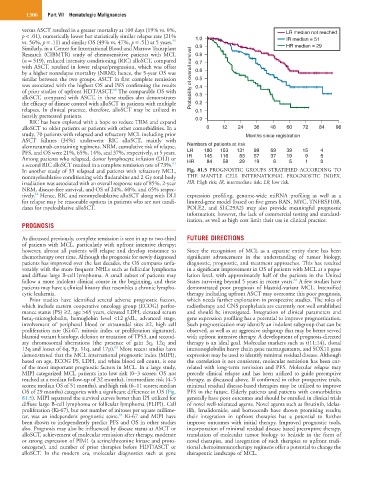
        In another study of 33 relapsed and patients with refractory MCL,   Fig.  81.5  PROGNOSTIC  GROUPS  STRATIFIED  ACCORDING  TO
        nonmyeloablative conditioning with fludarabine and 2 Gy total body   THE  MANTLE  CELL  INTERNATIONAL  PROGNOSTIC  INDEX.
        irradiation was associated with an overall response rate of 85%, 2-year   HR, High risk; IR, intermediate risk; LR, low risk.
        NRM, disease-free survival, and OS of 24%, 60%, and 65% respec-
            62
        tively.  Hence, RIC and nonmyeloablative alloSCT along with DLI   expression  profiling,  genome-wide  miRNA  profiling  as  well  as  a
        for relapse may be reasonable options in patients who are not candi-  limited-gene model (based on five genes RAN, MYC, TNFRSF10B,
        dates for myeloablative alloSCT.                      POLE2,  and  SLC29A2)  may  also  provide  meaningful  prognostic
                                                              information; however, the lack of commercial testing and standard-
                                                              ization, as well as high cost limit their use in clinical practice.
        PROGNOSIS
        As discussed previously, complete remission is seen in up to two-third   FUTURE DIRECTIONS
        of patients with MCL, particularly with upfront intensive therapy;
        however,  almost  all  patients  will  relapse  and  develop  resistance  to   Since  the  recognition  of  MCL  as  a  separate  entity  there  has  been
        chemotherapy over time. Although the prognosis for newly diagnosed   significant  advancement  in  the  understanding  of  tumor  biology,
        patients has improved over the last decades, the OS compares unfa-  diagnostic, prognostic, and treatment approaches. This has resulted
        vorably with the more frequent NHLs such as follicular lymphoma   in a significant improvement in OS of patients with MCL at a popu-
        and diffuse large B-cell lymphoma. A small subset of patients may   lation level, with approximately half of the patients in the United
                                                                                                 65
        follow a more indolent clinical course in the beginning, and these   States surviving beyond 5 years in recent years.  A few studies have
        patients may have a clinical history that resembles a chronic lympho-  demonstrated  poor  prognosis  of  blastoid-variant  MCL.  Intensified
        cytic leukemia.                                       therapy including upfront ASCT may overcome this poor prognosis,
           Prior  studies  have  identified  several  adverse  prognostic  factors,   which needs further exploration in prospective studies. The roles of
        which include eastern cooperative oncology group (ECOG) perfor-  radiotherapy and CNS prophylaxis are currently not well established
        mance status (PS) ≥2, age >65 years, elevated LDH, elevated serum   and  should  be  investigated.  Integration  of  clinical  parameters  and
        beta 2 -microglobulin,  hemoglobin  level  <12 g/dL,  advanced  stage,   gene expression profiling has a potential to improve prognostication.
        involvement  of  peripheral  blood  or  extranodal  sites  ≥2,  high  cell   Such prognostication may identify an indolent subgroup that can be
        proliferation  rate  (Ki-67,  mitotic  index  or  proliferation  signature),   observed, as well as an aggressive subgroup that may be better served
        blastoid variant histology, deletion or mutation of TP53, and second-  with upfront intensive therapy. A development of prognosis-directed
        ary  chromosomal  aberrations  (the  presence  of  gain  3q,  12q  and     therapy is an ideal goal. Molecular markers such as t(11;14), clonal
                                      63
        13q and losses of 6q, 9p, 11q, and 17p).  More recent studies have   immunoglobulin heavy chain gene rearrangements, and SOX11 gene
        demonstrated that the MCL international prognostic index (MIPI),   expression may be used to identify minimal residual disease. Although
        based on age, ECOG PS, LDH, and white blood cell count, is one   the correlation is not consistent, molecular remission has been cor-
        of the most important prognostic factors in MCL. In a large study,   related  with  long-term  remission  and  PFS.  Molecular  relapse  may
        MIPI categorized MCL patients into low risk (0–3 scores; OS not   precede  clinical  relapse  and  has  been  utilized  to  guide  preemptive
        reached at a median follow-up of 32 months), intermediate risk (4–5   therapy, as discussed above. If confirmed in other prospective trials,
        scores; median OS of 51 months), and high risk (6–11 scores; median   minimal residual disease-based therapies may be utilized to improve
        OS of 29 months) categories with a significant difference in OS (Fig.   PFS in the future. Elderly patients and patients with comorbidities
        81.5). MIPI separated the survival curves better than IPI utilized for   generally have poor outcomes and should be enrolled in clinical trials
        diffuse large B-cell lymphoma or follicular lymphoma (FLIPI). Cell   of novel well-tolerated agents. Novel agents such as ibrutinib, idelas-
        proliferation (Ki-67), but not number of mitoses per square millime-  ilib,  lenalidomide,  and  bortezomib  have  shown  promising  results;
                                        64
        ter,  was  an  independent  prognostic  score.   Ki-67  and  MIPI  have   their  integration  in  upfront  therapies  has  a  potential  to  further
        been shown to independently predict PFS and OS in other studies   improve outcomes with initial therapy. Improved prognostic tools,
        also. Prognosis may also be influenced by disease status at ASCT or   incorporation of minimal residual disease based preemptive therapy,
        alloSCT, achievement of molecular remission after therapy, moderate   translation  of  molecular  tumor  biology  to  bedside  in  the  form  of
        or strong expression of PIM1 (a serine/threonine kinase and proto-  novel therapies, and integration of such therapies to upfront tradi-
        oncogene),  and  number  of  prior  therapies  before  HDT/ASCT  or   tional chemoimmunotherapy regimens offer a potential to change the
        alloSCT.  In  the  modern  era,  molecular  diagnostics  such  as  gene   therapeutic landscape of MCL.

