


Page 1466 - Hematology_ Basic Principles and Practice ( PDFDrive )
P. 1466
Chapter 81  Mantle Cell Lymphoma  1303


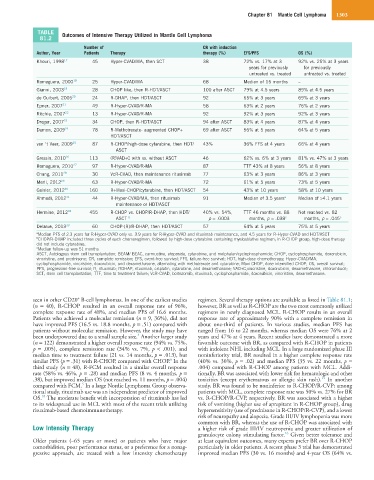
             TABLE   Outcomes of Intensive Therapy Utilized in Mantle Cell Lymphoma
              81.2
                            Number of                              CR with induction
             Author, Year   Patients  Therapy                      therapy (%)   EFS/PFS           OS (%)
             Khouri, 1998 17   45    Hyper-CVAD/MA, then SCT       38            72% vs. 17% at 3   92% vs. 25% at 3 years
                                                                                   years for previously   for previously
                                                                                   untreated vs. treated  untreated vs. treated
             Romaguera, 2000 18  25  Hyper-CVAD/MA                 68            Median of 15 months  –
             Gianni, 2003 19   28    CHOP like, then R-HDT/ASCT    100 after ASCT  79% at 4.5 years  89% at 4.5 years
             de Guibert, 2006 20  24  R-DHAP, then HDT/ASCT        92            65% at 3 years    69% at 3 years
             Epner, 2007 21    49    R-Hyper-CVAD/R-MA             58            63% at 2 years    76% at 2 years
             Ritchie, 2007 22  13    R-Hyper-CVAD/R-MA             92            92% at 3 years    92% at 3 years
             Dreger, 2007 23   34    CHOP, then R-HDT/ASCT         94 after ASCT  83% at 4 years   87% at 4 years
             Damon, 2009 24    78    R-Methotrexate- augmented CHOP+  69 after ASCT  56% at 5 years  64% at 5 years
                                     HDT/ASCT
             van ‘t Veer, 2009 25  87  R-CHOP/high-dose cytarabine, then HDT/  43%  36% FFS at 4 years  66% at 4 years
                                       ASCT
             Gressin, 2010 26  113   (R)VAD+C with vs. without ASCT  46          62% vs. 6% at 3 years  81% vs. 47% at 3 years
             Romaguera, 2010 27  97  R-Hyper-CVAD/R-MA             87            TTF 43% at 8 years  56% at 8 years
             Chang, 2011 28    30    VcR-CVAD, then maintenance rituximab  77    63% at 3 years    86% at 3 years
             Merli, 2012 29    63    R-Hyper-CVAD/R-MA             72            61% at 5 years    73% at 5 years
             Geisler, 2012 30  160   R+Maxi-CHOP/cytarabine, then HDT/ASCT  54   43% at 10 years   58% at 10 years
             Ahmadi, 2012 31   44    R-Hyper-CVAD/MA, then rituximab   91        Median of 3.5 years a  Median of >4.1 years
                                       maintenance or HDT/ASCT
             Hermine, 2012 32  455   R-CHOP vs. CHOP/R-DHAP, then HDT/  40% vs. 54%,   TTF 46 months vs. 88   Not reached vs. 82
                                       ASCT  b                       p = .0003     months, p = .038 c  months, p = .045 c
             Delarue, 2013 33  60    CHOP-(R)/R-DHAP, then HDT/ASCT  57          64% at 5 years    75% at 5 years
             a Median PFS of 2.3 years for R-Hyper-CVAD only vs. 3.9 years for R-Hyper-CVAD and rituximab maintenance, and 4.5 years for R-Hyper-CVAD and HDT/ASCT
             b CHOP/R-DHAP included three cycles of each chemoregimen, followed by high-dose cytarabine containing myeloablative regimen; in R-CHOP group, high-dose therapy
             did not include cytarabine.
             c Median follow-up was 51 months
             ASCT, Autologous stem cell transplantation; BEAM/ BEAC, carmustine, etoposide, cytarabine, and melphalan/cyclophosphamide; CHOP, cyclophosphamide, doxorubicin,
             vincristine, and prednisone; CR, complete remission; EFS, event-free survival; FFS, failure-free survival; HDT, high-dose chemotherapy; Hyper-CVAD/MA,
             cyclophosphamide, vincristine, doxorubicin, and dexamethasone, alternating with methotrexate and cytarabine; Maxi-CHOP, dose-intensified CHOP; OS, overall survival;
             PFS, progression-free survival; R, rituximab; RDHAP, rituximab, cisplatin, cytarabine, and dexamethasone; VAD+C,vincristine, doxorubicin, dexamethasone, chlorambucil;
             SCT, stem cell transplantation; TTF, time to treatment failure; VcR-CVAD, bortezomib, rituximab, cyclophosphamide, doxorubicin, vincristine, dexamethasone.


                          +
            seen in other CD20  B-cell lymphomas. In one of the earliest studies   regimen. Several therapy options are available as listed in Table 81.1;
            (n  =  40),  R-CHOP  resulted  in  an  overall  response  rate  of  96%,   however, BR as well as R-CHOP are the two most commonly utilized
            complete response rate of 48%, and median PFS of 16.6 months.   regimens in newly diagnosed MCL. R-CHOP results in an overall
            Patients who achieved a molecular remission (n = 9, 36%), did not   response rate of approximately 90% with a complete remission in
            have improved PFS (16.5 vs. 18.8 months, p = .51) compared with   about  one-third  of  patients.  In  various  studies,  median  PFS  has
            patients without molecular remission. However, the study may have   ranged from 16 to 22 months, whereas median OS were 76% at 2
                                              4
            been underpowered due to a small sample size.  Another larger study   years and 47% at 4 years. Recent studies have demonstrated a more
            (n = 122) demonstrated a higher overall response rate (94% vs. 75%,   favorable outcome with BR, as compared with R-CHOP in patients
            p  =  .005),  complete  remission  rate  (34%  vs.  7%,  p  <  .001),  and   with indolent NHL including MCL. In a large randomized phase III
            median time to treatment failure (21 vs. 14 months, p = .013), but   noninferiority trial, BR resulted in a higher complete response rate
                                                         6
            similar PFS (p = .31) with R-CHOP, compared with CHOP.  In the   (40% vs. 30%, p = .02) and median PFS (35 vs. 22 months, p =
            third study (n = 48), R-FCM resulted in a similar overall response   .004) compared with R-CHOP among patients with MCL. Addi-
            rate (58% vs. 46%, p = .28) and median PFS (8 vs. 4 months, p =   tionally, BR was associated with lower risk for hematologic and other
                                                                                                          14
            .38), but improved median OS (not reached vs. 11 months, p = .004)   toxicities  (except  erythematous  or  allergic  skin  rash).   In  another
                            5
            compared with FCM.  In a large Nordic Lymphoma Group observa-  study, BR was found to be noninferior to R-CHOP/R-CVP; among
            tional study, rituximab use was an independent predictor of improved   patients with MCL, complete response rate was 50% vs. 27% for BR
               35
            OS.  The moderate benefit with incorporation of rituximab has led   vs. R-CHOP/R-CVP, respectively. BR was associated with a higher
            to its widespread use in MCL with most of the recent trials utilizing   risk of vomiting (higher use of aprepitant in R-CHOP group), drug
            rituximab-based chemoimmunotherapy.                   hypersensitivity (use of prednisone in R-CHOP/R-CVP), and a lower
                                                                  risk of neuropathy and alopecia. Grade III/IV lymphopenia was more
                                                                  common with BR, whereas the use of R-CHOP was associated with
            Low Intensity Therapy                                 a higher risk of grade III/IV neutropenia and greater utilization of
                                                                                              16
                                                                  granulocyte colony stimulating factor.  Given better tolerance and
            Older  patients  (~65  years  or  more)  or  patients  who  have  major   at least equivalent outcomes, many experts prefer BR over R-CHOP
            comorbidities, poor performance status, or a preference for a nonag-  particularly in older patients. A recent phase 3 trial has demonstrated
            gressive  approach,  are  treated  with  a  low  intensity  chemotherapy   improved median PFS (30 vs. 16 months) and 4-year OS (64% vs.

