


Page 1468 - Hematology_ Basic Principles and Practice ( PDFDrive )
P. 1468
Chapter 81  Mantle Cell Lymphoma  1305


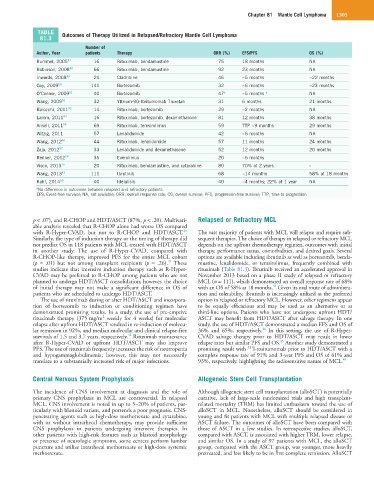
             TABLE   Outcomes of Therapy Utilized in Relapsed/Refractory Mantle Cell Lymphoma
              81.3
                             Number of
             Author, Year    patients  Therapy                         ORR (%)  EFS/PFS               OS (%)
             Rummel, 2005 47    16     Rituximab, bendamustine          75      18 months             NA
             Robinson, 2008 48  66     Rituximab, bendamustine          92      23 months             NA
             Inwards, 2008 49   24     Cladribine                       46      ~5 months             ~22 months
             Goy, 2009 50      141     Bortezomib                       32      ~6 months             ~23 months
             O’Connor, 2009 51  40     Bortezomib                       47 a    ~5 months   a         NA
             Wang, 2009 52      32     Yttrium-90-Ibritumomab Tiuxetan  31      6 months              21 months
             Baiocchi, 2011 53  14     Rituximab, bortezomib            29      ~2 months             NA
             Lamm, 2011 54      16     Rituximab, bortezomib, dexamethasone  81  12 months            38 months
             Ansell, 2011 55    69     Rituximab, temsirolimus          59      TTP ~9 months         29 months
             Witzig, 2011       57     Lenalidomide                     42      ~6 months             NA
             Wang, 2012 56      44     Rituximab, lenalidomide          57      11 months             24 months
             Zaja, 2012 57      33     Lenalidomide and dexamethasone   52      12 months             20 months
             Renner, 2012 58    35     Everolimus                       20      ~5 months
             Visco, 2013 15     20     Rituximab, bendamustine, and cytarabine  80  70% at 2 years    -
             Wang, 2013 43     111     Ibrutinib                        68      ~14 months            58% at 18 months
             Kahl, 2014 59      40     Idelalisib                       40      ~4 months; 22% at 1 year  NA
             a No difference in outcomes between relapsed and refractory patients.
             EFS, Event-free survival; NA, not available; ORR, overall response rate; OS, overall survival; PFS, progression-free survival; TTP, time to progression


            p < .07), and R-CHOP and HDT/ASCT (87%, p < .20). Multivari-  Relapsed or Refractory MCL
            able analysis revealed that R-CHOP alone had worse OS compared
                                                             40
            with  R-Hyper-CVAD,  but  not  to  R-CHOP  and  HDT/ASCT.    The vast majority of patients with MCL will relapse and require sub-
            Similarly, the type of induction therapy or the timing of therapy did   sequent therapies. The choice of therapy in relapsed or refractory MCL
            not predict OS in 118 patients with MCL treated with HDT/ASCT   depends on the upfront chemotherapy regimen, outcomes with initial
            in  another  study.  The  use  of  R-Hyper-CVAD,  compared  with   therapy, performance status, comorbidities, and desired goals. Several
            R-CHOP-like  therapy,  improved  PFS  for  the  entire  MCL  cohort     options are available including ibrutinib as well as bortezomib, benda-
                                                        41
            (p  =  .01)  but  not  among  transplant  recipients  (p  =  .26).  These   mustine,  lenalidomide,  or  temsirolimus,  frequently  combined  with
            studies indicate that intensive induction therapy such as R-Hyper-  rituximab (Table 81.3). Ibrutinib received an accelerated approval in
            CVAD may be preferred to R-CHOP among patients who are not   November 2013 based on a phase II study of relapsed or refractory
            planned to undergo HDT/ASCT consolidation; however, the choice   MCL (n = 111), which demonstrated an overall response rate of 68%
                                                                                          43
            of  initial  therapy  may  not  make  a  significant  difference  in  OS  of   with an OS of 58% at 18 months.  Given its oral route of administra-
            patients who are scheduled to undergo HDT/ASCT.       tion and tolerability, ibrutinib is increasingly utilized as the preferred
              The use of rituximab during or after HDT/ASCT and incorpora-  option in relapsed or refractory MCL. However, other regimens appear
            tion  of  bortezomib  to  induction  or  conditioning  regimen  have   to  be  equally  efficacious  and  may  be  used  as  an  alternative  or  as
            demonstrated promising results. In a study, the use of pre-emptive   third-line options. Patients who have not undergone upfront HDT/
                                   2
            rituximab  therapy  (375 mg/m   weekly  for  4  weeks)  for  molecular   ASCT  may  benefit  from  HDT/ASCT  after  salvage  therapy.  In  one
            relapse after upfront HDT/ASCT resulted in re-induction of molecu-  study, the use of HDT/ASCT demonstrated a median EFS and OS of
                                                                                       44
            lar remission in 92%, and median molecular and clinical relapse-free   36%  and  65%,  respectively.   In  this  setting,  the  use  of  R-Hyper-
                                           42
            survivals of 1.5 and 3.7 years, respectively.  Rituximab maintenance   CVAD  salvage  therapy  prior  to  HDT/ASCT  may  result  in  lower
                                                                                             45
            after  R-Hyper-CVAD  or  upfront  HDT/ASCT  may  also  improve   relapse rates but similar PFS and OS.  Another study demonstrated a
                                                                                  131
            PFS. The use of rituximab frequently increases the risk of neutropenia   promising result with  I-tositumomab prior to HDT/ASCT with a
            and  hypogammaglobulinemia;  however,  this  may  not  necessarily   complete response rate of 91% and 3-year PFS and OS of 61% and
            translate to a substantially increased risk of major infections.  93%, respectively, highlighting the radiosensitive nature of MCL. 46
            Central Nervous System Prophylaxis                    Allogeneic Stem Cell Transplantation
            The  incidence  of  CNS  involvement  at  diagnosis  and  the  role  of   Although allogeneic stem cell transplantation (alloSCT) is potentially
            primary  CNS  prophylaxis  in  MCL  are  controversial.  In  relapsed   curative,  lack of  large-scale  randomized  trials  and high transplant-
            MCL, CNS involvement is noted in up to 5–20% of patients, par-  related mortality (TRM) has limited enthusiasm toward the use of
            ticularly with blastoid variant, and portends a poor prognosis. CNS-  alloSCT  in  MCL.  Nonetheless,  alloSCT  should  be  considered  in
            penetrating agents such as high-dose methotrexate and cytarabine,   young and fit patients with MCL with multiple relapsed disease or
            with  or  without  intrathecal  chemotherapy,  may  provide  sufficient   ASCT failure. The outcomes of alloSCT have been compared with
            CNS  prophylaxis  in  patients  undergoing  intensive  therapies.  In   those of ASCT in a few studies. In retrospective studies, alloSCT,
            other patients with high-risk features such as blastoid morphology   compared with ASCT, is associated with higher TRM, lower relapse,
            or presence of neurologic symptoms, some centers perform lumbar   and similar OS. In a study of 97 patients with MCL, the alloSCT
            puncture and utilize intrathecal methotrexate or high-dose systemic   group, compared with the ASCT group, was younger, more heavily
            methotrexate.                                         pretreated, and less likely to be in first complete remission. AlloSCT

