


Page 1464 - Hematology_ Basic Principles and Practice ( PDFDrive )
P. 1464
Chapter 81  Mantle Cell Lymphoma  1301


                                                                  other  criteria;  therefore,  SOX11  is  a  very  useful  tool  in  cyclin
             Mantle zone pattern
                                                                  D1-negative cases.
                                                                  Differential Diagnosis

                                                                  MCL should be differentiated from other B-cell NHL, particularly
                                                                  SLL/chronic lymphocytic leukemia, lymphoplasmacytic lymphoma,
                                                                  marginal-zone  lymphoma,  and  follicular  lymphoma.  Additionally,
                                                                  with minimal differentiation, the blastoid variant MCL may resemble
                                                                  B-cell ALL and acute myeloid leukemia. Immunophenotypic markers
                                                                                                             +
                                                                                                                   −
                                                                                                +
                                                                                                      −
                                                                  are helpful in differentiating MCL (CD5 , CD10 , CD19 , CD23 ,
                                                                      +
                                                                                                                   −
                                                                                                            +
                                                                  FMC )  from  SLL/chronic  lymphocytic  leukemia  (CD5 ,  CD10 ,
                                                                                                             −
                                                                                   −
                                                                             +
                                                                                                                   +
                                                                       +
                                                                  CD19 , CD23 , FMC ), and follicular lymphoma (CD5 , CD10 ,
                                                                       +
                                                                  CD19 ). In CD5 negative or cyclin D1-negative MCL, careful exclu-
             Nodular pattern                                      sion of other lymphomas via detection of overexpression of cyclin
                                                                  D2, cyclin D3 or SOX11 and gene expression profiling may help in
                                                                  the diagnosis.
                                                                  Staging
                                                                  Staging procedures include a complete blood count, comprehensive
                                                                  metabolic panel, lactate dehydrogenase, evaluation of a bone marrow
                                                                  biopsy,  and  computed  tomography  (CT)  of  chest,  abdomen,  and
                                                                  pelvis.  Although  endoscopies  of  upper  and  lower  GI  tracts  are
                                                                  frequently  positive,  such  evaluation  did  not  change  management
                                                                  in  a  retrospective  study.  MCL  has  low  to  intermediate  avidity  for
                                                                  fluorodeoxyglucose  (FDG);  however,  the  blastoid  variant  is  more
                                                                  FDG  avid.  Nonetheless,  an  integrated  FDG  positron  emission
             Diffuse pattern                                      tomography  (PET)  and  CT  scan  is  frequently  utilized  for  staging
                                                                  of patients with MCL. Lumbar puncture is not routinely performed
                                                                  but should be done in patients with neurologic symptoms. Multi-
                                                                  gated acquisition scan or echocardiography is often performed prior
                                                                  to  the  use  of  anthracycline;  however,  their  role  in  asymptomatic
                                                                  patients  without  cardiac  disease  is  unclear.  Hepatitis  B  serologies
                                                                  are  performed  prior  to  the  use  of  rituximab  because  of  a  risk  of
                                                                  reactivation.
                                                                  THERAPY
                                                                  MCL  combines  the  worst  features  of  both  follicular  lymphoma
                                                                  (noncurability) and diffuse large B-cell lymphoma (aggressive course).
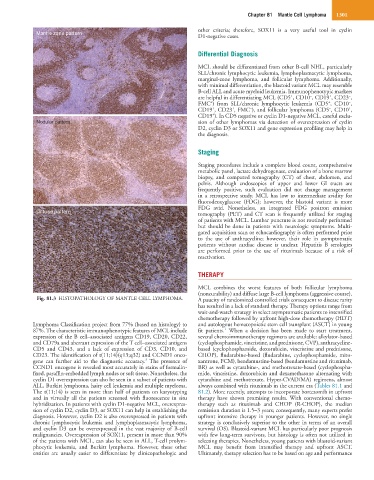
             Fig. 81.3  HISTOPATHOLOGY OF MANTLE CELL LYMPHOMA.   A paucity of randomized controlled trials consequent to disease rarity
                                                                  has resulted in a lack of standard therapy. Therapy options range from
                                                                  wait-and-watch strategy in select asymptomatic patients to intensified
                                                                  chemotherapy followed by upfront high-dose chemotherapy (HDT)
            Lymphoma Classification project from 77% (based on histology) to   and autologous hematopoietic stem cell transplant (ASCT) in young
                                                                          1
            87%. The characteristic immunophenotypic features of MCL include   fit  patients.   When  a  decision  has  been  made  to  start  treatment,
            expression of the B cell–associated antigens CD19, CD20, CD22,   several chemoimmunotherapy regimens are available: alkylator-based
            and CD79a and aberrant expression of the T cell–associated antigens   (cyclophosphamide, vincristine, and prednisone, CVP), anthracycline-
            CD5  and  CD43,  and  a  lack  of  expression  of  CD3,  CD10,  and   based (cyclophosphamide, doxorubicin, vincristine and prednisone,
            CD23. The identification of t(11;14)(q13;q32) and CCND1 onco-  CHOP),  fludarabine-based  (fludarabine,  cyclophosphamide,  mito-
                                                 3
            gene  can  further  aid  to  the  diagnostic  accuracy.  The  presence  of   xantrone, FCM), bendamustine-based (bendamustine and rituximab,
            CCND1 oncogene is revealed most accurately in stains of formalin-  BR) as well as cytarabine-, and methotrexate-based (cyclophospha-
            fixed, paraffin-embedded lymph nodes or soft tissue. Nonetheless, the   mide, vincristine, doxorubicin and dexamethasone alternating with
            cyclin D1 overexpression can also be seen in a subset of patients with   cytarabine and methotrexate, Hyper-CVAD/MA) regimens, almost
            ALL, Burkitt lymphoma, hairy cell leukemia and multiple myeloma.   always combined with rituximab in the current era (Tables 81.1 and
            The t(11;14) is seen in more than half of patients on karyotyping   81.2). More recently, attempts to incorporate bortezomib in upfront
            and  in  virtually  all  the  patients  screened  with  fluorescence  in  situ   therapy  have  shown  promising  results. With  conventional  chemo-
            hybridization. In patients with cyclin D1-negative MCL, overexpres-  therapy  such  as  rituximab  and  CHOP  (R-CHOP),  the  median
            sion of cyclin D2, cyclin D3, or SOX11 can help in establishing the   remission duration is 1.5–3 years; consequently, many experts prefer
            diagnosis. However, cyclin D2 is also overexpressed in patients with   upfront  intensive  therapy  in  younger  patients.  However,  no  single
            chronic  lymphocytic  leukemia  and  lymphoplasmacytic  lymphoma,   strategy is conclusively superior to the other in terms of an overall
            and cyclin D3  can be  overexpressed  in  the  vast majority  of  B-cell   survival (OS). Blastoid-variant MCL has particularly poor prognosis
            malignancies. Overexpression of SOX11, present in more than 90%   with few long-term survivors, but histology is often not utilized in
            of the patients with MCL, can also be seen in ALL, T-cell prolym-  selecting therapies. Nonetheless, young patients with blastoid-variant
            phocytic  leukemia,  and  Burkitt  lymphoma.  However,  these  other   MCL  may  benefit  from  intensified  therapy  and  upfront  ASCT.
            entities  are  usually  easier  to  differentiate  by  clinicopathologic  and   Ultimately, therapy selection has to be based on age and performance

