


Page 1467 - Hematology_ Basic Principles and Practice ( PDFDrive )
P. 1467
1304   Part VII  Hematologic Malignancies


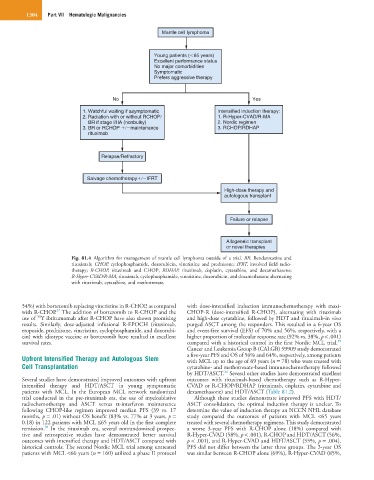
                                                      Mantle cell lymphoma


                                                   Young patients ( 65 years)
                                                   Excellent performance status
                                                   No major comorbidities
                                                   Symptomatic
                                                   Prefers aggressive therapy


                                      No                                            Yes
                            1. Watchful waiting if asymptomatic         Intensified induction therapy:
                            2. Radiation with or without RCHOP          1. R-Hyper-CVAD/R-MA
                                BR if stage I/IIA (nonbulky)            2. Nordic regimen
                            3. BR or RCHOP    maintenance               3. RCHOP/RDHAP
                                rituximab


                                  Relapse/Refractory


                              Salvage chemotherapy   IFRT
                                                                          High-dose therapy and
                                                                          autologous transplant


                                                                            Failure or relapse


                                                                           Allogeneic transplant
                                                                           or novel therapies
                        Fig. 81.4  Algorithm for management of mantle cell lymphoma outside of a trial. BR, Bendamustine and
                        rituximab; CHOP, cyclophosphamide, doxorubicin, vincristine and prednisone; IFRT, involved field radio-
                        therapy;  R-CHOP,  rituximab  and  CHOP;  RDHAP,  rituximab,  cisplatin,  cytarabine,  and  dexamethasone;
                        R-Hyper-CVAD/R-MA, rituximab, cyclophosphamide, vincristine, doxorubicin, and dexamethasone alternating
                        with rituximab, cytarabine, and methotrexate.


        54%) with bortezomib replacing vincristine in R-CHOP, as compared   with  dose-intensified  induction  immunochemotherapy  with  maxi-
                    37
        with R-CHOP.  The addition of bortezomib to R-CHOP and the   CHOP-R  (dose-intensified  R-CHOP),  alternating  with  rituximab
             90
        use of  Y ibritumomab after R-CHOP have also shown promising   and high-dose cytarabine, followed by HDT and rituximab-in vivo
        results.  Similarly,  dose-adjusted  infusional  R-EPOCH  (rituximab,   purged ASCT among the responders. This resulted in a 6-year OS
        etoposide, prednisone, vincristine, cyclophosphamide, and doxorubi-  and event-free survival (EFS) of 70% and 56%, respectively, with a
        cin) with idiotype vaccine or bortezomib have resulted in excellent   higher proportion of molecular response rate (92% vs. 38%, p < .001)
                                                                                                               39
        survival rates.                                       compared with a historical control in the first Nordic MCL trial.
                                                              Cancer and Leukemia Group B (CALGB) 59909 study demonstrated
        Upfront Intensified Therapy and Autologous Stem       a five-year PFS and OS of 56% and 64%, respectively, among patients
                                                              with MCL up to the age of 69 years (n = 78) who were treated with
        Cell Transplantation                                  cytarabine- and methotrexate-based immunochemotherapy followed
                                                                          24
                                                              by HDT/ASCT.  Several other studies have demonstrated excellent
        Several studies have demonstrated improved outcomes with upfront   outcomes  with  rituximab-based  chemotherapy  such  as  R-Hyper-
        intensified  therapy  and  HDT/ASCT  in  young  symptomatic   CVAD or R-CHOP/RDHAP (rituximab, cisplatin, cytarabine and
        patients  with  MCL.  In  the  European  MCL  network  randomized   dexamethasone) and HDT/ASCT (Table 81.2).
        trial  conducted  in  the  pre-rituximab  era,  the  use  of  myeloablative   Although these studies demonstrate improved PFS with HDT/
        radiochemotherapy  and  ASCT  versus  α-interferon  maintenance   ASCT consolidation, the optimal induction therapy is unclear. To
        following  CHOP-like  regimen  improved  median  PFS  (39  vs.  17   determine the value of induction therapy an NCCN NHL database
        months, p = .01) without OS benefit (83% vs. 77% at 3 years, p =   study  compared  the  outcomes  of  patients  with  MCL  <65  years
        0.18) in 122 patients with MCL ≤65 years old in the first complete   treated with several chemotherapy regimens. This study demonstrated
                38
        remission.   In  the  rituximab  era,  several  nonrandomized  prospec-  a  worse  3-year  PFS  with  R-CHOP  alone  (18%)  compared  with
        tive  and  retrospective  studies  have  demonstrated  better  survival   R-Hyper-CVAD (58%, p < .001), R-CHOP and HDT/ASCT (56%,
        outcomes with intensified therapy and HDT/ASCT compared with   p < .001), and R-Hyper-CVAD and HDT/ASCT (55%, p = .004).
        historical controls. The second Nordic MCL trial among untreated   PFS did not differ between the latter three groups. The 3-year OS
        patients with MCL <66 years (n = 160) utilized a phase II protocol   was similar between R-CHOP alone (69%), R-Hyper-CVAD (85%,

