


Page 1465 - Hematology_ Basic Principles and Practice ( PDFDrive )
P. 1465
1302   Part VII  Hematologic Malignancies


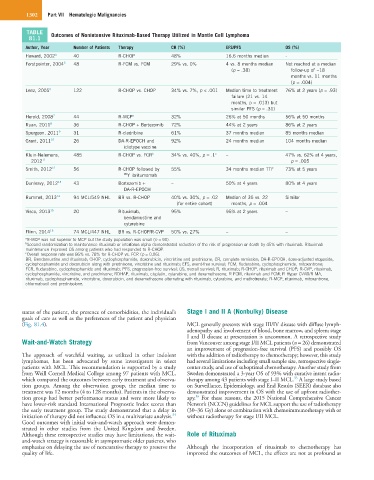
          TABLE   Outcomes of Nonintensive Rituximab-Based Therapy Utilized in Mantle Cell Lymphoma
          81.1
         Author, Year    Number of Patients  Therapy     CR (%)            EFS/PFS            OS (%)
         Howard, 2002 4  40             R-CHOP           48%               16.6 months median  -
         Forstpointer, 2004 5  48       R-FCM vs. FCM    29% vs. 0%        4 vs. 8 months median   Not reached at a median
                                                                             (p = .38)          follow-up of ~18
                                                                                                months vs. 11 months
                                                                                                (p = .004)
         Lenz, 2005 6    122            R-CHOP vs. CHOP  34% vs. 7%, p < .001  Median time to treatment   76% at 2 years (p = .93)
                                                                             failure (21 vs. 14
                                                                             months, p = .013) but
                                                                             similar PFS (p = .31)
         Herold, 2008 7  44             R-MCP a          32%               26% at 50 months   56% at 50 months
         Ruan, 2011 8    36             R-CHOP + Bortezomib  72%           44% at 2 years     86% at 2 years
         Spurgeon, 2011 9  31           R-cladribine     61%               37 months median   85 months median
         Grant, 2011 10  26             DA-R-EPOCH and   92%               24 months median   104 months median
                                          idiotype vaccine
         Kluin-Nelemans,   485          R-CHOP vs. FCR b  34% vs. 40%, p = .1 c  –            47% vs. 62% at 4 years,
           2012 11                                                                              p = .005
         Smith, 2012 12  56             R-CHOP followed by   55%           34 months median TTF  73% at 5 years
                                          90 Y ibritumomab
         Dunleavy, 2012 13  43          Bortezomib +     –                 50% at 4 years     80% at 4 years
                                          DA-R-EPOCH
         Rummel, 2013 14  94 MCL/549 NHL  BR vs. R-CHOP  40% vs. 30%, p = .02   Median of 35 vs. 22   Similar
                                                           (for entire cohort)  months, p = .004
         Visco, 2013 15  20             Rituximab,       95%               95% at 2 years     –
                                          bendamustine and
                                          cytarabine
         Flinn, 2014 16  74 MCL/447 NHL  BR vs. R-CHOP/R-CVP  50% vs. 27%  –                  –
         a R-MCP was not superior to MCP but the study population was small (n = 90).
         b Second randomization to maintenance rituximab or interferon alpha demonstrated reduction of the risk of progression or death by 45% with rituximab. Rituximab
         maintenance improved OS among patients who had responded to R-CHOP.
         c Overall response rate was 86% vs. 78% for R-CHOP vs. FCR (p = 0.06).
         BR, Bendamustine and rituximab; CHOP, cyclophosphamide, doxorubicin, vincristine and prednisone; CR, complete remission; DA-R-EPOCH, dose-adjusted etoposide,
         cyclophosphamide and doxorubicin along with prednisone, vincristine and rituximab; EFS, event-free survival; FCM, fludarabine, cyclophosphamide, mitoxantrone;
         FCR, fludarabine, cyclophosphamide and rituximab; PFS, progression-free survival; OS, overall survival; R, rituximab; R-CHOP, rituximab and CHOP; R-CVP, rituximab,
         cyclophosphamide, vincristine, and prednisone; RDHAP, rituximab, cisplatin, cytarabine, and dexamethasone; R-FCM, rituximab and FCM; R-Hyper-CVAD/R-MA,
         rituximab, cyclophosphamide, vincristine, doxorubicin, and dexamethasone alternating with rituximab, cytarabine, and methotrexate; R-MCP, rituximab, mitoxantrone,
         chlormabucil and prednisolone.


        status of the patient, the presence of comorbidities, the individual’s   Stage I and II A (Nonbulky) Disease
        goals of care as well as the preferences of the patient and physician
        (Fig. 81.4).                                          MCL generally presents with stage III/IV disease with diffuse lymph-
                                                              adenopathy and involvement of blood, bone marrow, and spleen; stage
                                                              I and II disease at presentation is uncommon. A retrospective study
        Wait-and-Watch Strategy                               from Vancouver among stage I/II MCL patients (n = 26) demonstrated
                                                              an improvement of progression-free survival (PFS) and possibly OS
        The  approach  of  watchful  waiting,  as  utilized  in  other  indolent   with the addition of radiotherapy to chemotherapy; however, this study
        lymphomas,  has  been  advocated  by  some  investigators  in  select   had several limitations including small sample size, retrospective single-
        patients with MCL. This recommendation is supported by a study   center study, and use of suboptimal chemotherapy. Another study from
        from Weill Cornell Medical College among 97 patients with MCL,   Sweden demonstrated a 3-year OS of 93% with curative intent radio-
                                                                                                 35
        which compared the outcomes between early treatment and observa-  therapy among 43 patients with stage I–II MCL.  A large study based
        tion  groups.  Among  the  observation  group,  the  median  time  to   on Surveillance, Epidemiology, and End Results (SEER) database also
        treatment was 12 months (4 to 128 months). Patients in the observa-  demonstrated improvement in OS with the use of upfront radiother-
                                                                 36
        tion group had better performance status and were more likely to   apy.   For  these  reasons,  the  2015  National  Comprehensive  Cancer
        have lower-risk standard International Prognostic Index scores than   Network (NCCN) guidelines for MCL support the use of radiotherapy
        the early treatment group. The study demonstrated that a delay in   (30–36 Gy) alone or combination with chemoimmunotherapy with or
                                                         34
        initiation of therapy did not influence OS in a multivariate analysis.    without radiotherapy for stage I/II MCL.
        Good outcomes with initial wait-and-watch approach were demon-
        strated  in  other  studies  from  the  United  Kingdom  and  Sweden.
        Although these retrospective studies may have limitations, the wait-  Role of Rituximab
        and-watch strategy is reasonable in asymptomatic older patients, who
        emphasize on delaying the use of noncurative therapy to preserve the   Although  the  incorporation  of  rituximab  to  chemotherapy  has
        quality of life.                                      improved the outcomes of MCL, the effects are not as profound as

