


Page 1476 - Hematology_ Basic Principles and Practice ( PDFDrive )
P. 1476
Chapter 82  Diagnosis and Treatment of Diffuse Large B-Cell Lymphoma and Burkitt Lymphoma  1311


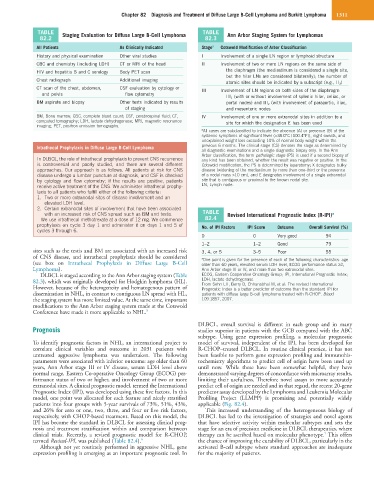
             TABLE   Staging Evaluation for Diffuse Large B-Cell Lymphoma  TABLE   Ann Arbor Staging System for Lymphomas
              82.2                                                  82.3
             All Patients               As Clinically Indicated    Stage a  Cotswold Modification of Arbor Classification
             History and physical examination  Other viral studies  I    Involvement of a single LN region or lymphoid structure
             CBC and chemistry (including LDH)  CT or MRI of the head  II  Involvement of two or more LN regions on the same side of
             HIV and hepatitis B and C serology  Body PET scan             the diaphragm (the mediastinum is considered a single site,
                                                                           but the hilar LNs are considered bilaterally); the number of
             Chest radiograph           Additional imaging
                                                                           atomic sites should be indicated by a subscript (e.g., II 3 )
             CT scan of the chest, abdomen,   CSF evaluation by cytology or   III  Involvement of LN regions on both sides of the diaphragm:
               and pelvis                 flow cytometry
                                                                           III 1  (with or without involvement of splenic hilar, celiac, or
             BM aspirate and biopsy     Other tests indicated by results   portal nodes) and III 2  (with involvement of paraaortic, iliac,
                                          of staging                       and mesenteric nodes
             BM, Bone marrow; CBC, complete blood count; CSF, cerebrospinal fluid; CT,   IV  Involvement of one or more extranodal sites in addition to a
             computed tomography; LDH, lactate dehydrogenase; MRI, magnetic resonance   site for which the designation E has been used
             imaging; PET, positron emission tomography.
                                                                   a All cases are subclassified to indicate the absence (A) or presence (B) of the
                                                                   systemic symptoms of significant fever (>38.0°C [100.4°F]), night sweats, and
                                                                   unexplained weight loss exceeding 10% of normal body weight within the
             Intrathecal Prophylaxis in Diffuse Large B-Cell Lymphoma  previous 6 months. The clinical stage (CS) denotes the stage as determined by
                                                                   all diagnostic examinations and a single diagnostic biopsy only. In the Ann
                                                                   Arbor classification, the term pathologic stage (PS) is used if a second biopsy of
             In DLBCL, the role of intrathecal prophylaxis to prevent CNS recurrence   any kind has been obtained, whether the result was negative or positive. In the
             is  controversial  and  poorly  studied,  and  there  are  several  different   Cotswold modification, the PS is determined by laparotomy; X designates bulky
             approaches. Our approach is as follows. All patients at risk for CNS   disease (widening of the mediastinum by more than one-third or the presence
             disease undergo a lumbar puncture at diagnosis, and CSF is checked   of a nodal mass >10 cm), and E designates involvement of a single extranodal
             by  cytology  and  flow  cytometry;  if  the  results  are  positive,  patients   site that is contiguous or proximal to the known nodal site.
             receive active treatment of the CNS. We administer intrathecal prophy-  LN, Lymph node.
             laxis to all patients who fulfill either of the following criteria:
             1.  Two or more extranodal sites of disease involvement and an
                elevated LDH level.
             2.  Certain extranodal sites of involvement that have been associated
                with an increased risk of CNS spread such as BM and testis.  TABLE   Revised International Prognostic Index (R-IPI) a
              We use intrathecal methotrexate at a dose of 12 mg. We commence   82.4
             prophylaxis  on  cycle  3  day  1  and  administer  it  on  days  1  and  5  of   No. of IPI Factors  IPI Score  Outcome  Overall Survival (%)
             cycles 3 through 6.
                                                                   0                0       Very good       94
                                                                   1–2              1–2     Good            79
            sites such as the testis and BM are associated with an increased risk   3, 4, or 5  3–5  Poor   55
            of  CNS  disease,  and  intrathecal  prophylaxis  should  be  considered    a One point is given for the presence of each of the following characteristics: age
            (see  box  on  Intrathecal  Prophylaxis  in  Diffuse  Large  B-Cell   older than 60 years, elevated serum LDH level, ECOG performance status ≥2,
            Lymphoma).                                             Ann Arbor stage III or IV, and more than two extranodal sites.
              DLBCL is staged according to the Ann Arbor staging system (Table   ECOG, Eastern Cooperative Oncology Group; IPI, International Prognostic Index;
            82.3), which was originally developed for Hodgkin lymphoma (HL).   LDH, lactate dehydrogenase
                                                                   From Sehn LH, Berry B, Chhanabhai M, et al: The revised International
            However, because of the heterogeneity and hematogenous pattern of   Prognostic Index is a better predictor of outcome than the standard IPI for
            dissemination in NHL, in contrast to contiguous LN spread with HL,   patients with diffuse large B-cell lymphoma treated with R-CHOP. Blood
            the staging system has more limited value. At the same time, important   109:1857, 2007.
            modifications to the Ann Arbor staging system made at the Cotswold
            Conference have made it more applicable to NHL. 5

                                                                  DLBCL,  overall  survival  is  different  in  each  group  and  in  many
            Prognosis                                             studies superior in patients with the GCB compared with the ABC
                                                                  subtype.  Using  gene  expression  profiling,  a  molecular  prognostic
            To identify prognostic factors in NHL, an international project to   model of survival, independent of the IPI, has been developed for
            correlate  clinical  variables  and  outcome  in  2031  patients  with   R-CHOP–treated  DLBCL.  In  routine  clinical  practice,  it  has  not
            untreated  aggressive  lymphoma  was  undertaken.  The  following   been feasible to perform gene expression profiling and immunohis-
            parameters were associated with inferior outcome: age older than 60   tochemistry algorithms to predict cell of origin have been used up
            years,  Ann  Arbor  stage  III  or  IV  disease,  serum  LDH  level  above   until  now.  While  these  have  been  somewhat  helpful,  they  have
            normal range, Eastern Co-operative Oncology Group (ECOG) per-  demonstrated varying degrees of concordance with microarray results,
            formance status of two or higher, and involvement of two or more   limiting their usefulness. Therefore novel assays to more accurately
            extranodal sites. A clinical prognostic model, termed the International   predict cell of origin are needed and in that regard, the recent 20-gene
            Prognostic Index (IPI), was developed using these five factors. In this   predictor assay developed by the Lymphoma and Leukemia Molecular
            model, one point was allocated for each feature and nicely stratified   Profiling  Project  (LLMPP)  is  promising  and  potentially  widely
            patients into four groups with 5-year survivals of 73%, 51%, 43%,   applicable (Fig. 82.4).
            and 26% for zero or one, two, three, and four or five risk factors,   This  increased  understanding  of  the  heterogeneous  biology  of
            respectively, with CHOP-based treatment. Based on this model, the   DLBCL has led to the investigation of strategies and novel agents
            IPI has become the standard in DLBCL for assessing clinical prog-  that  have  selective  activity  within  molecular  subtypes  and  sets  the
            nosis  and  treatment  stratification  within  and  comparison  between   stage for an era of precision medicine in DLBCL therapeutics, where
                                                                                                           5
            clinical  trials.  Recently,  a  revised  prognostic  model  for  R-CHOP,   therapy can be ascribed based on molecular phenotype.  This offers
            termed Revised-IPI, was published (Table 82.4). 6     the chance of improving the curability of DLBCL, particularly in the
              Although not yet routinely performed in aggressive NHL, gene   activated B-cell subtype where standard approaches are inadequate
            expression profiling is emerging as an important prognostic tool. In   for the majority of patients.

