


Page 1477 - Hematology_ Basic Principles and Practice ( PDFDrive )
P. 1477
1312   Part VII  Hematologic Malignancies


               A    1.0                                        B    1.0
                    0.8                                             0.8
                   Proportion PFS  0.6                             Proportion OS  0.6


                    0.4
                                                                    0.4
                    0.2

                                                                    0.0
                    0.0  p   .06   RR   2.0 (0.8–4.7)               0.2  p   .12   RR   1.8 (0.7–4.8)
                        0     1    2    3     4    5     6               0    1    2     3    4     5    6
                                    Time (years)                                    Time (years)
               C    1.0                                        D    1.0

                    0.8                                             0.8
                   Proportion PFS  0.6                             Proportion OS  0.6


                    0.4
                                                                    0.4
                    0.2  p   .001   RR   3.6 (1.6–8.4)              0.2  p   .01   RR   2.8 (1.1–7.3)

                    0.0                                             0.0
                        0     1    2    3     4    5     6               0    1    2     3    4     5    6
                                    Time (years)                                    Time (years)
               E    1.0                                        F    1.0

                    0.8                                             0.8
                   Proportion PFS  0.6                             Proportion OS  0.6


                                                                    0.4
                    0.4
                    0.2

                                                                    0.0
                    0.0  p   .01   RR   2.6 (1.1–6.3)               0.2   p   .04   RR   2.3 (0.8–6.3)
                        0     1    2    3     4    5     6               0    1    2     3    4     5    6
                                    Time (years)                                     Time (years)

                            Germinal center B-cell–like DLBCL  Unclassified DLBCL  Activated B-cell–like DLBCL
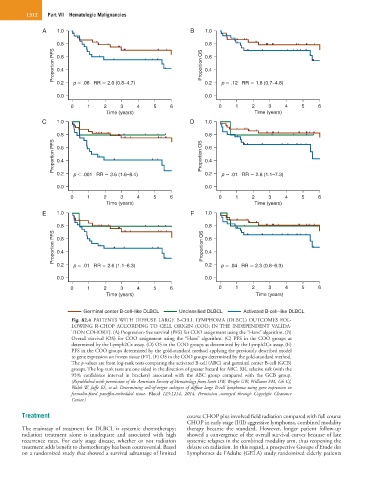
                        Fig. 82.4  PATIENTS WITH DIFFUSE LARGE B-CELL LYMPHOMA (DLBCL) OUTCOMES FOL-
                        LOWING R-CHOP ACCORDING TO CELL ORIGIN (COO; IN THE INDEPENDENT VALIDA-
                        TION COHORT). (A) Progression-free survival (PFS) for COO assignment using the “Hans” algorithm. (B)
                        Overall survival (OS) for COO assignment using the “Hans” algorithm. (C) PFS in the COO groups as
                        determined by the Lymph2Cx assay. (D) OS in the COO groups as determined by the Lymph2Cx assay. (E)
                        PFS in the COO groups determined by the gold-standard method applying the previously described model
                        to gene expression on frozen tissue (FT). (F) OS in the COO groups determined by the gold-standard method.
                        The p-values are from log-rank tests comparing the activated B-cell (ABC) and germinal center B-cell (GCB)
                        groups. The log-rank tests are one sided in the direction of greater hazard for ABC. RR, relative risk (with the
                        95%  confidence  interval  in  brackets)  associated  with  the  ABC  group  compared  with  the  GCB  group.
                        (Republished with permission of the American Society of Hematology from Scott DW, Wright GW, Williams PM, Lih CJ,
                        Walsh W, Jaffe ES, et al: Determining cell-of-origin subtypes of diffuse large B-cell lymphoma using gene expression in
                        formalin-fixed  paraffin-embedded  tissue.  Blood  123:1214,  2014.  Permission  conveyed  through  Copyright  Clearance
                        Center.)

        Treatment                                             course CHOP plus involved field radiation compared with full course
                                                              CHOP in early stage (I/II) aggressive lymphoma, combined modality
        The mainstay of treatment for DLBCL is systemic chemotherapy;   therapy  became  the  standard.  However,  longer  patient  follow-up
        radiation  treatment  alone  is  inadequate  and  associated  with  high   showed a convergence of the overall survival curves because of late
        recurrence  rates.  For  early  stage  disease,  whether  or  not  radiation   systemic relapses in the combined modality arm, thus reopening the
        treatment adds benefit to chemotherapy has been controversial. Based   debate on radiation. In this regard, a prospective Groupe d’Etude des
        on a randomized study that showed a survival advantage of limited   Lymphomes de l’Adulte (GELA) study randomized elderly patients

