


Page 1478 - Hematology_ Basic Principles and Practice ( PDFDrive )
P. 1478
Chapter 82  Diagnosis and Treatment of Diffuse Large B-Cell Lymphoma and Burkitt Lymphoma  1313


            with  favorable  early  stage  aggressive  lymphoma  to  receive  CHOP   Today,  most  newly  diagnosed  patients  with  DLBCL  receive
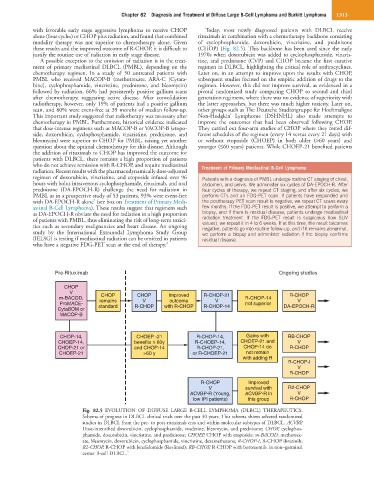
            alone (four cycles) or CHOP plus radiation, and found that combined   rituximab in combination with a chemotherapy backbone consisting
            modality  therapy  was  not  superior  to  chemotherapy  alone.  Given   of  cyclophosphamide,  doxorubicin,  vincristine,  and  prednisone
            these results and the improved outcome of R-CHOP, it is difficult to   (CHOP) (Fig. 82.5). This backbone has been used since the early
            justify the routine use of radiation in early stage disease.  1970s when doxorubicin was added to cyclophosphamide, vincris-
              A possible exception to the omission of radiation is in the treat-  tine,  and  prednisone  (CVP)  and  CHOP  became  the  first  curative
            ment  of  primary  mediastinal  DLBCL  (PMBL),  depending  on  the   regimen in DLBCL, highlighting the critical role of anthracyclines.
            chemotherapy  regimen.  In  a  study  of  50  untreated  patients  with   Later on, in an attempt to improve upon the results with CHOP,
            PMBL  who  received  MACOP-B  (methotrexate,  ARA-C  [Cytara-  subsequent studies focused on the empiric addition of drugs to the
            bine],  cyclophosphamide,  vincristine,  prednisone,  and  bleomycin)   regimen. However, this did not improve survival, as evidenced in a
            followed by radiation, 66% had persistently positive gallium scans   pivotal  randomized  study  comparing  CHOP  to  second  and  third
            after  chemotherapy,  suggesting  active  disease.  After  consolidation   generation regimens, where there was no evidence of superiority with
            radiotherapy, however, only 19% of patients had a positive gallium   the latter approaches, but there was much higher toxicity. Later on,
            scan, and 80% were event-free at 39 months of median follow-up.   other groups such as The Deutsche Studiengruppe für Hochmaligne
            This important study suggested that radiotherapy was necessary after   Non-Hodgkin’  Lymphome  (DSHNHL)  also  made  attempts  to
            chemotherapy in PMBL. Furthermore, historical evidence indicated   improve  the  outcomes  that  had  been  observed  following  CHOP.
            that dose-intense regimens such as MACOP-B or VACOP-B (etopo-  They carried out four-arm studies of CHOP where they tested dif-
            side,  doxorubicin,  cyclophosphamide,  vincristine,  prednisone,  and   ferent schedules of the regimen (every 14 versus every 21 days) with
            bleomycin) were superior to CHOP for PMBL, raising yet another   or  without  etoposide  (CHOEP)  in  both  older  (>60  years)  and
            question about the optimal chemotherapy for this disease. Although   younger (≤60 years) patients. While CHOEP-21 benefited patients
            the addition of rituximab to CHOP has improved the outcome for
            patients with DLBCL, there remains a high proportion of patients
            who do not achieve remission with R-CHOP, and require mediastinal   Treatment of Primary Mediastinal B-Cell Lymphoma
            radiation. Recent results with the pharmacodynamically dose-adjusted
            regimen of doxorubicin, vincristine, and etoposide infused over 96   Patients with a diagnosis of PMBL undergo routine CT staging of chest,
            hours with bolus intravenous cyclophosphamide, rituximab, and oral   abdomen, and pelvis. We administer six cycles of DA-EPOCH-R. After
            prednisone  (DA-EPOCH-R)  challenge  the  need  for  radiation  in   four cycles of therapy, we repeat CT staging, and after six cycles, we
            PMBL as in a prospective study of 53 patients, 93% were event-free   perform CTs and an FDG-PET scan. If patients have responded and
                                7
            with DA-EPOCH-R alone  (see box on Treatment of Primary Medi-  the posttherapy PET scan result is negative, we repeat CT scans every
            astinal B-Cell Lymphoma). These results suggest that regimens such   few months. If the FDG-PET result is positive, we attempt to perform a
            as DA-EPOCH-R obviate the need for radiation in a high proportion   biopsy, and if there is residual disease, patients undergo mediastinal
            of patients with PMBL, thus eliminating the risk of long-term toxici-  radiation  treatment.  If  the  FDG-PET  result  is  suspicious  (low  SUV
                                                                   values), we repeat it in 4 to 6 weeks. If at this time, the result becomes
            ties such as secondary malignancies and heart disease. An ongoing   negative, patients go into routine follow-up, and if it remains abnormal,
            study  by  the  International  Extranodal  Lymphoma  Study  Group   we perform a biopsy and administer radiation if the biopsy confirms
            (IELSG) is testing if mediastinal radiation can be omitted in patients   residual disease.
            who have a negative FDG-PET scan at the end of therapy. 8


                   Pre-Rituximab                                                            Ongoing studies

                      CHOP
                        V
                    m-BACOD,      CHOP        CHOP      Improved    R-CHOP-21    R-CHOP-14      R-CHOP
                     ProMACE-     remains       V       outcome        V         not superior     V
                    CytaBOM or   standard    R-CHOP    with R-CHOP  R-CHOP-14                 DA-EPOCH-R
                     MACOP-B


                     CHOP-14,                 CHOEP -21          R-CHOP-14,       Gains with   RB-CHOP
                    CHOEP-14,                benefits ≤ 60y      R-CHOEP-14,    CHOEP-21 and      V
                    CHOP-21 or               and CHOP-14         R-CHOP-21,      CHOP-14 do     R-CHOP
                    CHOEP-21                    >60 y           or R-CHOEP-21     not remain
                                                                                with adding R
                                                                                               R-CHOP-I
                                                                                                  V
                                                                                                R-CHOP
                                                                   R-CHOP         Improved
                                                                     V           survival with  R2-CHOP
                                                               ACVBP-R (Young,   ACVBP-R in       V
                                                                low IPI patients)  this group   R-CHOP
                            Fig.  82.5  EVOLUTION  OF  DIFFUSE  LARGE  B-CELL  LYMPHOMA  (DLBCL)  THERAPEUTICS.
                            Schema of progress in DLBCL clinical trials over the past 30 years. This schema shows selected randomized
                            studies in DLBCL from the pre- to post-rituximab eras and within molecular subtypes of DLBCL. ACVBP,
                            Dose-intensified doxorubicin, cyclophosphamide, vindesine, bleomycin, and prednisone; CHOP, cyclophos-
                            phamide, doxorubicin, vincristine, and prednisone; CHOEP, CHOP with etoposide; m-BACOD, methotrex-
                            ate, bleomycin, doxorubicin, cyclophosphamide, vincristine, dexamethasone; R-CHOP-I, R-CHOP ibrutinib;
                            R2-CHOP, R-CHOP with lenalidomide (Revlimid); RB-CHOP, R-CHOP with bortezomib, in non–germinal
                                           5
                            center B-cell DLBCL.

