


Page 1479 - Hematology_ Basic Principles and Practice ( PDFDrive )
P. 1479
1314   Part VII  Hematologic Malignancies


        ≤60 years and CHOP-14 benefited patients >60 years, these survival
        gains  did  not  remain  significant  with  the  addition  of  rituximab,
        (following on from a GELA study that showed a survival advantage
        in  older  patients  treated  with  R-CHOP  versus  CHOP).  The
        RICOVER-60 study was a randomized comparison in elderly patients
        of six versus eight cycles of CHOP-14, with or without rituximab.
        Although the DSHNHL found no significant differences in survival
        between the two groups, they reached the conclusion that R-CHOP-
        14 should be adapted as the new standard based on historical com-
        parisons in this population. Subsequently, however, two randomized
        studies,  one  in  all  age  groups  (≥18  years)  and  the  other  in  older
        patients  (>60  years),  showed  no  benefit  of  R-CHOP-14  over
        R-CHOP-21. 9,10  Therefore, R-CHOP-21 remains the standard.
           Others  have  investigated  the  use  of  increased  dose  intensity
        approaches as an alternative to R-CHOP. Rituximab with doxorubi-
        cin,  cyclophosphamide,  vindesine,  bleomycin,  and  prednisone
        (R-ACVBP) was compared to R-CHOP-21 in a randomized study
        performed by the GELA group in patients under 60 years with an
                                                 11
        age-adjusted international prognostic index score of 1.  While the
        R-ACVBP arm showed an improved progression free-survival (PFS)
        (87% versus 73%), the significant hematologic toxicity of the regimen
        confines its use to younger patients and it is not feasible for most
        patients with DLBCL who are over the age of 65 years. This restricts
        the potential of approaches like R-ACVBP to replace R-CHOP as
        the universal platform for this disease. Other intensive approaches
        such  as  using  autologous  stem  cell  transplantation  in  the  upfront
        setting have been tried but they have never shown a clear benefit over
                                                         12
        R-CHOP  alone  and  are  associated  with  much  higher  toxicity.
        Another increased dose-intensity regimen is dose-adjusted etoposide,
        prednisone,  vincristine,  cyclophosphamide,  and  doxorubicin  with
                              13
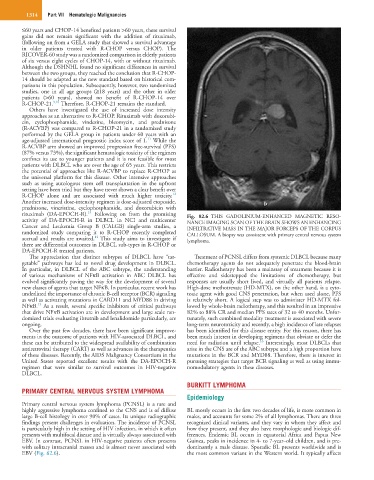
        rituximab  (DA-EPOCH-R).   Following  on  from  the  promising   Fig.  82.6  THIS  GADOLINIUM-ENHANCED  MAGNETIC  RESO-
        activity  of  DA-EPOCH-R  in  DLBCL  in  NCI  and  multicenter   NANCE IMAGING SCAN OF THE BRAIN SHOWS AN ENHANCING
        Cancer  and  Leukemia  Group  B  (CALGB)  single-arm  studies,  a   INFILTRATIVE MASS IN THE MAJOR FORCEPS OF THE CORPUS
        randomized  study  comparing  it  to  R-CHOP  recently  completed   CALLOSUM. A biopsy was consistent with primary central nervous system
                                14
        accrual  and  results  are  awaited.  This  study  aims  to  investigate  if   lymphoma.
        there are differential outcomes in DLBCL sub-types in R-CHOP or
        DA-EPOCH-R treated patients.
           The  appreciation  that  distinct  subtypes  of  DLBCL  have  “tar-  Treatment of PCNSL differs from systemic DLBCL because many
        getable”  pathways  has  led  to  novel  drug  development  in  DLBCL.   chemotherapy  agents  do  not  adequately  penetrate  the  blood-brain
        In  particular,  in  DLBCL  of  the  ABC  subtype,  the  understanding   barrier. Radiotherapy has been a mainstay of treatment because it is
        of  various  mechanisms  of  NFκB  activation  in  ABC  DLBCL  has   effective  and  sidestepped  the  limitations  of  chemotherapy,  but
        evolved significantly paving the way for the development of several   responses  are  usually  short  lived,  and  virtually  all  patients  relapse.
        new classes of agents that target NFκB. In particular, recent work has   High-dose methotrexate (HD-MTX), on the other hand, is a cyto-
        underlined the importance of chronic B-cell receptor (BCR) signaling   toxic agent with good CNS penetration, but when used alone, PFS
        as well as activating mutations in CARD11 and MYD88 in driving   is relatively short. A logical step was to administer HD-MTX fol-
             15
        NFκB.  As a result, several specific inhibitors of critical pathways   lowed by whole-brain radiotherapy, and this resulted in an impressive
        that drive NFκB activation are in development and large scale ran-  82% to 88% CR and median PFS rates of 32 to 40 months. Unfor-
        domized trials evaluating ibrutnib and lenalidomide particularly, are     tunately, such combined modality treatment is associated with severe
        ongoing.                                              long-term neurotoxicity and recently, a high incidence of late relapses
           Over the past few decades, there have been significant improve-  has been identified for this disease entity. For this reason, there has
        ments in the outcome of patients with HIV-associated DLBCL, and   been much interest in developing regimens that obviate or defer the
                                                                                      16
        these can be attributed to the widespread availability of combination   need for radiation until relapse.  Interestingly, most DLBCLs that
        antiretroviral therapy (CART) as well as advances in the therapeutics   arise in the CNS are of the ABC subtype and a high proportion have
        of these diseases. Recently, the AIDS Malignancy Consortium in the   mutations in the BCR and MYD88. Therefore, there is interest in
        United  States  reported  excellent  results  with  the  DA-EPOCH-R   pursuing strategies that target BCR signaling as well as using immu-
        regimen  that  were  similar  to  survival  outcomes  in  HIV-negative   nomodulatory agents in these diseases.
        DLBCL.
                                                              BURKITT LYMPHOMA
        PRIMARY CENTRAL NERVOUS SYSTEM LYMPHOMA
                                                              Epidemiology
        Primary central nervous system lymphoma (PCNSL) is a rare and
        highly aggressive lymphoma confined to the CNS and is of diffuse   BL mostly occurs in the first two decades of life, is more common in
        large B-cell histology in over 90% of cases. Its unique radiographic   males, and accounts for some 2% of all lymphomas. There are three
        findings present challenges in evaluation. The incidence of PCNSL   recognized clinical variants, and they vary in whom they affect and
        is particularly high in the setting of HIV infection, in which it often   how they present, and they also have morphologic and biologic dif-
        presents with multifocal disease and is virtually always associated with   ferences.  Endemic  BL  occurs  in  equatorial  Africa  and  Papua  New
        EBV. In contrast, PCNSL in HIV-negative patients often presents   Guinea, peaks in incidence in 4- to 7-year–old children, and is pre-
        with solitary intracranial masses and is almost never associated with   dominantly a male disease. Sporadic BL presents worldwide and is
        EBV (Fig. 82.6).                                      the most common variant in the Western world. It typically affects

