


Page 1538 - Hematology_ Basic Principles and Practice ( PDFDrive )
P. 1538
Chapter 85  T-Cell Lymphomas  1365


            variable numbers of admixed inflammatory cells often expanding into   similar to those of MF. However, the cellular infiltrates in SS are more
            adnexal structures (hair follicles and sweat glands). Epidermal exocy-  often monotonous, and epidermotropism may be absent.
            tosis of single or small clusters of neoplastic cells is a characteristic   Lymph  node  involvement  initially  involves  the  paracortical
            finding (Fig. 85.18A, C, and D). The presence of Pautrier microab-  regions. Progression is associated with small-to-large clusters of atypi-
            scesses, defined as four or more atypical lymphocytes arranged in an   cal  cells  with  preserved  nodal  architecture,  followed  by  partial  or
            aggregate in the epidermis, is classic but is seen in only a minority of   total  effacement  of  the  node  by  neoplastic  cells.  Visceral  involve-
            cases. Reticular fibroplasia of the papillary dermis is also a common   ment is a late clinical feature. Variable peripheral blood involvement
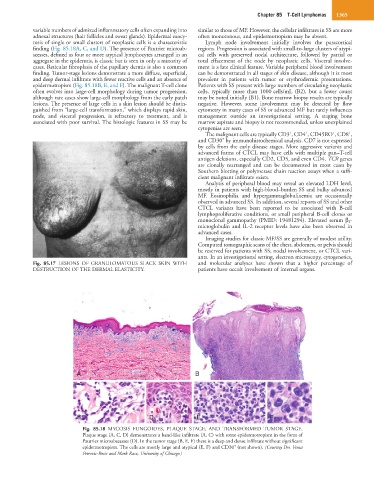
            finding. Tumor-stage lesions demonstrate a more diffuse, superficial,   can be demonstrated in all stages of skin disease, although it is most
            and deep dermal infiltrate with fewer reactive cells and an absence of   prevalent  in  patients  with  tumor  or  erythrodermic  presentations.
            epidermotropism (Fig. 85.18B, E, and F). The malignant T-cell clone   Patients with SS present with large numbers of circulating neoplastic
            often evolves into large-cell morphology during tumor progression,   cells,  typically  more  than  1000 cells/mL  (B2),  but  a  lower  count
            although rare cases show large-cell morphology from the early patch   may be noted initially (B1). Bone marrow biopsy results are typically
            lesions. The presence of large cells in a skin lesion should be distin-  negative.  However,  some  involvement  may  be  detected  by  flow
            guished from “large-cell transformation,” which displays rapid skin,   cytometry in many cases of SS or advanced MF but rarely influences
            node,  and  visceral  progression,  is  refractory  to  treatment,  and  is   management  outside  an  investigational  setting.  A  staging  bone
            associated with poor survival. The histologic features in SS may be   marrow aspirate and biopsy is not recommended, unless unexplained
                                                                  cytopenias are seen.
                                                                                                +
                                                                                                                   +
                                                                                                              +
                                                                                                     +
                                                                    The malignant cells are typically CD3 , CD4 , CD45RO , CD8 ,
                                                                          +
                                                                  and CD30  by immunohistochemical analysis. CD7 is not expressed
                                                                  by cells from the early disease stages. More aggressive variants and
                                                                  advanced forms of CTCL may have cells with multiple pan–T-cell
                                                                  antigen deletions, especially CD2, CD5, and even CD4. TCR genes
                                                                  are  clonally  rearranged  and  can  be  documented  in  most  cases  by
                                                                  Southern blotting or polymerase chain reaction assays when a suffi-
                                                                  cient malignant infiltrate exists.
                                                                    Analysis of peripheral blood may reveal an elevated LDH level,
                                                                  mostly in patients with high-blood–burden SS and bulky advanced
                                                                  MF.  Eosinophilia  and  hypergammaglobulinemia  are  occasionally
                                                                  observed in advanced SS. In addition, several reports of SS and other
                                                                  CTCL  variants  have  been  reported  to  be  associated  with  B-cell
                                                                  lymphoproliferative conditions, or small peripheral B-cell clones or
                                                                  monoclonal gammopathy (PMID: 19481294). Elevated serum β 2 -
                                                                  microglobulin and IL-2 receptor levels have also been observed in
                                                                  advanced cases.
                                                                    Imaging studies for classic MF/SS are generally of modest utility.
                                                                  Computed tomographic scans of the chest, abdomen, or pelvis should
                                                                  be reserved for patients with SS, nodal involvement, or CTCL vari-
                                                                  ants. In an investigational setting, electron microscopy, cytogenetics,
            Fig.  85.17  LESIONS  OF  GRANULOMATOUS  SLACK  SKIN  WITH   and  molecular  analyses  have  shown  that  a  higher  percentage  of
            DESTRUCTION OF THE DERMAL ELASTICITY.                 patients have occult involvement of internal organs.


                          A                                      B


                          C C                     D              E                       F

                            Fig.  85.18  MYCOSIS  FUNGOIDES,  PLAQUE  STAGE,  AND  TRANSFORMED  TUMOR  STAGE.
                            Plaque stage (A, C, D) demonstrates a band-like infiltrate (A, C) with some epidermotropism in the form of
                            Pautrier microabscesses (D). In the tumor stage (B, E, F) there is a deep and dense infiltrate without significant
                                                                              +
                            epidermotropism. The cells are mostly large and atypical (E, F) and CD30  (not shown). (Courtesy Drs. Vesna
                            Petrovic-Rosic and Mark Racz, University of Chicago.)

