


Page 1536 - Hematology_ Basic Principles and Practice ( PDFDrive )
P. 1536
Chapter 85  T-Cell Lymphomas  1363


            commonly associated with histologic evidence and large-cell transfor-  The term large-plaque parapsoriasis has also been traditionally used
            mation. They can be located on any part of the body. Ulceration of   for these types of poorly defined lesions that may evolve into MF. It
            these lesions is common, and secondary infection is a major cause   most commonly consists of a few scattered, erythematous-to-brown
            of morbidity (Fig. 85.12). Tumors  may  be the  initial  presentation   plaques that are usually larger than 6 cm. There is a predilection for
            in a small percentage of patients (d’emblée presentation, Vidal and   the buttocks and intertriginous areas. Histologic examination shows
            Brocq, 1889).                                         a  superficial  lymphocytic  infiltrate  with  minimal  nuclear  atypia.
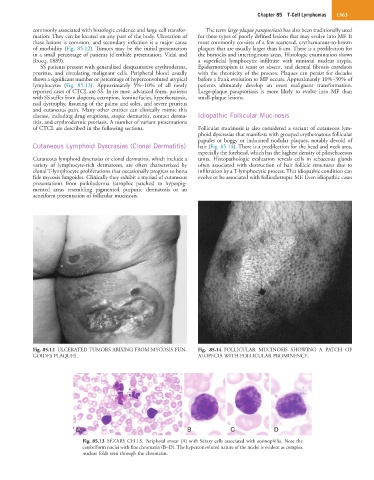
              SS patients present with generalized desquamative erythroderma,   Epidermotropism is scant or absent, and dermal fibrosis correlates
            pruritus,  and  circulating  malignant  cells.  Peripheral  blood  usually   with the chronicity of the process. Plaques can persist for decades
            shows a significant number or percentage of hyperconvoluted atypical   before a frank evolution to MF occurs. Approximately 10%–30% of
            lymphocytes  (Fig.  85.13).  Approximately  5%–10%  of  all  newly   patients  ultimately  develop  an  overt  malignant  transformation.
            reported cases of CTCL are SS. In its most advanced form, patients   Large-plaque  parapsoriasis  is  more  likely  to  evolve  into  MF  than
            with SS suffer from alopecia, ectropion, leonine facies, hyperkeratosis,   small-plaque lesions.
            nail dystrophy, fissuring of the palms and soles, and severe pruritus
            and cutaneous pain. Many other entities can clinically mimic this
            disease, including drug eruptions, atopic dermatitis, contact derma-  Idiopathic Follicular Mucinosis
            titis, and erythrodermic psoriasis. A number of variant presentations
            of CTCL are described in the following sections.      Follicular mucinosis is also considered a variant of cutaneous lym-
                                                                  phoid dyscrasias that manifests with grouped erythematous follicular
                                                                  papules or boggy or indurated nodular plaques, notably devoid of
            Cutaneous Lymphoid Dyscrasias (Clonal Dermatitis)     hair (Fig. 85.14). There is a predilection for the head and neck area,
                                                                  especially the forehead, which has the highest density of pilosebaceous
            Cutaneous lymphoid dyscrasias or clonal dermatitis, which include a   units.  Histopathologic  evaluation  reveals  cells  in  sebaceous  glands
            variety  of  lymphocyte-rich  dermatoses,  are  often  characterized  by   often  associated  with  destruction  of  hair  follicle  structures  due  to
            clonal T-lymphocyte proliferations that occasionally progress to bona   infiltration by a T-lymphocytic process. This idiopathic condition can
            fide mycosis fungoides. Clinically they exhibit a myriad of cutaneous   evolve or be associated with folliculotropic MF. Even idiopathic cases
            presentations  from  poikiloderma  (atrophic  patches)  to  hyperpig-
            mented  areas  resembling  pigmented  purpuric  dermatosis  or  an
            acneiform presentation of follicular mucinosis.


            Fig. 85.12  ULCERATED TUMORS ARISING FROM MYCOSIS FUN-  Fig.  85.14  FOLLICULAR  MUCINOSIS  SHOWING  A  PATCH  OF
            GOIDES PLAQUES.                                       ALOPECIA WITH FOLLICULAR PROMINENCE.


                          A A                                 B             C              D
                            Fig. 85.13  SÉZARY CELLS. Peripheral smear (A) with Sézary cells associated with eosinophilia. Note the
                            cerebriform nuclei with fine chromatin (B–D). The hyperconvoluted nature of the nuclei is evident as complex
                            nuclear folds seen through the chromatin.

