


Page 1537 - Hematology_ Basic Principles and Practice ( PDFDrive )
P. 1537
1364   Part VII  Hematologic Malignancies


        can be associated with clonal T-lymphocytic infiltration. In general,   origin.  Although  the  typical  course  is  usually  indolent,  spanning
        patients  older  than  40  years  with  a  more  generalized  cutaneous   decades, approximately 15% of patients develop MF, HL, or NHL
        involvement and a chronic course are more likely to develop associ-  during their lifetime. A direct link between LyP, CTCL, and HL was
        ated MF. No cases of MF have been reported in children with alopecia   demonstrated in a patient with the three lymphoproliferative disor-
        mucinosa,  although  a  few  reports  of  HL  have  been  reported  in   ders  arising  from  a  common T-cell  clone,  as  shown  by  TCR  gene
        children with follicular mucinosis. Patients with folliculotropic MF   studies.
        and follicular mucinosis are reported to have a worse prognosis, stage
        for stage, which may be caused by inability of topical treatment to
        penetrate to the deeper layers of the process.        Pagetoid Reticulosis
                                                              Pagetoid reticulosis (i.e., Woringer-Kolopp disease) is a rare condition
        Lymphomatoid Papulosis                                affecting young adults. It typically manifests with a solitary, hyper-
                                                              keratotic, often verrucous plaque on the lower limb. Biopsy results
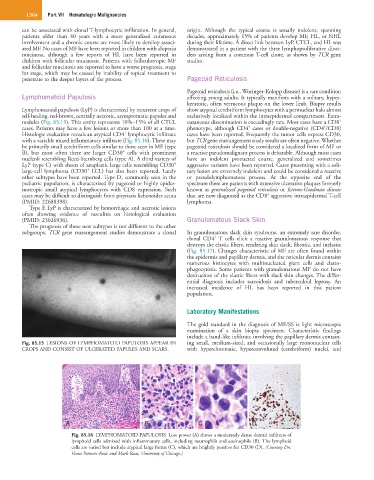
        Lymphomatoid papulosis (LyP) is characterized by recurrent crops of   show atypical cerebriform lymphocytes with a perinuclear halo almost
        self-healing, red-brown, centrally necrotic, asymptomatic papules and   exclusively localized within the intraepidermal compartment. Extra-
                                                                                                                +
        nodules (Fig. 85.15). This entity represents 10%–15% of all CTCL   cutaneous dissemination is exceedingly rare. Most cases have a CD8
                                                                                                           +
                                                                                  +
        cases. Patients may have a few lesions or more than 100 at a time.   phenotype,  although  CD4   cases  or  double-negative  (CD4 /CD8)
                                          +
        Histologic evaluation reveals an atypical CD4  lymphocytic infiltrate   cases have been reported. Frequently the tumor cells express CD30,
        with a variable mixed inflammatory infiltrate (Fig. 85.16). These may   but TCR gene rearrangement study results are often negative. Whether
        be primarily small cerebriform cells similar to those seen in MF (type   pagetoid reticulosis should be considered a localized form of MF or
                                         +
        B),  but  most  often  there  are  larger  CD30   cells  with  prominent   a reactive pseudomalignant process is debatable. Although most cases
        nucleoli resembling Reed-Sternberg cells (type A). A third variety of   have  an  indolent  protracted  course,  generalized  and  sometimes
                                                          +
        LyP (type C) with sheets of anaplastic large cells resembling CD30    aggressive variants have been reported. Cases presenting with a soli-
                              +
        large-cell  lymphoma  (CD30   LCL)  has  also  been  reported.  Lately   tary lesion are extremely indolent and could be considered a reactive
        other subtypes have been reported. Type D, commonly seen in the   or  pseudolymphomatous  process.  At  the  opposite  end  of  the
        pediatric population, is characterized by pagetoid or highly epider-  spectrum there are patients with extensive ulcerative plaques formerly
        motropic  small  atypical  lymphocytes  with  CD8  expression.  Such   known as generalized pagetoid reticulosis or Ketron-Goodman disease
                                                                                        +
        cases may be difficult to distinguish from pityriasis lichenoides acuta   that are now diagnosed as the CD8  aggressive intraepidermal T-cell
        (PMID: 22688398).                                     lymphoma.
           Type E LyP is characterized by hemorrhagic and necrotic lesions
        often  showing  evidence  of  vasculitis  on  histological  evaluation
        (PMID: 23026936).                                     Granulomatous Slack Skin
           The prognosis of these new subtypes is not different to the other
        subgroups.  TCR  gene  rearrangement  studies  demonstrate  a  clonal   In granulomatous slack skin syndrome, an extremely rare disorder,
                                                                       +
                                                              clonal  CD4  T  cells  elicit  a  reactive  granulomatous  response  that
                                                              destroys the elastic fibers, rendering skin slack, fibrotic, and inelastic
                                                              (Fig. 85.17). Changes characteristic of MF are often found within
                                                              the epidermis and papillary dermis, and the reticular dermis contains
                                                              numerous  histiocytes  with  multinucleated  giant  cells  and  elasto-
                                                              phagocytosis.  Some  patients  with  granulomatous MF  do not have
                                                              destruction of the elastic fibers with slack skin changes. The differ-
                                                              ential  diagnosis  includes  sarcoidosis  and  tuberculoid  leprosy.  An
                                                              increased  incidence  of  HL  has  been  reported  in  this  patient
                                                              population.
                                                              Laboratory Manifestations

                                                              The gold standard in the diagnosis of MF/SS is light microscopic
                                                              examination  of  a  skin  biopsy  specimen.  Characteristic  findings
                                                              include a band-like infiltrate involving the papillary dermis contain-
        Fig. 85.15  LESIONS OF LYMPHOMATOID PAPULOSIS APPEAR IN   ing small, medium-sized, and occasionally large mononuclear cells
        CROPS AND CONSIST OF ULCERATED PAPULES AND SCARS.     with  hyperchromatic,  hyperconvoluted  (cerebriform)  nuclei,  and


                       A                        B                 C                D
                        Fig. 85.16  LYMPHOMATOID PAPULOSIS. Low power (A) shows a moderately dense dermal infiltrate of
                        lymphoid cells admixed with inflammatory cells, including neutrophils and eosinophils (B). The lymphoid
                        cells are varied but include atypical large forms (C), which are brightly positive for CD30 (D). (Courtesy Drs.
                        Vesna Petrovic-Rosic and Mark Racz, University of Chicago.)

