


Page 1539 - Hematology_ Basic Principles and Practice ( PDFDrive )
P. 1539
1366   Part VII  Hematologic Malignancies

        Differential Diagnosis                                presentation. These  primary  cutaneous  CD30   LCLs  are  probably
                                                                                                 +
                                                              closely related to LyP, regressing atypical histiocytosis, and primary
        Primary CTCL represents a heterogeneous group of disorders with   cutaneous  HL.  The  tumor  has  a  favorable  prognosis,  and  often
        considerable variability in histologic characteristics, phenotype, and   complete or partial spontaneous regression occurs. This is in contrast
                                                                                      +
        prognosis. The Kiel Classification, the Working Formulation, and the   to primary noncutaneous CD30  LCLs, which can be seen in children
        Revised European-American Lymphoma (REAL) classification system   or adults and which carries a poor prognosis. These primary cutane-
        were  developed  for  NHLs  and  were  not  designed  to  provide  an   ous lesions, in contrast to nodal or pediatric cases, have been shown
        adequate characterization of the spectrum of CTCLs. To address the   to rarely have the chromosomal translocation t(2;5) associated with
        deficiencies  of  the  previously  proposed  systems,  a  more  clinically   overexpression of ALK (ALK negative). Histopathology consists of
        useful classification was developed by the European Organization for   diffuse  nonepidermotropic  infiltrates  with  cohesive  sheets  of  large
                                                                   +
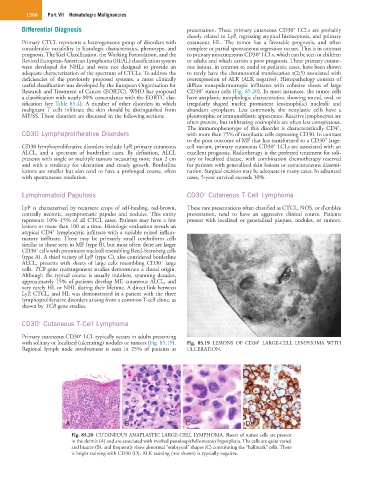
        Research and Treatment of Cancer (EORTC). WHO has proposed   CD30  tumor cells (Fig. 85.20). In most instances, the tumor cells
        a classification with nearly 90% concordance with the EORTC clas-  have anaplastic morphologic characteristics, showing round, oval, or
        sification  (see Table  85.4).  A  number  of  other  disorders  in  which   irregularly  shaped  nuclei;  prominent  (eosinophilic)  nucleoli;  and
        malignant T  cells  infiltrate  the  skin  should  be  distinguished  from   abundant  cytoplasm.  Less  commonly,  the  neoplastic  cells  have  a
        MF/SS. These disorders are discussed in the following sections.  pleomorphic or immunoblastic appearance. Reactive lymphocytes are
                                                              often present, but infiltrating eosinophils are often less conspicuous.
                                                                                                               +
                                                              The immunophenotype of this disorder is characteristically CD4 ,
        CD30 Lymphoproliferative Disorders                    with more than 75% of neoplastic cells expressing CD30. In contrast
                                                                                                           +
                                                              to the poor outcome of MF that has transformed to a CD30  large-
                                                                                          +
        CD30 lymphoproliferative disorders include LyP, primary cutaneous   cell variant, primary cutaneous CD30  LCLs are associated with an
        ALCL,  and  a  spectrum  of  borderline  cases.  By  definition,  ALCL   excellent prognosis. Radiotherapy is the preferred treatment for soli-
        presents with single or multiple tumors measuring more than 2 cm   tary or localized disease, with combination chemotherapy reserved
        and  with  a  tendency  for  ulceration  and  steady  growth.  Borderline   for patients with generalized skin lesions or extracutaneous dissemi-
        lesions are smaller but also tend to have a prolonged course, often   nation. Surgical excision may be adequate in many cases. In advanced
        with spontaneous resolution.                          cases, 5-year survival exceeds 30%.

                                                                    −
        Lymphomatoid Papulosis                                CD30  Cutaneous T-Cell Lymphoma
        LyP  is  characterized  by  recurrent  crops  of  self-healing,  red-brown,   These rare presentations often classified as CTCL, NOS, or d’emblée
        centrally  necrotic,  asymptomatic  papules  and  nodules. This  entity   presentation,  tend  to  have  an  aggressive  clinical  course.  Patients
        represents  10%–15%  of  all  CTCL  cases.  Patients  may  have  a  few   present  with  localized  or  generalized  plaques,  nodules,  or  tumors.
        lesions or more than 100 at a time. Histologic evaluation reveals an
                  +
        atypical CD4  lymphocytic infiltrate with a variable mixed inflam-
        matory  infiltrate.  These  may  be  primarily  small  cerebriform  cells
        similar to those seen in MF (type B), but most often there are larger
             +
        CD30  cells with prominent nucleoli resembling Reed-Sternberg cells
        (type A). A third variety of LyP (type C), also considered borderline
                                                      +
        ALCL,  presents  with  sheets  of  large  cells  resembling  CD30   large
        cells. TCR gene rearrangement studies demonstrate a clonal origin.
        Although the typical course is usually indolent, spanning decades,
        approximately 15% of patients develop MF, cutaneous ALCL, and
        very rarely HL or NHL during their lifetime. A direct link between
        LyP, CTCL, and HL was demonstrated in a patient with the three
        lymphoproliferative disorders arising from a common T-cell clone, as
        shown by TCR gene studies.

        CD30  Cutaneous T-Cell Lymphoma
              +
                           +
        Primary cutaneous CD30  LCL typically occurs in adults presenting
                                                                                     +
        with solitary or localized (ulcerating) nodules or tumors (Fig. 85.19).   Fig.  85.19  LESIONS  OF  CD30   LARGE-CELL  LYMPHOMA  WITH
        Regional  lymph  node  involvement  is  seen  in  25%  of  patients  at   ULCERATION.


                       A                  B                   C                  D
                        Fig. 85.20  CUTANEOUS ANAPLASTIC LARGE-CELL LYMPHOMA. Sheets of tumor cells are present
                        in the dermis (A) and are associated with marked pseudoepitheliomatous hyperplasia. The cells are quite varied
                        and bizarre (B), and frequently show abnormal “embryoid” shapes (C) constituting the “hallmark” cells. There
                        is bright staining with CD30 (D). ALK staining (not shown) is typically negative.

