


Page 1564 - Hematology_ Basic Principles and Practice ( PDFDrive )
P. 1564
Chapter 86  Plasma Cell Neoplasms  1391


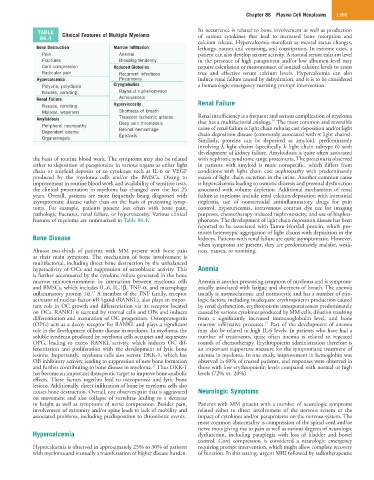
             TABLE   Clinical Features of Multiple Myeloma        Its occurrence is related to bone involvement as well as production
              86.4                                                of  various  cytokines  that  lead  to  increased  bone  resorption  and
                                                                  calcium release. Hypercalcemia manifests as mental status changes,
             Bone Destruction         Marrow Infiltration         lethargy, nausea and vomiting, and constipation. In extreme cases, a
               Pain                      Anemia                   patient can also develop seizure activity. A normal serum calcium level
               Fractures                 Bleeding tendency        in the presence of high paraprotein and/or low albumen level may
               Cord compression       Reduced Globulins           require calculation or measurement of ionized calcium levels to assess
               Radicular pain            Recurrent infections     true  and  effective  serum  calcium  levels.  Hypercalcemia  can  also
             Hypercalcemia               Pneumonia                induce renal failure caused by dehydration, and it is to be considered
               Polyuria, polydipsia   Cryoglobulins               a hematologic emergency meriting prompt intervention.
               Nausea, vomiting          Raynaud’s phenomenon
             Renal Failure               Acrocyanosis
               Nausea, vomiting       Hyperviscosity              Renal Failure
               Malaise, weakness         Shortness of breath
             Amyloidosis                 Transient ischemic attacks  Renal insufficiency is a frequent and serious complication of myeloma
                                                                                          16
                                                                  that has a multifactorial etiology.  The most common and reversible
               Peripheral neuropathy     Deep vein thrombosis     cause of renal failure is light chain tubular cast deposition and/or light
               Dependent edema           Retinal hemorrhage       chain deposition disease (commonly associated with κ light chains).
               Organomegaly              Epistaxis                Similarly,  proteins  can  be  deposited  as  amyloid,  predominantly
                                                                  involving λ light chains (specifically λ light chain subtype 6) with
                                                                  development of kidney failure. Amyloidosis is quite often associated
            the basis of routine blood work. The symptoms may also be related   with nephrotic syndrome range proteinuria. The proteinuria observed
            either to deposition of paraproteins in various organs as either light   in  patients  with  amyloid  is  more  nonspecific,  which  differs  from
            chain  or  amyloid  deposits  or  to  cytokines  such  as  IL-6  or  VEGF   conditions  with  light  chain  cast  nephropathy  with  predominantly
            produced  by  the  myeloma  cells  and/or  the  BMSCs.  Owing  to   excess of light chain excretion in the urine. Another common cause
            improvement in routine blood work and availability of sensitive tests,   is hypercalcemia leading to osmotic diuresis and prerenal dysfunction
            the clinical presentation in myeloma has changed over the last 25   associated with volume depletion. Additional mechanisms of renal
            years.  Overall,  patients  are  more  frequently  being  diagnosed  with   failure in myeloma include renal calcium deposition with interstitial
            asymptomatic disease rather than on the basis of presenting symp-  nephritis,  use  of  nonsteroidal  antiinflammatory  drugs  for  pain
            toms.  For  example,  patients  present  less  often  with  bone  pain,   control,  hyperuricemia,  intravenous  contrast  dye  use  for  imaging
            pathologic fractures, renal failure, or hyperviscosity. Various clinical   purposes, chemotherapy-induced nephrotoxicity, and use of bisphos-
            features of myeloma are summarized in Table 86.4.     phonates. The development of light chain deposition disease has been
                                                                  reported to be associated with Tamm-Horsfall protein, which pro-
                                                                  motes heterotypic aggregation of light chains with deposition in the
            Bone Disease                                          kidneys. Patients with renal failure are quite asymptomatic. However,
                                                                  when symptoms are present, they are predominately malaise, weak-
            Almost  two-thirds  of  patients  with  MM  present  with  bone  pain   ness, nausea, or vomiting.
            as  their  main  symptom.  The  mechanism  of  bone  involvement  is
            multifactorial, including direct bone destruction by the unbalanced
            hyperactivity of OCs and suppression of osteoblastic activity. This   Anemia
            is further accentuated by the cytokine milieu generated in the bone
            marrow  microenvironment  by  interaction  between  myeloma  cells   Anemia is another presenting symptom of myeloma and is symptom-
            and BMSCs, which includes IL-6, IL-1β, TNF-α, and macrophage   atically associated with fatigue and shortness of breath. The anemia
                               11
            inflammatory protein 1α.  A member of the TNF family, receptor   usually is normochromic and normocytic and has a number of etio-
            activator of nuclear factor-κB ligand (RANKL), also plays an impor-  logic factors, including inadequate erythropoietin production caused
            tant role in OC growth and differentiation via its receptor located   by renal dysfunction, erythropoietin unresponsiveness predominately
            on OCs. RANKL is secreted by stromal cells and OBs and induces   caused by various cytokines produced by MM cells, dilution resulting
            differentiation and maturation of OC progenitors. Osteoprotegerin   from  a  significantly  increased  immunoglobulin  level,  and  bone
                                                                                        17
            (OPG) acts as a decoy receptor for RANKL and plays a significant   marrow infiltrative processes.  Part of the development of anemia
            role in the development of bone disease in myeloma. In myeloma, the   may also be related to high IL-6 levels. In patients who have had a
            soluble syndecan produced by myeloma cells occupies and sequesters   number  of  treatments,  quite  often  anemia  is  related  to  repeated
            OPG,  leading  to  excess  RANKL  activity,  which  induces  OC  dif-  rounds of chemotherapy. Erythropoietin administration therefore is
            ferentiation  and  proliferation  with  the  development  of  lytic  bone   an important supportive measure for the symptomatic treatment of
            lesions. Importantly, myeloma cells also secrete DKK-1, which has   anemia in myeloma. In one study, improvement in hemoglobin was
            OB inhibitory activity, leading to suppression of new bone formation   observed in 60% of treated patients, and responses were observed in
                                                   15
            and further contributing to bone disease in myeloma.  Thus DKK-1   those with low erythropoietin levels compared with normal or high
            has become an important therapeutic target to improve bone anabolic   levels (72% vs. 20%).
            effects. These  factors  together  lead  to  osteoporosis  and  lytic  bone
            lesions. Additionally, direct infiltration of bone by myeloma cells also
            causes bone destruction. Overall, one observes pain that is aggravated   Neurologic Symptoms
            on  movement  and  also  collapse  of  vertebrae  leading  to  a  decrease
            in height as well as symptoms of nerve compression. Besides pain,   Patients with MM present with a number of neurologic symptoms
            involvement of extremity and/or spine leads to lack of mobility and   related  either  to  direct  involvement  of  the  nervous  system  or  the
            associated problems, including predisposition to thrombotic events.  impact of cytokines and/or paraproteins on the nervous system. The
                                                                  most common abnormality is compression of the spinal cord and/or
                                                                  nerve roots giving rise to pain as well as various degrees of neurologic
            Hypercalcemia                                         dysfunction,  including  paraplegia  with  loss  of  bladder  and  bowel
                                                                  control.  Cord  compression  is  considered  a  neurologic  emergency
            Hypercalcemia is observed in approximately 25% to 30% of patients   requiring prompt intervention, which might allow complete recovery
            with myeloma and is usually a manifestation of higher disease burden.   of function. In this setting, urgent MRI followed by radiotherapeutic

