


Page 1566 - Hematology_ Basic Principles and Practice ( PDFDrive )
P. 1566
Chapter 86  Plasma Cell Neoplasms  1393


             TABLE   Evaluation of Patients With Multiple Myeloma  be repeated to confirm achievement of a complete response. Patients
              86.5                                                who produce intact immunoglobulins can also produce excess light
                                                                  chain, giving a picture that is associated with both heavy and light
             Evaluation for Diagnosis                             chains; for example, a patient can have an IgG κ and a κ light-chain
             Evaluation for Monoclonal Protein                    myeloma. Associated with the presence of a monoclonal protein, the
               Serum protein electrophoresis, immunofixation      uninvolved immunoglobulins are suppressed. For example, patients
               Quantitative immunoglobulin by nephelometric method  with IgG myeloma will have suppressed IgA and IgM. In a setting
               24-Hour urine collection for electrophoresis and Bence Jones   where all three immunoglobulins are suppressed, one should suspect
                  protein assessment and immunofixation           either light-chain disease and/or the possibility of IgD or IgE MM.
               Serum free light chain and ratio                   Very  rarely,  a  biclonal  or  triclonal  pattern  of  immunoglobulins  is
             Evaluation for Clonal Plasma Cells                   observed,  more  often  with  the  same  light  chain  but  rarely  with  a
             Bone marrow aspirate and biopsy for                  different  heterotypic  light  chain.  This  may  suggest  truly  separate
               Histology                                          clones, especially with separate light chains. Quantitation of Bence
               Clonality by immunostaining or flow cytometry by κ/λ staining  Jones  proteins  in  urine  is  still  important,  both  for  diagnosis  of
               Fine-needle aspiration of plasmacytoma if indicated  myeloma  and  for  follow-up.  It  is  important  to  note  that  a  free
             Evaluation for End-Organ Damage                      light-chain  measurement  in  the  urine  is  not  informative.  Those
               Hemogram to detect anemia                          patients with only a monoclonal protein in the urine require frequent
               Chemistry panel for renal function and calcium     24-hour Bence Jones protein measurements during follow-up. Thera-
               Radiologic evaluation: skeletal survey             peutically, patients with each of the various types of immunoglobulins
               PET-CT or MRI as indicated for bone lesions or extramedullary   are treated with a similar type of therapy; however, patients with IgA
                  disease                                         myeloma appear to have an inferior survival. The immunoglobulin
             Evaluation for Risk Stratification                   isotype remains constant in a given patient over the natural history
                                                                  of the disease; however, occasionally, a patient producing one immu-
               β 2 -Microglobulin and serum albumin for ISS stage  noglobulin  at  the  time  of  diagnosis,  at  relapse,  or  with  advanced
               Cytogenetics and fluorescence in situ hybridization on bone marrow   disease may present with only the same light chain as initially observed
                  sample
               LDH                                                with the original immunoglobulin (light chain escape) or occasionally
                                                                  may  become  nonsecretory.  Both  the  changes  are  reflective  of  the
               C-reactive protein                                 change in plasma cells to a more aggressive or undifferentiated form.
             Other Investigations for Selected Patients           As a result of the observed light-chain escape, patients without initial
               Abdominal fat pad or rectal biopsy for amyloid     Bence  Jones  proteins  initially  detected  in  the  urine  will  require
               Solitary lytic lesion biopsy                       periodic  24-hour  urine  Bence  Jones  protein  measurements  during
               Serum viscosity if IgM component or high IgA levels or serum M   follow-up.
                  component >7 g/dL                                 The unique sequences that are observed with the idiotype protein
               Immunofixation for IgD or IgE in select cases      (CDR3)  have  been  used  as  a  marker  that  specifically  identifies  a
             CT, Computed tomography; Ig, immunoglobulin; ISS, International Staging   tumor  cell  clone  and  have  been  applied  to  a  polymerase  chain
             System; LDH, lactate dehydrogenase; MRI, magnetic resonance imaging; PET,   reaction–based methodology to detect MRD with high sensitivity.
             positron emission tomography.
                                                                  Early studies using such molecular methods for detecting MRD have


             No monoclonal gammopathy            lgGκ monoclonal gammopathy       Free λ monoclonal gammopathy
                  URINE             SERUM             URINE           SERUM             URINE            SERUM


             SP G  A M   κ  λ  SP G A M κ    λ   SP G A M κ    λ  SP G A M κ   λ   SP G A M κ   λ   SP G A M κ    λ


            A                                   B                                 C

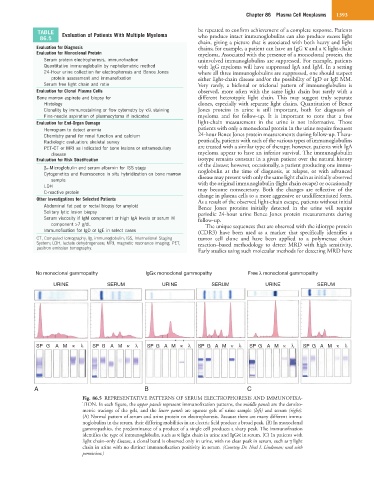
                            Fig. 86.5  REPRESENTATIVE PATTERNS OF SERUM ELECTROPHORESIS AND IMMUNOFIXA-
                            TION. In each figure, the upper panels represent immunofixation patterns, the middle panels are the densito-
                            metric  tracings  of  the  gels,  and  the  lower  panels  are  agarose  gels  of  urine  sample  (left)  and  serum  (right).
                            (A) Normal pattern of serum and urine protein on electrophoresis. Because there are many different immu-
                            noglobulins in the serum, their differing mobilities in an electric field produce a broad peak. (B) In monoclonal
                            gammopathies, the predominance of a product of a single cell produces a sharp peak. The immunofixation
                            identifies the type of immunoglobulin, such as κ light chain in urine and IgGκ in serum. (C) In patients with
                            light chain–only disease, a clonal band is observed only in urine, with no clear peak in serum, such as γ light
                            chain in urine with no distinct immunofixation positivity in serum. (Courtesy Dr. Neal I. Lindeman; used with
                            permission.)

