


Page 1567 - Hematology_ Basic Principles and Practice ( PDFDrive )
P. 1567
1394   Part VII  Hematologic Malignancies


        identified those patients who achieve complete molecular remissions   also adequate for diagnosis (Fig. 86.7). Cytogenetic and FISH studies
        that are associated with improved overall outcome.    should be performed on bone marrow samples at the time of diag-
                                                              nosis, and if initially confirmed as low-risk disease, then they should
                                                              be  repeated  on  bone  marrow  performed  at  the  time  of  relapse.
        Serum Free Light Chains                               Although important for prognostication, cytogenetic or FISH study–
                                                              identified  abnormalities  are  not  adequate  for  differentiating  MM
        This test measures serum light chains that are not associated with   from MGUS or SMM. A seven-color flow cytometry panel is now
        heavy chains. The presence of serum free light chains provides an   also used with bone marrow samples to detect MRD.
        additional marker and measurement of plasma cell proliferation, and
        its quantitation has been used to determine protein levels in a number
        of patients who were previously considered oligosecretory or nonse-  Investigation to Detect End-Organ Damage
        cretory.  For  example,  80%  of  patients  with  previously  diagnosed
        nonsecretory  myeloma  have  measurable  serum  free  light  chains.   The diagnosis of a plasma cell disorder is based on the presence of a
        Routine use of serum free light chain measurements is indicated for   monoclonal protein and clonal plasma cells. However, the diagnosis
        diagnosis, response evaluation, and prognosis. As shown in patients
        with  MGUS  and  SMM,  serum  free  light  chain  ratio  allows  for
        identification of those patients with increased likelihood of progres-  TABLE
        sion to symptomatic myeloma. The measurement of serum free light   86.6  Phenotypic Characterization of Plasma Cells
        chain does not replace the measurement of Bence Jones proteins in
        24-hour urine collection.                              Adhesion Molecule    Normal Plasma Cells  MM Cells
           A recently developed heavy/light chain assay allows identification   CD138     +                 +
        and quantification of the different light chain types belonging to each
        immunoglobulin class (e.g., IgAκ and IgAλ) and allows calculation   CD19          +                 −
        of  ratios  of  monoclonal/polyclonal  immunoglobulins  (heavy/light   CD28       −                 −
        chain ratio). In one study, heavy/light chain assays allowed quantifica-  CD38    +                 +
        tion of monoclonal proteins not accurately measurable by SPEP or   CD40           +                 + a
        nephelometry, and the heavy/light chain ratio indicated the presence
        of disease in 8 of 31 patients who achieved CR and in sequential   CD45           +                 − b
        studies indicated evolving relapse in three patients before immuno-  CD27         −                 +
        fixation became positive. The assay requires further validation before   CD11a    +                 −
        wider clinical use.
                                                               CD11b                      −                 −
                                                               CD44                       +                 +
        Bone Marrow Examination                                CD54                       +                 +
        Except for patients with solitary plasmacytoma, the presence of clonal   CD56     −                 +
        plasma cells (>5%) is usually observed in all plasma cell disorders,   CD58       −                 +
        and malignant plasma cells can be distinguished from normal plasma   LFA-1        −                −/+
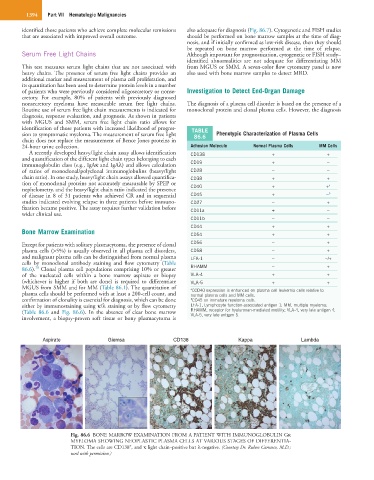
        cells  by  monoclonal  antibody  staining  and  flow  cytometry  (Table
             20
        86.6).  Clonal plasma cell populations comprising 10% or greater   RHAMM          −                 +
        of  the  nucleated  cells  within  a  bone  marrow  aspirate  or  biopsy   VLA-4  +                 +
        (whichever  is  higher  if  both  are  done)  is  required  to  differentiate   VLA-5  +            +
        MGUS from SMM and for MM (Table 86.1). The quantitation of   a CCD40 expression is enhanced on plasma cell leukemia cells relative to
        plasma cells should be performed with at least a 200-cell count, and   normal plasma cells and MM cells.
        confirmation of clonality is essential for diagnosis, which can be done   b CD45 on immature myeloma cells.
        either by immunostaining using κ/λ staining or by flow cytometry   LFA-1, Lymphocyte function-associated antigen 1; MM, multiple myeloma;
        (Table  86.6  and  Fig.  86.6).  In  the  absence  of  clear  bone  marrow   RHAMM, receptor for hyaluronan-mediated motility; VLA-4, very late antigen 4;
                                                               VLA-5, very late antigen 5.
        involvement,  a  biopsy-proven  soft  tissue  or  bony  plasmacytoma  is


               Aspirate             Giemsa                CD138                Kappa                Lambda


                        Fig. 86.6  BONE MARROW EXAMINATION FROM A PATIENT WITH IMMUNOGLOBULIN Gκ
                        MYELOMA SHOWING NEOPLASTIC PLASMA CELLS AT VARIOUS STAGES OF DIFFERENTIA-
                                           +
                        TION. The cells are CD138 , and κ light chain–positive but λ-negative. (Courtesy Dr. Ruben Carrasco, M.D.;
                        used with permission.)

