


Page 1568 - Hematology_ Basic Principles and Practice ( PDFDrive )
P. 1568
Chapter 86  Plasma Cell Neoplasms  1395


                                                                  of  MGUS/SMM,  which  currently  does  not  require  therapeutic
                                                                  intervention, and active symptomatic MM, which needs treatment,
                                                                  is based on the detection of end-organ damage, which includes bone
                                                                  lesions, anemia, renal dysfunction, and hypercalcemia. The details of
                                                                  the diagnostic criteria are listed in Tables 86.7 and 86.8. 20


                                                                  Radiographic Evaluation

                                                                  The standard evaluation of bone lesions in myeloma is by a skeletal
                                                                  survey that includes plain x-rays of the entire skeleton. The presence
                                                                  of  characteristic  lytic  lesions  is  considered  diagnostic  for  myeloma
                                                                  (Fig. 86.8). Rarely, in POEMS, bone lesions are osteosclerotic. The
                                                                  bone lesions do not always resolve following effective therapy. Because
                                                                  of the absence or suppression of osteoblastic activity, the bone scan
                                                                  is diagnostically not a useful investigative tool in myeloma. Almost
                                                                  all patients with myeloma have osteoporosis as a result of unbalanced
                                                                  osteoclastic activity. Bone mineral density (BMD) measurement by
                                                                  dual-energy x-ray absorptiometry helps identify osteoporosis and is
                                                                  consider a useful investigation. However, it is not uniformly used,
                                                                  because all patients with myeloma are known to have osteoporosis,
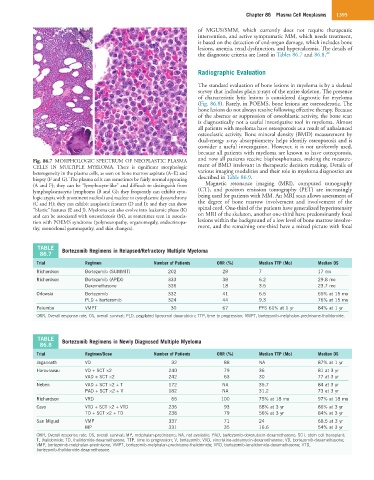
            Fig. 86.7  MORPHOLOGIC SPECTRUM OF NEOPLASTIC PLASMA   and now all patients receive bisphosphonates, making the measure-
            CELLS  IN  MULTIPLE  MYELOMA.  There  is  significant  morphologic   ment of BMD irrelevant in therapeutic decision making. Details of
            heterogeneity in the plasma cells, as seen on bone marrow aspirate (A–E) and   various imaging modalities and their role in myeloma diagnostics are
            biopsy (F and G). The plasma cells can sometimes be fairly normal appearing   described in Table 86.9.
            (A and F); they can be “lymphocyte-like” and difficult to distinguish from   Magnetic  resonance  imaging  (MRI),  computed  tomography
            lymphoplasmacytic lymphoma (B and G); they frequently can exhibit cyto-  (CT),  and  positron  emission  tomography  (PET)  are  increasingly
            logic atypia with prominent nucleoli and nuclear to cytoplasmic dyssynchrony   being used for patients with MM. An MRI scan allows assessment of
            (C and H); they can exhibit anaplastic features (D and I); and they can show   the  degree  of  bone  marrow  involvement  and  involvement  of  the
            “blastic” features (E and J). Myeloma can also evolve into leukemic phase (K)   spinal cord. One-third of the patients have generalized hyperintensity
            and can be associated with osteosclerosis (M), as sometimes seen in associa-  on MRI of the skeleton, another one-third have predominantly focal
            tion with POEMS syndrome (polyneuropathy, organomegaly, endocrinopa-  lesions within the background of a low level of bone marrow involve-
            thy, monoclonal gammopathy, and skin changes).        ment, and the remaining one-third have a mixed picture with focal


             TABLE   Bortezomib Regimens in Relapsed/Refractory Multiple Myeloma
              86.7
             Trial           Regimen               Number of Patients   ORR (%)       Median TTP (Mo)    Median OS
             Richardson      Bortezomib (SUMMIT)        202               28          7                  17 mo
             Richardson      Bortezomib (APEX)          333               38          6.2                29.8 mo
                             Dexamethasone              336               18          3.5                23.7 mo
             Orlowski        Bortezomib                 332               41          6.5                65% at 15 mo
                             PLD + bortezomib           324               44          9.3                76% at 15 mo
             Palumbo         VMPT                        30               67          PFS 61% at 1 yr    84% at 1 yr
             ORR, Overall response rate; OS, overall survival; PLD, pegylated liposomal doxorubicin; TTP, time to progression; VMPT, bortezomib-melphalan-prednisone-thalidomide.


             TABLE   Bortezomib Regimens in Newly Diagnosed Multiple Myeloma
              86.8
             Trial           Regimen/Dose          Number of Patients   ORR (%)       Median TTP (Mo)    Median OS
             Jagannath       VD                          32               88          NA                 87% at 1 yr
             Harousseau      VD + SCT ×2                240               79          36                 81 at 3 yr
                             VAD + SCT ×2               242               63          30                 77 at 3 yr
             Neben           VAD + SCT ×2 + T           172               NA          35.7               84 at 3 yr
                             PAD + SCT ×2 + V           182               NA          31.2               73 at 3 yr
             Richardson      VRD                         66              100          75% at 18 mo       97% at 18 mo
             Cavo            VTD + SCT ×2 + VTD         236               93          68% at 3 yr        86% at 3 yr
                             TD + SCT ×2 + TD           238               79          56% at 3 yr        84% at 3 yr
             San Miguel      VMP                        337               71          24                 68.5 at 3 yr
                             MP                         331               35          16.6               54% at 3 yr
             ORR, Overall response rate; OS, overall survival; MP, melphalan-prednisone; NA, not available; PAD, bortezomib-doxorubicin-dexamethasone; SCT, stem cell transplant;
             T, thalidomide; TD, thalidomide-dexamethasone; TTP, time to progression; V, bortezomib; VAD, vincristine-adriamycin-dexamethasone; VD, bortezomib-dexamethasone;
             VMP, bortezomib-melphalan-prednisone; VMPT, bortezomib-melphalan-prednisone-thalidomide; VRD, bortezomib-lenalidomide-dexamethasone; VTD,
             bortezomib-thalidomide-dexamethasone.

