


Page 1590 - Hematology_ Basic Principles and Practice ( PDFDrive )
P. 1590
Chapter 86  Plasma Cell Neoplasms  1417


                                    Clochonic acid                                        + Censored
                          40        Zoledronic acid       35%               100                 = .0107
                                                                                           2
                                                                            90
                       Patients with skeletal-  related events (%)  20  HR-0.74 (95% Cl, 0.62-0.87); 27%  Overall survival  (% patients)  70  CLO (n = 682)
                                                                                          HR = 0.82 (0.6% Cl, 0.70, 0.06)
                                                                            80
                          30
                                                                            60
                                                                            50
                                                                            40
                                                                            30
                          10
                                                                            10
                           0          P = .0004                             20 0      ZOL (n = 668)
                             0   6   21  18  24  30  36  42                     0     1    2     3    4    5
                     A             Time from randomization (mo)        D        Survival since initial randomization (yr)
                Number at risk
                Clochonic acid  979 629 465 337 256 173 112  74          ZOL    668  544  447   292  165   64
                Zoledronic acid 0.5  981 663 506 390 284 201 138  97     CLO 100  662  534  + Censored  143  53
                                                                                          437
                                                                                                271
                       Cumulative incidence function, skeletal-related events (%)  0.4  HR-0.77 (95% Cl,  HR, 0.53 (95% Cl,  Overall survival  (% patients)  90  CLO (n = 276)
                                                                                           2
                                                                                                = .4690
                                                                                          HR = 1.10 (95% Cl, 0.85, 1.60)
                                                                            80
                                                    0.33-0.84)
                                                                            70
                                                    log-rank P = .0068
                                                                            60
                          0.3
                                                                            50
                                                                            40
                          0.2
                                                                            30
                                                                            20
                                0.65-0.92)
                          0.1
                                                                                      ZOL (n = 302)
                                                                            10
                                log-rank P = .0038
                           0
                             0 6 121824303642485460
                                                                                Survival since initial randomization (yr)
                              Time from randomization  0 6 121824303642485460  0  0   1    2     3    4    5
                                                  Time from randomization
                     B               (mo)       C        (mo)          E
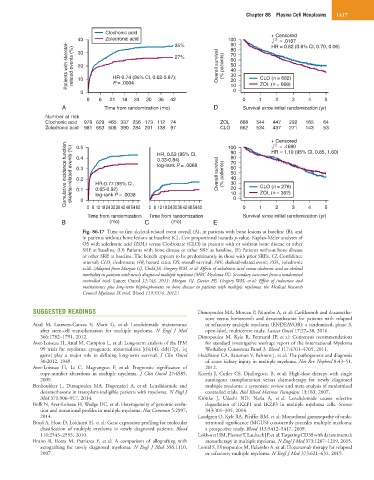
                            Fig. 86.17  Time to first skeletal-related event overall (A), in patients with bone lesions at baseline (B), and
                            in patients without bone lesions at baseline (C). Cox proportional hazards p-value. Kaplan-Meier analyses of
                            OS with zoledronic acid (ZOL) versus Clodronate (CLO) in patients with or without bone disease or other
                            SRE at baseline. (D) Patients with bone disease or other SRE at baseline. (E) Patients without bone disease
                            or other SRE at baseline. The benefit appears to be predominantly in those with prior SREs. CI, Confidence
                            interval; CLO, clodronate; HR, hazard ratio; OS, overall survival; SRE, skeletal-related event; ZOL, zoledronic
                            acid. (Adapted from Morgan GJ, Child JA, Gregory WM, et al: Effects of zoledronic acid versus clodronic acid on skeletal
                            morbidity in patients with newly diagnosed multiple myeloma (MRC Myeloma IX): Secondary outcomes from a randomised
                            controlled  trial.  Lancet  Oncol  12:743,  2011;  Morgan  GJ,  Davies  FE,  Gregory WM,  et al:  Effect  of  induction  and
                            maintenance plus long-term bisphosphonates on bone disease in patients with multiple myeloma: the Medical Research
                            Council Myeloma IX trial. Blood 119:5374, 2012.)
            SUGGESTED READINGS                                    Dimopoulos MA, Moreau P, Palumbo A, et al: Carfilzomib and dexametha-
                                                                    sone  versus  bortezomib  and  dexamethasone  for  patients  with  relapsed
            Attal  M,  Lauwers-Cances  V,  Marit  G,  et al:  Lenalidomide  maintenance   or refractory multiple myeloma (ENDEAVOR): a randomised, phase 3,
              after  stem-cell  transplantation  for  multiple  myeloma.  N  Engl  J  Med   open-label, multicentre study. Lancet Oncol 17:27–38, 2016.
              366:1782–1791, 2012.                                Dimopoulos  M,  Kyle  R,  Fermand  JP,  et al:  Consensus  recommendations
            Avet-Loiseau H, Attal M, Campion L, et al: Long-term analysis of the IFM   for standard investigative workup: report of the International Myeloma
              99 trials for myeloma: cytogenetic abnormalities [t(4;14), del(17p), 1q   Workshop Consensus Panel 3. Blood 117:4701–4705, 2011.
              gains]  play  a  major  role  in  defining  long-term  survival.  J  Clin  Oncol   Hutchison CA, Batuman V, Behrens J, et al: The pathogenesis and diagnosis
              30:2012, 1949.                                        of acute kidney injury in multiple myeloma. Nat Rev Nephrol 8:43–51,
            Avet-Loiseau  H,  Li  C,  Magrangeas  F,  et al:  Prognostic  significance  of    2012.
              copy-number  alterations  in  multiple  myeloma.  J  Clin  Oncol  27:4585,   Koreth  J,  Cutler  CS,  Djulbegovic  B,  et al:  High-dose  therapy  with  single
              2009.                                                 autologous  transplantation  versus  chemotherapy  for  newly  diagnosed
            Benboubker  L,  Dimopoulos  MA,  Dispenzieri  A,  et al:  Lenalidomide  and   multiple myeloma: a systematic review and meta-analysis of randomized
              dexamethasone in transplant-ineligible patients with myeloma. N Engl J   controlled trials. Biol Blood Marrow Transplant 13:183, 2007.
              Med 371:906–917, 2014.                              Krönke  J,  Udeshi  ND,  Narla  A,  et al:  Lenalidomide  causes  selective
            Bolli N, Avet-Loiseau H, Wedge DC, et al: Heterogeneity of genomic evolu-  degradation  of  IKZF1  and  IKZF3  in  multiple  myeloma  cells.  Science
              tion and mutational profiles in multiple myeloma. Nat Commun 5:2997,   343:301–305, 2014.
              2014.                                               Landgren O, Kyle RA, Pfeiffer RM, et al: Monoclonal gammopathy of unde-
            Broyl A, Hose D, Lokhorst H, et al: Gene expression profiling for molecular   termined significance (MGUS) consistently precedes multiple myeloma:
              classification  of  multiple  myeloma  in  newly  diagnosed  patients.  Blood   a prospective study. Blood 113:5412–5417, 2009.
              116:2543–2553, 2010.                                Lokhorst HM, Plesner T, Laubach JP, et al: Targeting CD38 with daratumumab
            Bruno  B,  Rotta  M,  Patriarca  F,  et al:  A  comparison  of  allografting  with   monotherapy in multiple myeloma. N Engl J Med 373:1207–1219, 2015.
              autografting  for  newly  diagnosed  myeloma.  N  Engl  J  Med  356:1110,   Lonial S, Dimopoulos M, Palumbo A, et al: Elotuzumab therapy for relapsed
              2007.                                                 or refractory multiple myeloma. N Engl J Med 373:621–631, 2015.

