


Page 1687 - Hematology_ Basic Principles and Practice ( PDFDrive )
P. 1687
Chapter 93  Late Complications of Hematologic Diseases and Their Therapies  1505


            including anxiety, depression, posttraumatic stress disorder, and bar-  significantly  because  of  differences  in  therapy,  age  at  exposure  to
            riers to accessing the healthcare system because of problems obtaining   therapy, or pharmacogenetics. General associations of late effects with
            health insurance coverage. The impact of cancer therapy on psycho-  conventional treatment for common hematologic malignancies are
            social functioning is dependent on many variables, including intensity   reviewed  in Tables  93.1–93.3. The  risk  for  specific  late  effects  in
            and  duration  of  therapy,  treatment-related  complications,  family   survivors who have undergone HCT depends on the conditioning
            functioning, developmental processes, and treatment-specific sequelae   regimen, donor source, complications experienced during the trans-
            such as altered cognitive or physical functioning. 286  plantation process, presence or absence of GVHD, and prior cancer
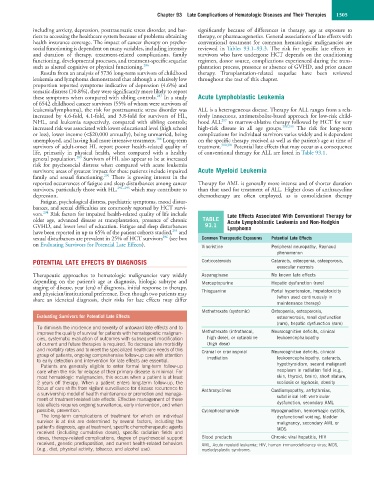
              Results from an analysis of 5736 long-term survivors of childhood   therapy.  Transplantation-related  sequelae  have  been  reviewed
            leukemia and lymphoma demonstrated that although a relatively low   throughout the text of this chapter.
            proportion reported symptoms indicative of depression (4.6%) and
            somatic distress (10.8%), they were significantly more likely to report
                                                    287
            these symptoms when compared with sibling controls.  In a study   Acute Lymphoblastic Leukemia
            of 6542 childhood cancer survivors (55% of whom were survivors of
            leukemia/lymphoma), the risk for posttraumatic stress disorder was   ALL is a heterogeneous disease. Therapy for ALL ranges from a rela-
            increased  by  4.6-fold,  4.1-fold,  and  3.8-fold  for  survivors  of  HL,   tively innocuous, antimetabolite-based approach for low-risk child-
                                                                         297
            NHL,  and  leukemia  respectively,  compared  with  sibling  controls;   hood ALL  to marrow-ablative therapy followed by HCT for very
            increased risk was associated with lower educational level (high school   high-risk  disease  in  all  age  groups. 298,299   The  risk  for  long-term
            or less), lower income (<$20,000 annually), being unmarried, being   complications for individual survivors varies widely and is dependent
                                                    288
            unemployed, and having had more intensive treatment.  Long-term   on the specific therapy received as well as the patient’s age at time of
            survivors of adult-onset HL report poorer health-related quality of   treatment. 300,301  Potential late effects that may occur as a consequence
            life,  primarily  in  physical  health,  when  compared  with  a  healthy   of conventional therapy for ALL are listed in Table 93.1.
                          289
            general population.  Survivors of HL also appear to be at increased
            risk  for  psychosocial  distress  when  compared  with  acute  leukemia
            survivors; areas of greatest impact for these patients include impaired   Acute Myeloid Leukemia
                                   290
            family  and  sexual  functioning.  There  is  growing  interest  in  the
            reported occurrences of fatigue and sleep disturbances among cancer   Therapy for AML is generally more intense and of shorter duration
            survivors, particularly those with HL, 291–293  which may contribute to   than that used for treatment of ALL. Higher doses of anthracycline
            depression.                                           chemotherapy  are  often  employed,  as  is  consolidation  therapy
              Fatigue, psychological distress, psychiatric symptoms, mood distur-
            bances, and sexual difficulties are commonly reported by HCT survi-
               294
            vors.  Risk factors for impaired health-related quality of life include   Late Effects Associated With Conventional Therapy for
            older  age,  advanced  disease  at  transplantation,  presence  of  chronic   TABLE   Acute Lymphoblastic Leukemia and Non-Hodgkin
            GVHD, and lower level of education. Fatigue and sleep disturbances   93.1  Lymphoma
                                                         295
            have been reported in up to 65% of the patient cohorts studied,  and
                                                      296
            sexual disturbances are prevalent in 25% of HCT survivors  (see box   Common Therapeutic Exposures  Potential Late Effects
            on Evaluating Survivors for Potential Late Effects).   Vincristine            Peripheral neuropathy, Raynaud
                                                                                            phenomenon
            POTENTIAL LATE EFFECTS BY DIAGNOSIS                    Corticosteroids        Cataracts, osteopenia, osteoporosis,
                                                                                            avascular necrosis
            Therapeutic  approaches  to  hematologic  malignancies  vary  widely   Asparaginase  No known late effects
            depending  on  the  patient’s  age  at  diagnosis,  biologic  subtype  and   Mercaptopurine  Hepatic dysfunction (rare)
            staging of disease, year (era) of diagnosis, initial response to therapy,
            and physician/institutional preference. Even though two patients may   Thioguanine  Portal hypertension, hepatotoxicity
            share  an  identical  diagnosis,  their  risks  for  late  effects  may  differ   (when used continuously in
                                                                                            maintenance therapy)
                                                                   Methotrexate (systemic)  Osteopenia, osteoporosis,
             Evaluating Survivors for Potential Late Effects                                osteonecrosis, renal dysfunction
                                                                                            (rare), hepatic dysfunction (rare)
             To diminish the incidence and severity of untoward late effects and to
             improve the quality of survival for patients with hematopoietic malignan-  Methotrexate (intrathecal,   Neurocognitive deficits, clinical
             cies, systematic evaluation of outcomes with subsequent modification   high dose), or cytarabine   leukoencephalopathy
             of current and future therapies is required. To decrease late morbidity   (high dose)
             and mortality rates and to meet the specialized healthcare needs of this   Cranial or craniospinal   Neurocognitive deficits, clinical
             group of patients, ongoing comprehensive follow-up care with attention
             to early detection and intervention for late effects are essential.  irradiation  leukoencephalopathy, cataracts,
              Patients  are  generally  eligible  to  enter  formal  long-term  follow-up   hypothyroidism, second malignant
             care when the risk for relapse of their primary disease is minimal. For        neoplasm in radiation field (e.g.,
             most hematologic malignancies, this occurs when a patient is at least          skin, thyroid, brain), short stature,
             2  years  off  therapy.  When  a  patient  enters  long-term  follow-up,  the   scoliosis or kyphosis, obesity
             focus of care shifts from vigilant surveillance for disease recurrence to   Anthracyclines  Cardiomyopathy, arrhythmias,
             a survivorship model of health maintenance or promotion and manage-
             ment of treatment-related late effects. Effective management of these          subclinical left ventricular
             late effects requires ongoing surveillance, early intervention, and when       dysfunction, secondary AML
             possible, prevention.                                 Cyclophosphamide       Hypogonadism, hemorrhagic cystitis,
              The  long-term  complications  of  treatment  for  which  an  individual      dysfunctional voiding, bladder
             survivor  is  at  risk  are  determined  by  several  factors,  including  the   malignancy, secondary AML or
             patient’s diagnosis, age at treatment, specific chemotherapeutic agents        MDS
             received  (including  cumulative  doses),  specific  radiation  fields  and
             doses, therapy-related complications, degree of psychosocial support   Blood products  Chronic viral hepatitis, HIV
             received, genetic predisposition, and current health-related behaviors   AML, Acute myeloid leukemia; HIV, human immunodeficiency virus; MDS,
             (e.g., diet, physical activity, tobacco, and alcohol use).  myelodysplastic syndrome.

