


Page 1692 - Hematology_ Basic Principles and Practice ( PDFDrive )
P. 1692
1510   Part VIII  Comprehensive Care of Patients with Hematologic Malignancies


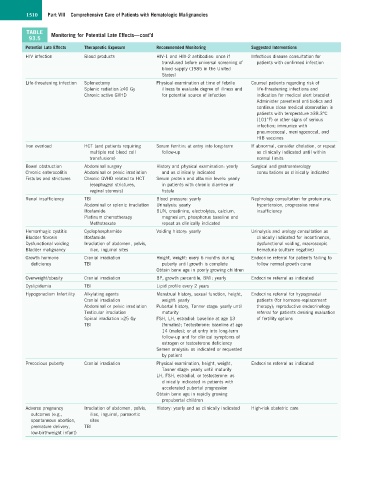
          TABLE   Monitoring for Potential Late Effects—cont’d
          93.5
         Potential Late Effects  Therapeutic Exposure  Recommended Monitoring      Suggested Interventions
         HIV infection       Blood products         HIV-1 and HIV-2 antibodies: once if   Infectious disease consultation for
                                                      transfused before universal screening of   patients with confirmed infection
                                                      blood supply (1985 in the United
                                                      States)
         Life-threatening infection  Splenectomy    Physical examination at time of febrile   Counsel patients regarding risk of
                             Splenic radiation ≥40 Gy  illness to evaluate degree of illness and   life-threatening infections and
                             Chronic active GVHD      for potential source of infection  indication for medical alert bracelet
                                                                                     Administer parenteral antibiotics and
                                                                                     continue close medical observation in
                                                                                     patients with temperature ≥38.3°C
                                                                                     (101°F) or other signs of serious
                                                                                     infection; immunize with
                                                                                     pneumococcal, meningococcal, and
                                                                                     HIB vaccines
         Iron overload       HCT (and patients requiring   Serum ferritin: at entry into long-term   If abnormal, consider chelation, or repeat
                              multiple red blood cell   follow-up                    as clinically indicated until within
                              transfusions)                                          normal limits
         Bowel obstruction   Abdominal surgery      History and physical examination: yearly   Surgical and gastroenterology
         Chronic enterocolitis  Abdominal or pelvic irradiation  and as clinically indicated  consultations as clinically indicated
         Fistulas and strictures  Chronic GVHD related to HCT   Serum protein and albumin levels: yearly
                              (esophageal strictures,   in patients with chronic diarrhea or
                              vaginal stenosis)       fistula
         Renal insufficiency  TBI                   Blood pressure: yearly         Nephrology consultation for proteinuria,
                             Abdominal or splenic irradiation  Urinalysis: yearly    hypertension, progressive renal
                             Ifosfamide             BUN, creatinine, electrolytes, calcium,   insufficiency
                             Platinum chemotherapy    magnesium, phosphorus baseline and
                              Methotrexate            repeat as clinically indicated
         Hemorrhagic cystitis  Cyclophosphamide     Voiding history: yearly        Urinalysis and urology consultation as
         Bladder fibrosis    Ifosfamide                                              clinically indicated for incontinence,
         Dysfunctional voiding  Irradiation of abdomen, pelvis,                      dysfunctional voiding, macroscopic
         Bladder malignancy   iliac, inguinal sites                                  hematuria (culture negative)
         Growth hormone      Cranial irradiation    Height, weight: every 6 months during   Endocrine referral for patients failing to
           deficiency        TBI                      puberty until growth is complete  follow normal growth curve
                                                    Obtain bone age in poorly growing children
         Overweight/obesity  Cranial irradiation    BP, growth percentile, BMI: yearly  Endocrine referral as indicated
         Dyslipidemia        TBI                    Lipid profile every 2 years
         Hypogonadism Infertility  Alkylating agents  Menstrual history, sexual function, height,   Endocrine referral for hypogonadal
                             Cranial irradiation      weight: yearly                 patients (for hormone-replacement
                             Abdominal or pelvic irradiation  Pubertal history, Tanner stage: yearly until   therapy); reproductive endocrinology
                             Testicular irradiation   maturity                       referral for patients desiring evaluation
                             Spinal irradiation >25 Gy  FSH, LH, estradiol: baseline at age 13   of fertility options
                             TBI                      (females); Testosterone: baseline at age
                                                      14 (males); or at entry into long-term
                                                      follow-up and for clinical symptoms of
                                                      estrogen or testosterone deficiency
                                                    Semen analysis: as indicated or requested
                                                      by patient
         Precocious puberty  Cranial irradiation    Physical examination, height, weight,   Endocrine referral as indicated
                                                      Tanner stage: yearly until maturity
                                                    LH, FSH, estradiol, or testosterone: as
                                                      clinically indicated in patients with
                                                      accelerated pubertal progression
                                                    Obtain bone age in rapidly growing
                                                      prepubertal children
         Adverse pregnancy   Irradiation of abdomen, pelvis,   History: yearly and as clinically indicated  High-risk obstetric care
           outcomes (e.g.,    iliac, inguinal, paraaortic
           spontaneous abortion,   sites
           premature delivery,   TBI
           low-birthweight infant)

