


Page 1689 - Hematology_ Basic Principles and Practice ( PDFDrive )
P. 1689
Chapter 93  Late Complications of Hematologic Diseases and Their Therapies  1507

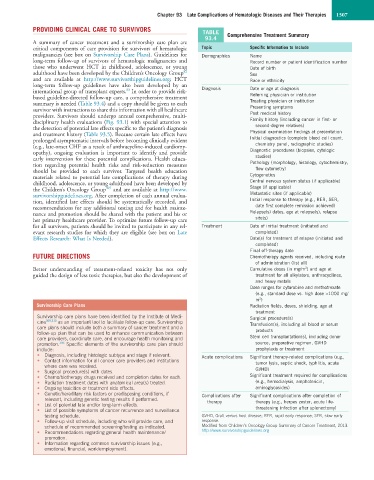
            PROVIDING CLINICAL CARE TO SURVIVORS                   TABLE
                                                                    93.4   Comprehensive Treatment Summary
            A  summary  of  cancer  treatment  and  a  survivorship  care  plan  are
            critical  components  of  care  provision  for  survivors  of  hematologic   Topic  Specific Information to Include
            malignancies (see box on Survivorship Care Plans). Guidelines for   Demographics  Name
            long-term  follow-up  of  survivors  of  hematologic  malignancies  and   Record number or patient identification number
            those  who  underwent  HCT  in  childhood,  adolescence,  or  young    Date of birth
                                                             82
            adulthood have been developed by the Children’s Oncology Group         Sex
            and  are  available  at  http://www.survivorshipguidelines.org;  HCT   Race or ethnicity
            long-term  follow-up  guidelines  have  also  been  developed  by  an
                                          83
            international group of transplant experts.  In order to provide risk-  Diagnosis  Date or age at diagnosis
            based guideline-directed follow-up care, a comprehensive treatment     Referring physician or institution
            summary is needed (Table 93.4) and a copy should be given to each      Treating physician or institution
            survivor with instructions to share this information with all healthcare   Presenting symptoms
            providers. Survivors should undergo annual comprehensive, multi-       Past medical history
            disciplinary health evaluations (Fig. 93.1) with special attention to   Family history (including cancer in first- or
            the detection of potential late effects specific to the patient’s diagnosis   second-degree relatives)
            and treatment history (Table 93.5). Because certain late effects have   Physical examination findings at presentation
            prolonged asymptomatic intervals before becoming clinically evident    Initial diagnostics (complete blood cell count,
            (e.g., late-onset CHF as a result of anthracycline-induced cardiomy-     chemistry panel, radiographic studies)
            opathy),  ongoing  evaluation  is  important  to  identify  and  provide   Diagnostic procedures (biopsies, cytologic
            early intervention for these potential complications. Health educa-      studies)
            tion  regarding  potential  health  risks  and  risk-reduction  measures   Pathology (morphology, histology, cytochemistry,
            should  be  provided  to  each  survivor.  Targeted  health  education   flow cytometry)
            materials  related  to  potential  late  complications  of  therapy  during   Cytogenetics
            childhood, adolescence, or young adulthood have been developed by      Central nervous system status (if applicable)
                                    305
            the Children’s Oncology Group  and are available at http://www.        Stage (if applicable)
            survivorshipguidelines.org. After completion of each annual evalua-    Metastatic sites (if applicable)
            tion,  identified  late  effects  should  be  systematically  recorded,  and   Initial response to therapy (e.g., RER, SER,
            recommendations for any additional testing and for health mainte-        date first complete remission achieved)
            nance and promotion should be shared with the patient and his or       Relapse(s) dates, age at relapse(s), relapse
            her primary healthcare provider. To optimize future follow-up care       site(s)
            for all survivors, patients should be invited to participate in any rel-  Treatment  Date of initial treatment (initiated and
            evant research studies for which they are eligible (see box on Late      completed)
            Effects Research: What Is Needed).                                     Date(s) for treatment of relapse (initiated and
                                                                                     completed)
                                                                                   Final off-therapy date
            FUTURE DIRECTIONS                                                      Chemotherapy agents received, including route
                                                                                     of administration (list all)
                                                                                                     2
            Better  understanding  of  treatment-related  toxicity  has  not  only   Cumulative doses (in mg/m ) and age at
            guided the design of less toxic therapies, but also the development of   treatment for all alkylators, anthracyclines,
                                                                                     and heavy metals
                                                                                   Dose ranges for cytarabine and methotrexate
                                                                                     (e.g., standard dose vs. high dose >1000 mg/
                                                                                      2
                                                                                     m )
             Survivorship Care Plans                                               Radiation fields, doses, shielding, age at
                                                                                     treatment
             Survivorship care plans have been identified by the Institute of Medi-  Surgical procedure(s)
             cine 309,310  as an important tool to facilitate follow-up care. Survivorship   Transfusion(s), including all blood or serum
             care plans should include both a summary of cancer treatment and a
             follow-up plan that can be used to enhance communication between        products
             care providers, coordinate care, and encourage health monitoring and   Stem cell transplantation(s), including donor
             promotion. 306  Specific elements of the survivorship care plan should   source, preparative regimen, GVHD
             include:                                                                prophylaxis or treatment
             •  Diagnosis, including histologic subtype and stage if relevant.  Acute complications  Significant therapy-related complications (e.g.,
             •  Contact information for all cancer care providers and institutions
                where care was received.                                             tumor lysis, septic shock, typhlitis, acute
             •  Surgical procedure(s) with dates.                                    GVHD)
             •  Chemo/biotherapy drugs received and completion dates for each.     Significant treatment required for complications
             •  Radiation treatment dates with anatomical area(s) treated.           (e.g., hemodialysis, amphotericin,
             •  Ongoing toxicities or treatment side effects.                        aminoglycosides)
             •  Genetic/hereditary risk factors or predisposing conditions, if   Complications after   Significant complications after completion of
                relevant, including genetic testing results if performed.
             •  List of potential late and/or long-term effects.     therapy         therapy (e.g., herpes zoster, acute life-
             •  List of possible symptoms of cancer recurrence and surveillance      threatening infection after splenectomy)
                testing schedule.                                  GVHD, Graft-versus-host disease; RER, rapid early response; SER, slow early
             •  Follow-up visit schedule, including who will provide care, and   response.
                schedule of recommended screening/testing as indicated.  Modified from Children’s Oncology Group Summary of Cancer Treatment, 2013.
             •  Recommendations regarding general health maintenance/  http://www.survivorshipguidelines.org
                promotion.
             •  Information regarding common survivorship issues (e.g.,
                emotional, financial, work/employment).

