


Page 1688 - Hematology_ Basic Principles and Practice ( PDFDrive )
P. 1688
1506   Part VIII  Comprehensive Care of Patients with Hematologic Malignancies


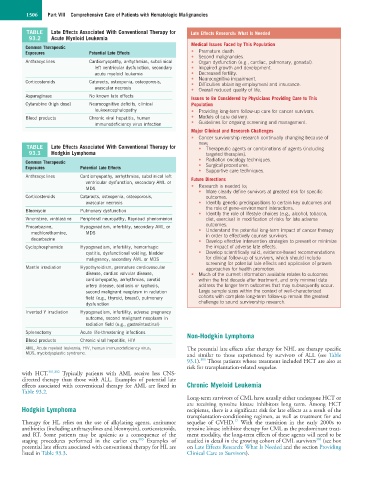
          TABLE   Late Effects Associated With Conventional Therapy for   Late Effects Research: What Is Needed
          93.2    Acute Myeloid Leukemia
                                                                Medical Issues Faced by This Population
         Common Therapeutic
         Exposures            Potential Late Effects            •  Premature death.
                                                                •  Second malignancies.
         Anthracyclines       Cardiomyopathy, arrhythmias, subclinical   •  Organ dysfunction (e.g., cardiac, pulmonary, gonadal).
                                left ventricular dysfunction, secondary   •  Impaired growth and development.
                                acute myeloid leukemia          •  Decreased fertility.
                                                                •  Neurocognitive impairment.
         Corticosteroids      Cataracts, osteopenia, osteoporosis,   •  Difficulties obtaining employment and insurance.
                                avascular necrosis              •  Overall reduced quality of life.
         Asparaginase         No known late effects             Issues to Be Considered by Physicians Providing Care to This
         Cytarabine (high dose)  Neurocognitive deficits, clinical   Population
                                leukoencephalopathy             •  Providing long-term follow-up care for cancer survivors.
         Blood products       Chronic viral hepatitis, human    •  Models of care delivery.
                                immunodeficiency virus infection  •  Guidelines for ongoing screening and management.
                                                                Major Clinical and Research Challenges
                                                                •  Cancer survivorship research continually changing because of
                                                                  new;
          TABLE   Late Effects Associated With Conventional Therapy for   •  Therapeutic agents or combinations of agents (including
          93.3    Hodgkin Lymphoma                                  targeted therapies).
                                                                  •  Radiation oncology techniques.
         Common Therapeutic
         Exposures         Potential Late Effects                 •  Surgical procedures.
                                                                  •  Supportive care techniques.
         Anthracyclines    Cardiomyopathy, arrhythmias, subclinical left   Future Directions
                             ventricular dysfunction, secondary AML or
                             MDS                                •  Research is needed to;
                                                                  •  More clearly define survivors at greatest risk for specific
         Corticosteroids   Cataracts, osteopenia, osteoporosis,     outcomes.
                             avascular necrosis                   •  Identify genetic predispositions to certain key outcomes and
                                                                    the role of gene–environment interactions.
         Bleomycin         Pulmonary dysfunction
                                                                  •  Identify the role of lifestyle choices (e.g., alcohol, tobacco,
         Vincristine, vinblastine  Peripheral neuropathy, Raynaud phenomenon  diet, exercise) in modification of risks for late adverse
         Procarbazine,     Hypogonadism, infertility, secondary AML or   outcomes.
           mechlorethamine,   MDS                                 •  Understand the potential long-term impact of cancer therapy
                                                                    in order to effectively counsel survivors.
           dacarbazine
                                                                  •  Develop effective intervention strategies to prevent or minimize
         Cyclophosphamide  Hypogonadism, infertility, hemorrhagic   the impact of adverse late effects.
                             cystitis, dysfunctional voiding, bladder   •  Develop scientifically valid, evidence-based recommendations
                             malignancy, secondary AML or MDS       for clinical follow-up of survivors, which should include
                                                                    screening for potential late effects and application of proven
         Mantle irradiation  Hypothyroidism, premature cardiovascular   approaches for health promotion.
                             disease, cardiac valvular disease,   •  Much of the current information available relates to outcomes
                             cardiomyopathy, arrhythmias, carotid   within the first decade after treatment, and only minimal data
                             artery disease, scoliosis or kyphosis,   address the longer term outcomes that may subsequently occur.
                             second malignant neoplasm in radiation   Large sample sizes within the context of well-characterized
                             field (e.g., thyroid, breast), pulmonary   cohorts with complete long-term follow-up remain the greatest
                             dysfunction                          challenge to sound survivorship research.
         Inverted Y irradiation  Hypogonadism, infertility, adverse pregnancy
                             outcome, second malignant neoplasm in
                             radiation field (e.g., gastrointestinal)
         Splenectomy       Acute life-threatening infections  Non-Hodgkin Lymphoma
         Blood products    Chronic viral hepatitis, HIV
         AML, Acute myeloid leukemia; HIV, human immunodeficiency virus;    The potential late effects after therapy for NHL are therapy specific
         MDS, myelodysplastic syndrome.                       and  similar  to  those  experienced  by  survivors  of  ALL  (see  Table
                                                                   303
                                                              93.1).  Those patients whose treatment included HCT are also at
                                                              risk for transplantation-related sequelae.
        with  HCT. 301,302   Typically  patients  with  AML  receive  less  CNS-
        directed  therapy  than  those  with  ALL.  Examples  of  potential  late
        effects associated with conventional therapy for AML are listed in     Chronic Myeloid Leukemia
        Table 93.2.
                                                              Long-term survivors of CML have usually either undergone HCT or
                                                              are  receiving  tyrosine  kinase  inhibitors  long  term.  Among  HCT
        Hodgkin Lymphoma                                      recipients, there is a significant risk for late effects as a result of the
                                                              transplantation-conditioning regimen, as well as treatment for and
                                                                              17
        Therapy  for  HL  relies  on  the  use  of  alkylating  agents,  antitumor   sequelae  of  GVHD.   With  the  transition  in  the  early  2000s  to
        antibiotics (including anthracyclines and bleomycin), corticosteroids,   tyrosine kinase inhibitor therapy for CML as the predominant treat-
        and  RT.  Some  patients  may  be  apslenic  as  a  consequence  of  the   ment modality, the long-term effects of these agents will need to be
                                                                                                        304
                                              303
        staging  procedures  performed  in  the  earlier  era.   Examples  of   studied in detail in the growing cohort of CML survivors  (see box
        potential late effects associated with conventional therapy for HL are   on Late Effects Research: What Is Needed and the section Providing
        listed in Table 93.3.                                 Clinical Care to Survivors).

