


Page 1693 - Hematology_ Basic Principles and Practice ( PDFDrive )
P. 1693
Chapter 93  Late Complications of Hematologic Diseases and Their Therapies  1511


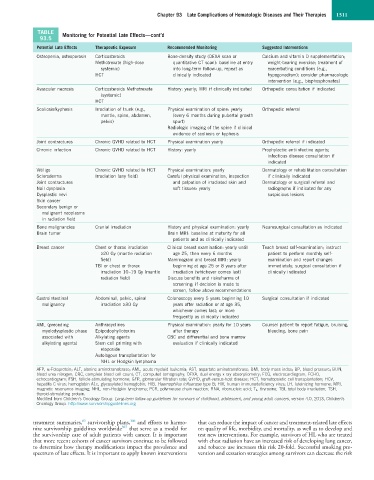
             TABLE   Monitoring for Potential Late Effects—cont’d
              93.5
             Potential Late Effects  Therapeutic Exposure  Recommended Monitoring      Suggested Interventions
             Osteopenia, osteoporosis  Corticosteroids  Bone-density study (DEXA scan or   Calcium and vitamin D supplementation;
                                Methotrexate (high-dose   quantitative CT scan): baseline at entry   weight-bearing exercise; treatment of
                                  systemic)               into long-term follow-up, repeat as   exacerbating conditions (e.g.,
                                HCT                       clinically indicated           hypogonadism); consider pharmacologic
                                                                                         intervention (e.g., bisphosphonates)
             Avascular necrosis  Corticosteroids Methotrexate   History: yearly; MRI if clinically indicated  Orthopedic consultation if indicated
                                  (systemic)
                                HCT
             Scoliosis/kyphosis  Irradiation of trunk (e.g.,   Physical examination of spine: yearly   Orthopedic referral
                                  mantle, spine, abdomen,   (every 6 months during pubertal growth
                                  pelvis)                 spurt)
                                                        Radiologic imaging of the spine if clinical
                                                          evidence of scoliosis or kyphosis
             Joint contractures  Chronic GVHD related to HCT  Physical examination yearly  Orthopedic referral if indicated
             Chronic infection  Chronic GVHD related to HCT  History: yearly           Prophylactic antiinfective agents;
                                                                                         infectious disease consultation if
                                                                                         indicated
             Vitiligo           Chronic GVHD related to HCT  Physical examination: yearly  Dermatology or rehabilitation consultation
             Scleroderma        Irradiation (any field)  Careful physical examination, inspection   if clinically indicated
             Joint contractures                           and palpation of irradiated skin and   Dermatology or surgical referral and
             Nail dysplasia                               soft tissues: yearly           radiographs if indicated for any
             Dysplastic nevi                                                             suspicious lesions
             Skin cancer
             Secondary benign or
               malignant neoplasms
               in radiation field
             Bone malignancies  Cranial irradiation     History and physical examination: yearly  Neurosurgical consultation as indicated
             Brain tumor                                Brain MRI: baseline at maturity for all
                                                          patients and as clinically indicated
             Breast cancer      Chest or thorax irradiation   Clinical breast examination: yearly until   Teach breast self-examination; instruct
                                  ≥20 Gy (mantle radiation   age 25, then every 6 months  patient to perform monthly self-
                                  field)                Mammogram and breast MRI: yearly   examination and report changes
                                TBI or chest or thorax    beginning at age 25 or 8 years after   immediately; surgical consultation if
                                  irradiation 10–19 Gy (mantle   irradiation (whichever comes last)  clinically indicated
                                  radiation field)      Discuss benefits and risks/harms of
                                                          screening; if decision is made to
                                                          screen, follow above recommendations
             Gastrointestinal   Abdominal, pelvic, spinal   Colonoscopy every 5 years beginning 10   Surgical consultation if indicated
               malignancy         irradiation ≥30 Gy      years after radiation or at age 35,
                                                          whichever comes last; or more
                                                          frequently as clinically indicated
             AML (preceding     Anthracyclines          Physical examination: yearly for 10 years   Counsel patient to report fatigue, bruising,
               myelodysplastic phase   Epipodophyllotoxins  after therapy                bleeding, bone pain
               associated with   Alkylating agents      CBC and differential and bone marrow
               alkylating agents)  Stem cell priming with   evaluation if clinically indicated
                                  etoposide
                                Autologous transplantation for
                                  NHL or Hodgkin lymphoma
             AFP, α-Fetoprotein; ALT, alanine aminotransferase; AML, acute myeloid leukemia; AST, aspartate aminotransferase; BMI, body mass index; BP, blood pressure; BUN,
             blood urea nitrogen; CBC, complete blood cell count; CT, computed tomography; DEXA, dual-energy x-ray absorptiometry; ECG, electrocardiogram; ECHO,
             echocardiogram; FSH, follicle-stimulating hormone; GFR, glomerular filtration rate; GVHD, graft-versus-host disease; HCT, hematopoietic cell transplantation; HCV,
             hepatitis C virus; hemoglobin A1c, glycosylated hemoglobin; HIB, Haemophilus influenzae type B; HIV, human immunodeficiency virus; LH, luteinizing hormone; MRI,
             magnetic resonance imaging; NHL, non-Hodgkin lymphoma; PCR, polymerase chain reaction; RNA, ribonucleic acid; T 4, thyroxine; TBI, total body irradiation; TSH,
             thyroid-stimulating protein.
             Modified from Children’s Oncology Group: Long-term follow-up guidelines for survivors of childhood, adolescent, and young adult cancers, version 4.0, 2013, Children’s
             Oncology Group. http://www.survivorshipguidelines.org

                            82
                                            306
            treatment summaries,  survivorship plans,  and efforts to harmo-  that can reduce the impact of cancer and treatment-related late effects
                                         307
            nize survivorship guidelines worldwide  that serve as a model for   on quality of life, morbidity, and mortality, as well as to develop and
            the survivorship care of adult patients with cancer. It is important   test new interventions. For example, survivors of HL who are treated
            that more recent cohorts of cancer survivors continue to be followed   with chest radiation have an increased risk of developing lung cancer,
            to determine how therapy modifications impact the prevalence and   and tobacco use increases this risk 20-fold. Successful smoking pre-
            spectrum of late effects. It is important to apply known interventions   vention and cessation strategies among survivors can decrease the risk

