


Page 171 - Hematology_ Basic Principles and Practice ( PDFDrive )
P. 171
Chapter 12  Cell Adhesion  129


            The application of tension to integrins can increase ligand binding,   protein  leukocyte  function-associated  antigen-3  (LFA-3)  and  B7-1
            and  a  reduction  in  tension  lessens  integrin  adhesiveness.  Cell–cell   (CD80) and B7-2 (CD86), respectively, on antigen-presenting cells.
            interactions result from integrin recognition of cell-surface members   The  immunoglobulin-like  receptor,  platelet  and  endothelial  cell
            of the immunoglobulin superfamily. Binding of fibrinogen to αIIbβ3   adhesion molecule-1 (PECAM-1; CD31) uses homotypical interac-
            integrins on adjacent platelets creates a molecular bridge that promotes   tions  to  promote  contacts  between  adjacent  endothelial  cells  and
            platelet aggregation. Furthermore, fibrinogen simultaneously binds to   to  mediate  adhesion  of  leukocytes  to  platelets  and  endothelium.
            the  αMβ2  integrin  on  leukocytes  and  to  an  immunoglobulin-like   The  immunoglobulin-like  junctional  adhesion  molecules  (JAMs),
            receptor on endothelial cells, promoting leukocyte adhesion to the   expressed on endothelial and epithelial cells and leukocytes, regulate
            endothelium.                                          endothelial  and  epithelial  cell  junctions,  paracellular  permeability,
                                                                  and  leukocyte  trafficking  between  endothelial  and  epithelial  cells
                                                                  by  homotypical  interactions  or  by  heterotypical  interactions  with
            IMMUNOGLOBULIN-LIKE RECEPTORS                         integrins. JAM-A, the founding member of this family, functions as a
                                                                  homodimer and transmits intracellular signals critical for its function
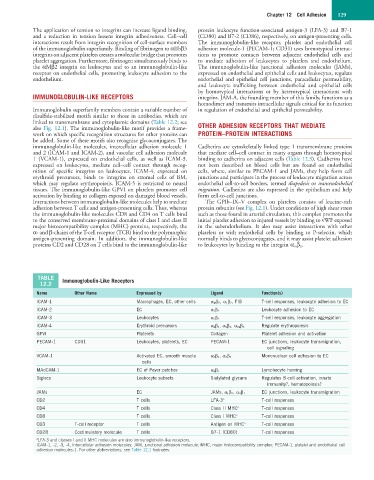
            Immunoglobulin superfamily members contain a variable number of   in regulation of endothelial and epithelial permeability.
            disulfide-stabilized motifs similar to those in antibodies, which are
            linked to transmembrane and cytoplasmic domains (Table 12.2; see
            also  Fig.  12.1). The  immunoglobulin-like  motif  provides  a  frame-  OTHER ADHESION RECEPTORS THAT MEDIATE
            work on which specific recognition structures for other proteins can   PROTEIN–PROTEIN INTERACTIONS
            be added. Some of these motifs also recognize glycoconjugates. The
            immunoglobulin-like  molecules,  intercellular  adhesion  molecule  1   Cadherins are cytoskeletally linked type 1 transmembrane proteins
            and 2 (ICAM-1 and ICAM-2), and vascular cell adhesion molecule   that mediate cell–cell contact in many organs through homotypical
            1  (VCAM-1),  expressed  on  endothelial  cells,  as  well  as  ICAM-3,   binding to cadherins on adjacent cells (Table 12.3). Cadherins have
            expressed  on  leukocytes,  mediate  cell–cell  contact  through  recog-  not  been  described  on  blood  cells  but  are  found  on  endothelial
            nition  of  specific  integrins  on  leukocytes.  ICAM-4,  expressed  on   cells,  where,  similar  to  PECAM-1  and  JAMs,  they  help  form  cell
            erythroid  precursors,  binds  to  integrins  on  stromal  cells  of  BM,   junctions and participate in the process of leukocyte migration across
            which may regulate erythropoiesis. ICAM-5 is restricted to neural   endothelial cell-to-cell borders, termed diapedesis or transendothelial
            tissues. The immunoglobulin-like GPVI on platelets promotes cell   migration. Cadherins are also expressed in the epithelium and help
            activation by binding to collagen exposed on damaged blood vessels.   form cell-to-cell junctions.
            Interactions between immunoglobulin-like molecules help to mediate   The  GPIb–IX–V  complex  on  platelets  consists  of  leucine-rich
            adhesion between T cells and antigen-presenting cells. Thus, whereas   protein subunits (see Fig. 12.1). Under conditions of high shear stress
            the immunoglobulin-like molecules CD8 and CD4 on T cells bind   such as those found in arterial circulation, this complex promotes the
            to the conserved membrane-proximal domains of class I and class II   initial platelet adhesion to injured vessels by binding to vWF exposed
            major histocompatibility complex (MHC) proteins, respectively, the   in  the  subendothelium.  It  also  may  assist  interactions  with  other
            α- and β-chains of the T-cell receptor (TCR) bind to the polymorphic   platelets  or  with  endothelial  cells  by  binding  to  P-selectin,  which
            antigen-presenting  domain.  In  addition,  the  immunoglobulin-like   normally binds to glycoconjugates, and it may assist platelet adhesion
            proteins CD2 and CD28 on T cells bind to the immunoglobulin-like   to leukocytes by binding to the integrin α m β 2 .


             TABLE   Immunoglobulin-Like Receptors
              12.2
             Name        Other Name           Expressed by            Ligand           Function(s)
             ICAM-1                           Macrophages, EC, other cells  α M β 2 , α L β 2 , FIB  T-cell responses, leukocyte adhesion to EC
             ICAM-2                           EC                      α L β 2          Leukocyte adhesion to EC
             ICAM-3                           Leukocytes              α L β 2          T-cell responses, leukocyte aggregation
             ICAM-4                           Erythroid precursors    α 4 β 1 , α V β 3 , α llb β 3  Regulate erythropoiesis
             GPVI                             Platelets               Collagen         Platelet adhesion and activation
             PECAM-1     CD31                 Leukocytes, platelets, EC  PECAM-1       EC junctions, leukocyte transmigration,
                                                                                        cell signaling
             VCAM-1                           Activated EC, smooth muscle   α 4 β 1 , α 4 β 7  Mononuclear cell adhesion to EC
                                               cells
             MAdCAM-1                         EC of Peyer patches     α 4 β 7          Lymphocyte homing
             Siglecs                          Leukocyte subsets       Sialylated glycans  Regulates B-cell activation, innate
                                                                                        immunity?, hematopoiesis?
             JAMs                             EC                      JAMs, α L β 2 , α 4 β 1  EC junctions, leukocyte transmigration
             CD2                              T cells                 LFA-3 a          T-cell responses
             CD4                              T cells                 Class II MHC a   T-cell responses
             CD8                              T cells                 Class I MHC a    T-cell responses
             CD3         T-cell receptor      T cells                 Antigen on MHC a  T-cell responses
             CD28        Costimulatory molecule  T cells              B7-1 (CD80)      T-cell responses
             a LFA-3 and classes I and II MHC molecules are also immunoglobulin-like receptors.
             ICAM-1, -2, -3, -4, Intercellular adhesion molecules; JAM, junctional adhesion molecule; MHC, major histocompatibility complex; PECAM-1, platelet and endothelial cell
             adhesion molecules-1. For other abbreviations, see Table 12.1 footnotes.

