


Page 175 - Hematology_ Basic Principles and Practice ( PDFDrive )
P. 175
Chapter 12  Cell Adhesion  133


            unstimulated platelets to home to the site of vascular injury and then
            be activated by locally generated mediators.
                                                                                 CD28         B7-1/B7-2
            Neutrophil Rolling, Spreading, and Migration

            Near sites of extravascular bacterial infections, neutrophils first tether to   LFA-1  ICAM 1,2,3
            and roll on the endothelial surface of venules through the interactions
            of selectins with cell-surface carbohydrate ligands (Fig. 12.3). Little, if   CD-2          Antigen-
            any, leukocyte adhesion occurs in nearby arterioles. Neutrophil rolling   T cell   LFA-3   presenting
            on the endothelium occurs under shear forces, just as platelets adhere                        cell
            to subendothelial matrix under shear forces, although the shear flow in   TCR/CD3
            postcapillary venules is lower than that in arterioles. Rolling requires a
            balance between the formation of selectin–ligand bonds at the leading             MHC
            edge of the cell and the dissociation of bonds at the trailing edge of the   CD4/CD8
            cell. Whereas shear forces affect the lifetimes of selectin–ligand bonds,
            lower forces prolong lifetimes (catch bonds) and higher forces shorten
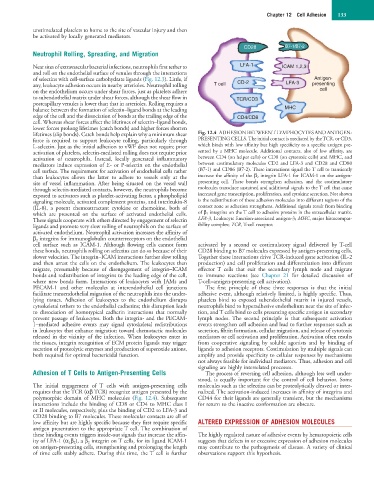
            lifetimes (slip bonds). Catch bonds help explain why a minimum shear   Fig. 12.4  ADHESION BETWEEN T LYMPHOCYTES AND ANTIGEN-
            force  is  required  to  support  leukocyte  rolling,  particularly  through   PRESENTING CELLS. The initial contact is mediated by the TCR, or CD3,
            L-selectin. Just as the initial adhesion to vWF does not require prior   which binds with low affinity but high specificity to a specific antigen pre-
            activation of platelets, selectin-mediated rolling does not require prior   sented  by  a  MHC  molecule.  Additional  contacts,  also  of  low  affinity,  are
            activation  of  neutrophils.  Instead,  locally  generated  inflammatory   between CD4 (on helper cells) or CD8 (on cytotoxic cells) and MHC, and
            mediators  induce  expression  of  E-  or  P-selectin  on  the  endothelial   between  costimulatory  molecules  CD2  and  LFA-3  and  CD28  and  CD80
            cell surface. The requirement for activation of endothelial cells rather   (B7-1) and CD86 (B7-2). These interactions signal the T cell to transiently
            than  leukocytes  allows  the  latter  to  adhere  to  vessels  only  at  the   increase the affinity of the β 2 integrin LFA-1 for ICAM-1 on the antigen-
            site  of  vessel  inflammation.  After  being  situated  on  the  vessel  wall   presenting  cell.  These  bonds  strengthen  adhesion,  and  the  costimulatory
            through selectin-mediated contacts, however, the neutrophils become   molecules transduce sustained and additional signals to the T cell that cause
            exposed to activators such as platelet-activating factor, a phospholipid   increased gene transcription, proliferation, and cytokine secretion. Not shown
            signaling molecule, activated complement proteins, and interleukin-8   is the redistribution of these adhesion molecules into different regions of the
            (IL-8),  a  potent  chemoattractant  cytokine  or  chemokine,  both  of   contact zone as adhesion strengthens. Additional signals result from binding
            which  are  presented  on  the  surface  of  activated  endothelial  cells.   of β 1 integrins on the T cell to adhesive proteins in the extracellular matrix.
            These signals cooperate with others directed by engagement of selectin   LFA-3, Leukocyte function-associated antigen-3; MHC, major histocompat-
            ligands and promote very slow rolling of neutrophils on the surface of   ibility complex; TCR, T-cell receptor.
            activated endothelium. Neutrophil activation increases the affinity of
            β 2  integrins for immunoglobulin counterreceptors on the endothelial
            cell  surface  such  as  ICAM-1.  Although  flowing  cells  cannot  form   activated  by  a  second  or  costimulatory  signal  delivered  by  T-cell
            these bonds, neutrophils rolling on selectins can do so because of their   CD28 binding to B7 molecules expressed by antigen-presenting cells.
            slower velocities. The integrin–ICAM interactions further slow rolling   Together these interactions drive TCR-induced gene activation (IL-2
            and  then  arrest  the  cells  on  the  endothelium. The  leukocytes  then   production) and cell proliferation and differentiation into different
            migrate,  presumably  because  of  disengagement  of  integrin–ICAM   effector  T  cells  that  exit  the  secondary  lymph  node  and  migrate
            bonds and redistribution of integrins to the leading edge of the cell,   to  immune  reactions  (see  Chapter  21  for  detailed  discussion  of
            where  new  bonds  form.  Interactions  of  leukocytes  with  JAMs  and   T-cell–antigen-presenting cell activation).
            PECAM-1  and  other  molecules  at  interendothelial  cell  junctions   The  first  principle  of  these  three  responses  is  that  the  initial
            facilitate transendothelial migration of the neutrophils into the under-  adhesive event, although relatively limited, is highly specific. Thus,
            lying  tissues.  Adhesion  of  leukocytes  to  the  endothelium  disrupts   platelets  bind  to  exposed  subendothelial  matrix  in  injured  vessels,
            cytoskeletal tethers to the endothelial cadherins; this disruption leads   neutrophils bind to hyperadhesive endothelium near the site of infec-
            to  dissociation  of  homotypical  cadherin  interactions  that  normally   tion, and T cells bind to cells presenting specific antigen in secondary
            prevent passage of leukocytes. Both the integrin- and the PECAM-   lymph  nodes.  The  second  principle  is  that  subsequent  activation
            1–mediated  adhesive  events  may  signal  cytoskeletal  redistributions   events strengthen cell adhesion and lead to further responses such as
            in leukocytes that enhance migration toward chemotactic molecules   secretion, fibrin formation, cellular migration, and release of cytotoxic
            released  in  the  vicinity  of  the  infection. When  leukocytes  enter  in   mediators or cell activation and proliferation. Activation often results
            the tissues, integrin recognition of ECM protein ligands may trigger   from  cooperative  signaling  by  soluble  agonists  and  by  binding  of
            secretion of proteolytic enzymes and production of superoxide anions,   ligands to adhesion receptors. Costimulation by multiple signals can
            both required for optimal bactericidal function.      amplify and provide specificity to cellular responses by mechanisms
                                                                  not always feasible for individual mediators. Thus, adhesion and cell
                                                                  signaling are highly interrelated processes.
            Adhesion of T Cells to Antigen-Presenting Cells         The process of reversing cell adhesion, although less well under-
                                                                  stood,  is  equally  important  for  the  control  of  cell  behavior.  Some
            The  initial  engagement  of  T  cells  with  antigen-presenting  cells   molecules such as the selectins can be proteolytically cleaved or inter-
            requires that the TCR (αβ TCR) recognize antigen presented by the   nalized. The activation-induced increases in affinity of integrins and
            polymorphic  domain  of  MHC  molecules  (Fig.  12.4).  Subsequent   CD44 for their ligands are generally transient, but the mechanisms
            interactions include the binding of CD8 or CD4 to MHC class I   for return to the inactive conformation are obscure.
            or II molecules, respectively, plus the binding of CD2 to LFA-3 and
            CD28 binding to B7 molecules. These molecular contacts are all of
            low affinity but are highly specific because they first require specific   ALTERED EXPRESSION OF ADHESION MOLECULES
            antigen presentation to the appropriate T cell. The combination of
            these binding events triggers inside-out signals that increase the affin-  The highly regulated nature of adhesive events by hematopoietic cells
            ity of LFA-1 (α Lβ 2), a β 2 integrin on T cells, for its ligand ICAM-1   suggests that defects in or excessive expression of adhesion molecules
            on antigen-presenting cells, strengthening and prolonging the length   may contribute to the pathogenesis of disease. A variety of clinical
            of time cells stably adhere. During this time, the T cell is further   observations support this hypothesis.

