


Page 172 - Hematology_ Basic Principles and Practice ( PDFDrive )
P. 172
130    Part II  Cellular Basis of Hematology


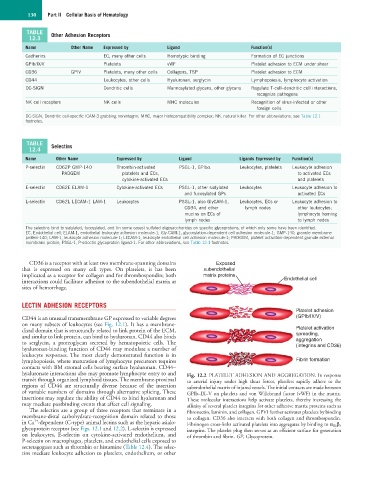
          TABLE   Other Adhesion Receptors
          12.3
         Name           Other Name  Expressed by        Ligand                     Function(s)
         Cadherins                 EC, many other cells  Homotypic binding         Formation of EC junctions
         GPlb/IX/V                 Platelets            vWF                        Platelet adhesion to ECM under shear
         CD36           GPIV       Platelets, many other cells  Collagens, TSP     Platelet adhesion to ECM
         CD44                      Leukocytes, other cells  Hyaluronan, serglycin  Lymphopoiesis, lymphocyte activation
         DC-SIGN                   Dendritic cells      Mannosylated glycans, other glycans  Regulate T-cell–dendritic cell interactions,
                                                                                     recognize pathogens
         NK cell receptors         NK cells             MHC molecules              Recognition of virus-infected or other
                                                                                     foreign cells
         DC-SIGN, Dendritic cell-specific ICAM-3 grabbing nonintegrin; MHC, major histocompatibility complex; NK, natural killer. For other abbreviations, see Table 12.1
         footnotes.


          TABLE   Selectins
          12.4
         Name      Other Name          Expressed by         Ligand             Ligands Expressed by  Function(s)
         P-selectin  CD62P GMP-140     Thrombin-activated   PSGL-1, GPlbα      Leukocytes, platelets  Leukocyte adhesion
                     PADGEM              platelets and ECs,                                       to activated ECs
                                         cytokine-activated ECs                                   and platelets
         E-selectin  CD62E ELAM-1      Cytokine-activated ECs  PSGL-1, other sialylated   Leukocytes  Leukocyte adhesion to
                                                             and fucosylated GPs                  activated ECs
         L-selectin  CD62L LECAM-1 LAM-1  Leukocytes        PSGL-1, also GlyCAM-1,   Leukocytes, ECs or   Leukocyte adhesion to
                                                             CD34, and other     lymph nodes      other leukocytes;
                                                             mucins on ECs of                     lymphocyte homing
                                                             lymph nodes                          to lymph nodes
         The selectins bind to sialylated, fucosylated, and (in some cases) sulfated oligosaccharides on specific glycoproteins, of which only some have been identified.
         EC, Endothelial cell; ELAM-1, endothelial leukocyte adhesion molecule-1; Gly-CAM-1, glycosylation-dependent cell adhesion molecule-1; GMP-140, granule membrane
         protein-140; LAM-1, leukocyte adhesion molecule-1; LECAM-1, leukocyte endothelial cell adhesion molecule-1; PADGEM, platelet activation-dependent granule external
         membrane protein; PSGL-1, P-selectin glycoprotein ligand-1. For other abbreviations, see Table 12.1 footnotes.


           CD36 is a receptor with at least two membrane-spanning domains   Exposed
        that  is  expressed  on  many  cell  types.  On  platelets,  it  has  been   subendothelial
        implicated as a receptor for collagen and for thrombospondin; both   matrix proteins
        interactions could facilitate adhesion to the subendothelial matrix at                Endothelial cell
        sites of hemorrhage.

        LECTIN ADHESION RECEPTORS
                                                                                                  Platelet adhesion
        CD44 is an unusual transmembrane GP expressed to variable degrees                         (GPIb/IX/V)
        on many subsets of leukocytes (see Fig. 12.1). It has a membrane-
        distal domain that is structurally related to link protein of the ECM,                    Platelet activation
        and similar to link protein, can bind to hyaluronan. CD44 also binds                      spreading,
                                                                                                  aggregation
        to  serglycin,  a  proteoglycan  secreted  by  hematopoietic  cells.  The                 (integrins and CD36)
        hyaluronan-binding function of CD44 may modulate a number of
        leukocyte responses. The most clearly demonstrated function is in
        lymphopoiesis, where maturation of lymphocyte precursors requires                         Fibrin formation
        contacts with BM stromal cells bearing surface hyaluronan. CD44–
        hyaluronate interactions also may promote lymphocyte entry to and   Fig. 12.2  PLATELET ADHESION AND AGGREGATION. In response
        transit through organized lymphoid tissues. The membrane-proximal   to  arterial  injury  under  high  shear  forces,  platelets  rapidly  adhere  to  the
        regions  of  CD44  are  structurally  diverse  because  of  the  insertion   subendothelial matrix of injured vessels. The initial contacts are made between
        of variable numbers of domains through alternative splicing. These   GPIb–IX–V on platelets and von Willebrand factor (vWF) in the matrix.
        insertions may regulate the ability of CD44 to bind hyaluronan and   These molecular interactions help activate platelets, thereby increasing the
        may mediate postbinding events that affect cell signaling.  affinity of several platelet integrins for other adhesive matrix proteins such as
           The selectins are a group of three receptors that terminate in a   fibronectin, laminin, and collagen. GPVI further activates platelets by binding
        membrane-distal carbohydrate-recognition domain related to those   to collagen. CD36 also interacts with both collagen and thrombospondin.
            2+
        in Ca -dependent (C-type) animal lectins such as the hepatic asialo-  Fibrinogen cross-links activated platelets into aggregates by binding to α IIb β 3
        glycoprotein receptor (see Figs. 12.1 and 12.2). L-selectin is expressed   integrins. The platelet plug then serves as an efficient surface for generation
        on  leukocytes,  E-selectin  on  cytokine-activated  endothelium,  and   of thrombin and fibrin. GP, Glycoprotein.
        P-selectin on macrophages, platelets, and endothelial cells exposed to
        secretagogues such as thrombin or histamine (Table 12.4). The selec-
        tins mediate leukocyte adhesion to platelets, endothelium, or other

