


Page 174 - Hematology_ Basic Principles and Practice ( PDFDrive )
P. 174
132    Part II  Cellular Basis of Hematology


        P-selectin contains signals that direct sorting into secretory granules,   Tyrosine kinases have been localized at the interaction zones between
        internalization  through  coated  pits  of  the  plasma  membrane,  and   integrins, the cytoskeleton and several adaptor and effector molecules,
        movement from endosomes to lysosomes; the latter two signals are   and tyrosine phosphorylation of a number of proteins accompanies
        probably also present in the cytoplasmic domain of E-selectin. The   integrin-mediated cell signaling. Tyrosine phosphorylation initiates
        net  result  of  these  events  is  to  control  the  duration  of  exposure   a  cascade  of  signaling  events,  including  the  activation  of  serine/
        of E- and P-selectin on the endothelium, where they can mediate   threonine kinases, which cause a variety of cellular responses. Ligand
        adhesion of leukocytes. Activation of leukocytes also mobilizes a pool   binding to integrins also results in generation of lipid second mes-
                                                                                                        2+
        of β 2 integrins from storage compartments to the plasma membrane,   sengers, alkalization of the cytoplasm, and influxes of Ca .
        although some of these molecules are also constitutively expressed on
        the cell surface. Finally, platelet activation redistributes a portion of
        the GPIb–IX–V complexes from ligand-accessible positions on the   COOPERATIVE INTERACTIONS BETWEEN SIGNALING
        plasma  membrane  to  sequestered,  invaginated  membrane  domains   AND ADHESION MOLECULES
        known as the surface-connected canalicular system. This process, which
        requires interactions of the cytoplasmic domain of GPIb–IX–V with   Signaling and adhesion molecules frequently function cooperatively
        the cytoskeleton, may serve to downregulate GPIb-mediated adhe-  in  sequential  cascades  to  enhance  the  specificity  of  cell  adhesion.
        sion of platelets to immobilized vWF.                 Three examples of how these cooperative interactions facilitate blood
                                                              cell responses are described next.
        REGULATION OF BINDING AFFINITY
                                                              Platelet Adhesion and Aggregation
        Regulation of binding affinity is an important control mechanism for
        other adhesion receptors. Many integrins are constitutively present on   At  sites  of  blood  vessel  injury  in  the  arterial  circuit,  platelets
        the cell surface but interact poorly with their ligands. Cell activation   rapidly  tether  to  and  then  translocate  or  roll  along  the  damaged
        by a number of agonists induces conformational changes in integrins   vessel through reversible interactions of GPIb–IX–V receptors with
        so  that  they  effectively  recognize  their  ligands.  An  example  is  the   immobilized vWF exposed in the subendothelial matrix of injured
        α IIb β 3  integrin, which requires platelet stimulation to bind fibrinogen;   vessels (Fig. 12.3). These interactions are facilitated by arterial flow,
        if this binding affinity were not regulated, circulating platelets would   perhaps because of complex effects of high wall shear stresses on the
        indiscriminately aggregate in the fibrinogen-rich plasma milieu. The   lifetimes  of  bonds  between  GPIb  and  vWF.  An  important  feature
        cytoplasmic domains of integrins can exert both positive and negative   of this initial reversible adhesive event is that prior activation of the
        influences on binding affinity. Binding of specific cytoplasmic proteins   platelets is not required. After adhesion, however, the interaction of
        to these domains may propagate structural changes to the extracellular   immobilized vWF with GPIb receptors triggers intracellular signals
        ligand-binding regions of the integrins. Three-dimensional structures   that  lead  to  platelet  activation. These  signals  synergize  with  those
        of  integrins  suggest  that  the  integrin  “headpiece”  that  contains  the   produced  by  engagement  of  the  collagen  receptor  GPVI.  Platelet
        ligand-binding site faces down toward the membrane in the inactive   activation,  in  turn,  increases  the  affinity  of  platelet  integrins  for
        conformation  and  rapidly  extends  upward  in  a  “switchblade”-like   collagen and fibronectin, which stabilizes adhesion. Binding of these
        opening  motion  on  activation.  Low-affinity  ligand  binding  may   ligands transduces signals that propagate further activation responses
        stabilize  some  active  conformations  of  integrins,  perhaps  explaining   such as spreading, secretion of granule contents, and recruitment of
        why integrins on unactivated cells will sometimes bind to immobilized,   additional platelets through cell–cell contact mediated by binding of
        multivalent adhesive proteins but not to the same proteins in solu-  fibrinogen to activated α IIb β 3  integrins. This adhesion cascade allows
        tion.  Cellular  activation  may  also  regulate  the  binding  avidities  of
        CD44, L-selectin, P-selectin, and some integrins through changes in
        membrane distribution engineered by interactions of their cytoplasmic
        domains with the cytoskeleton or with clathrin-coated pits.  Endothelial cells

        CELL SIGNALLING THROUGH ADHESION MOLECULES                          Blood flow    Tight

                                                              Neutrophil   Rolling       adhesion      Emigration
        In addition to their roles in cell–cell and cell–matrix contacts, adhe-
        sion  molecules  may  cause  cell  signaling  through  indirect  or  direct
        mechanisms. Proteoglycans in the ECM can sequester growth factors
        that  can  be  released  to  bind  to  surface  receptors  on  nearby  cells.
        Some chemoattractants bind to proteoglycans on the surface of endo-
        thelial  cells,  where  they  can  activate  adherent  leukocytes.  Binding
        of  adhesive  ligands  to  cell-surface  integrins,  GPIb–IX–V,  CD44,   Selectins  Integrins  Integrins and
        cadherins,  CD36,  PECAM-1,  selectins,  ICAM-1  and  VCAM-1,                                 PECAM-1
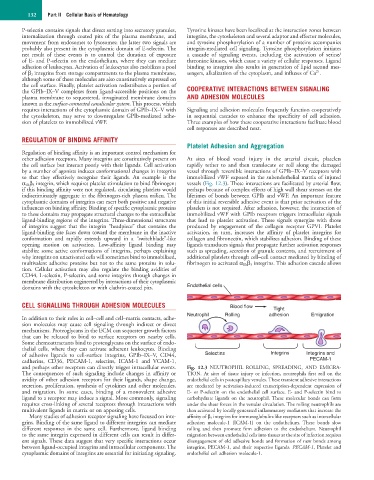
        and perhaps other receptors can directly trigger intracellular events.   Fig.  12.3  NEUTROPHIL  ROLLING,  SPREADING,  AND  EMIGRA-
        The  consequences  of  such  signaling  include  changes  in  affinity  or   TION.  At  sites  of  tissue  injury  or  infection,  neutrophils  first  roll  on  the
        avidity of other adhesion receptors for their ligands, shape change,   endothelial cells in postcapillary venules. These transient adhesive interactions
        secretion, proliferation, synthesis of cytokines and other molecules,   are  mediated  by  activation-induced  transcription-dependent  expression  of
        and  migration.  In  some  cases,  binding  of  a  monovalent  adhesive   E-  or  P-selectin  on  the  endothelial  cell  surface.  E-  and  P-selectin  bind  to
        ligand to a receptor may induce a signal. More commonly, signaling   carbohydrate  ligands  on  the  neutrophil. These  molecular  bonds  can  form
        requires cross-linking of several receptors through interactions with   under the shear forces in the venular circulation. The rolling neutrophils are
        multivalent ligands in matrix or on apposing cells.   then activated by locally generated inflammatory mediators that increase the
           Many studies of adhesion receptor signaling have focused on inte-  affinity of β 2  integrins for immunoglobulin-like receptors such as intercellular
        grins. Binding of the same ligand to different integrins can mediate   adhesion  molecule-1  (ICAM-1)  on  the  endothelium.  These  bonds  slow
        different  responses  in  the  same  cell.  Furthermore,  ligand  binding   rolling  and  then  promote  firm  adhesion  to  the  endothelium.  Neutrophil
        to the same integrin expressed in different cells can result in differ-  migration between endothelial cells into tissues at the site of infection requires
        ent signals. These data suggest that very specific interactions occur   disengagement of old adhesive bonds and formation of new bonds among
        between ligand-occupied integrins and intracellular components. The   integrins, PECAM-1, and their respective ligands. PECAM-1, Platelet and
        cytoplasmic domains of integrins are essential for initiating signaling.   endothelial cell adhesion molecule-1.

