


Page 1838 - Hematology_ Basic Principles and Practice ( PDFDrive )
P. 1838
1634   Part X  Transplantation


                                  80
                                  70                                         No graft (n = 26)
                                                                             CB (n = 90)
                                  60                                         URD (n = 296)

                                  50
                                 Patients, n  40


                                  30

                                  20

                                  10

                                   0
                                 NW European  Southern European European mix  Asian  African White Hispanic Middle Eastern
                                                                             Non-European mix
                                     Eastern European


                                                       Patient Ancestry
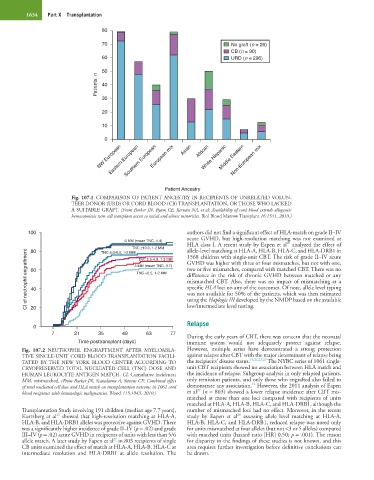
                        Fig. 107.1  COMPARISON OF PATIENT ANCESTRY IN RECIPIENTS OF UNRELATED VOLUN-
                        TEER DONOR (URD) OR CORD BLOOD (CB) TRANSPLANTATION, OR THOSE WHO LACKED
                        A SUITABLE GRAFT. (From Barker JN, Byam CE, Kernan NA, et al: Availability of cord blood extends allogeneic
                        hematopoietic stem cell transplant access to racial and ethnic minorities. Biol Blood Marrow Transplant 16:1541, 2010.)

          100                                                 authors did not find a significant effect of HLA-match on grade II–IV
                                                              acute  GVHD,  but  high-resolution  matching  was  not  examined  at
                                          0 MM (mean TNC, 4.4)                                 28
                                                              HLA class I. A recent study by Eapen et al  analyzed the effect of
                                            TNC ≥10.0, 1-2 MM  allele-level matching at HLA-A, HLA-B, HLA-C, and HLA-DRB1 in
           80
          CI of neutrophil engraftment  60   3 MM (mean TNC, 3.7)  two or five mismatches, compared with matched CBT. There was no
                                  TNC 5.0-9.9, 1-2 MM
                                                              1568 children with single-unit CBT. The risk of grade II–IV acute
                                              TNC 2.5-4.9, 1-2 MM
                                                              GVHD was higher with three or four mismatches, but not with one,
                                              TNC <2.5, 1-2 MM
                                                              difference in the risk of chronic GVHD between matched or any
                                                              mismatched CBT. Also, there was no impact of mismatching at a
                                                              specific HLA loci on any of the outcomes. Of note, allele level typing
           40
                                                              was not available for 50% of the patients, which was then estimated
                                                              using the Haplogic III developed by the NMDP based on the available
                                                              low/intermediate level testing.
           20
                                                              Relapse
            0
                  7      21      35      49      63      77
                                                              During the early years of CBT, there was concern that the neonatal
                           Time posttransplant (days)         immune  system  would  not  adequately  protect  against  relapse.
        Fig.  107.2  NEUTROPHIL  ENGRAFTMENT  AFTER  MYELOABLA-  However,  multiple  series  have  demonstrated  a  strong  protection
        TIVE SINGLE-UNIT CORD BLOOD TRANSPLANTATION FACILI-   against relapse after CBT with the major determinant of relapse being
                                                                                   19,22,23,29
        TATED  BY THE  NEW  YORK  BLOOD  CENTER  ACCORDING TO   the recipients’ disease status.   The NYBC series of 1061 single-
        CRYOPRESERVED TOTAL  NUCLEATED  CELL  (TNC)  DOSE  AND   unit CBT recipients showed no association between HLA match and
        HUMAN LEUKOCYTE ANTIGEN MATCH. CI, Cumulative incidence;   the incidence of relapse. Subgroup analysis in only relapsed patients,
        MM, mismatched. (From Barker JN, Scaradavou A, Stevens CE: Combined effect   only remission patients, and only those who engrafted also failed to
                                                                                   12
        of total nucleated cell dose and HLA match on transplantation outcome in 1061 cord   demonstrate any association.  However, the 2011 analysis of Eapen
                                                                 27
        blood recipients with hematologic malignancies. Blood 115:1843, 2010.)  et al  (n = 803) showed a lower relapse incidence after CBT mis-
                                                              matched  at  more  than  one  loci  compared  with  recipients  of  units
                                                              matched at HLA-A, HLA-B, HLA-C, and HLA-DRB1, although the
        Transplantation Study involving 191 children (median age 7.7 years),   number of mismatched loci had no effect. Moreover, in the recent
                                                                               28
                   23
        Kurtzberg et al  showed that high-resolution matching at HLA-A,   study  by  Eapen  et  al   assessing  allele  level  matching  at  HLA-A,
        HLA-B, and HLA-DRB1 alleles was protective against GVHD. There   HLA-B, HLA-C, and HLA-DRB1, reduced relapse was noted only
        was a significantly higher incidence of grade II–IV (p = .02) and grade   for units mismatched at four alleles (but not <3 or 5 alleles) compared
        III–IV (p = .02) acute GVHD in recipients of units with less than 5/6   with matched units (hazard ratio [HR] 0.50; p = .001). The reason
                                      27
        allele match. A later study by Eapen et al  in 803 recipients of single   for disparity in the findings of these studies is not known, and this
        CB units examined the effect of match at HLA-A, HLA-B, HLA-C at   area requires further investigation before definitive conclusions can
        intermediate  resolution  and  HLA-DRB1  at  allele  resolution.  The   be drawn.

