


Page 1841 - Hematology_ Basic Principles and Practice ( PDFDrive )
P. 1841
Chapter 107  Unrelated Donor Cord Blood Transplantation for Hematologic Malignancies  1637

                                                                       +
            demonstrated  that  all  evaluable  patients  achieved  donor-derived   CD34  cell doses have not predicted which unit will win. Current
            neutrophil engraftment at a median of 23 days. The striking finding   evidence  suggests  that  unit  dominance  is  predominantly  immune-
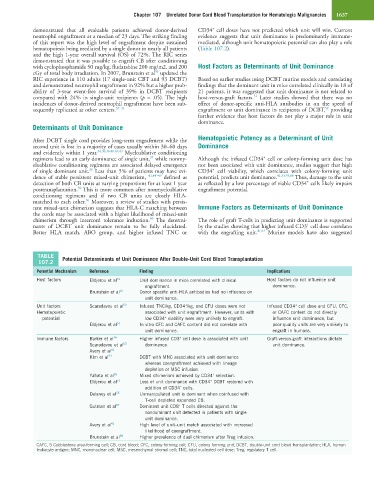
            of  this  report  was  the  high  level  of  engraftment  despite  sustained   mediated, although unit hematopoietic potential can also play a role
            hematopoiesis being mediated by a single donor in nearly all patients   (Table 107.2).
            and the high 1-year overall survival (OS) of 72%. The RIC series
            demonstrated that it was possible to engraft CB after conditioning
            with cyclophosphamide 50 mg/kg, fludarabine 200 mg/m2, and 200   Host Factors as Determinants of Unit Dominance
                                                    36
            cGy of total body irradiation. In 2007, Brunstein et al  updated the
            RIC experience in 110 adults (17 single-unit CBT and 93 DCBT)   Based on earlier studies using DCBT murine models and correlating
            and demonstrated neutrophil engraftment in 92% but a higher prob-  findings that the dominant unit in mice correlated clinically in 18 of
            ability  of  3-year  event-free  survival  of  39%  in  DCBT  recipients   21 patients, it was suggested that unit dominance is not related to
                                                                                    51
            compared  with  24%  in  single-unit  recipients  (p  =  .05). The  high   host-versus-graft  factors.   Later  studies  showed  that  there  was  no
            incidences of donor-derived neutrophil engraftment have been sub-  effect  of  donor-specific  anti-HLA  antibodies  in  on  the  speed  of
                                                                                                           52
            sequently replicated at other centers. 37–41          engraftment or unit dominance in recipients of DCBT,  providing
                                                                  further evidence that host factors do not play a major role in unit
                                                                  dominance.
            Determinants of Unit Dominance
                                                                  Hematopoietic Potency as a Determinant of Unit
            After DCBT single cord provides long-term engraftment while the
            second unit is lost in a majority of cases usually within 30–60 days   Dominance
            and evidently within 1 year. 34,36,38,40,42,43  Myeloablative conditioning
                                                                                       +
                                                  34
            regimens lead to an early dominance of single unit,  while nonmy-  Although the infused CD34  cell or colony-forming unit dose has
            eloablative conditioning regimens are associated delayed emergence   not been associated with unit dominance, studies suggest that high
                                                                       +
                              36
            of single dominant unit.  Less than 5% of patients may have evi-  CD34   cell  viability,  which  correlates  with  colony-forming  unit
            dence  of  stable  persistent  mixed-unit  chimerism,   41,44–49   defined  as   potential, predicts unit dominance. 41,53,59,60  Thus, damage to the unit
                                                                                                     +
            detection of both CB units at varying proportions for at least 1 year   as reflected by a low percentage of viable CD34  cells likely impairs
                          50
            posttransplantation.  This is more common after nonmyeloablative   engraftment potential.
            conditioning  regimens  and  if  two  CB  units  are  closely  HLA-
                             36
            matched to each other.  Moreover, a review of studies with persis-
            tent mixed-unit chimerism suggests that HLA-C matching between   Immune Factors as Determinants of Unit Dominance
            the cords may be associated with a higher likelihood of mixed-unit
                                                  50
            chimerism  through  intercord  tolerance  induction.   The  determi-  The role of graft T-cells in predicting unit dominance is supported
                                                                                                     +
            nants  of  DCBT  unit  dominance  remain  to  be  fully  elucidated.   by the studies showing that higher infused CD3  cell dose correlates
            Better  HLA  match,  ABO  group,  and  higher  infused  TNC  or   with  the  engrafting  unit. 41,61   Murine  models  have  also  suggested
             TABLE   Potential Determinants of Unit Dominance After Double-Unit Cord Blood Transplantation
              107.2
             Potential Mechanism  Reference    Finding                                  Implications
             Host factors     Eldjerou et al 51  Unit dominance in mice correlated with clinical   Host factors do not influence unit
                                                engraftment.                              dominance.
                              Brunstein et al 52  Donor specific anti-HLA antibodies had no influence on
                                                unit dominance.
                                                              +
                                                                                                  +
             Unit factors     Scaradavou et al 53  Infused TNC/kg, CD34 /kg, and CFU doses were not   Infused CD34  cell dose and CFU, CFC,
             Hematopoietic                      associated with unit engraftment. However, units with   or CAFC content do not directly
                                                       +
               potential                        low CD34  viability were very unlikely to engraft.  influence unit dominance, but
                              Eldjerou et al 51  In vitro CFC and CAFC content did not correlate with   poor-quality units are very unlikely to
                                                unit dominance.                           engraft in humans.
                                                            +
             Immune factors   Barker et al 34  Higher infused CD3  cell dose is associated with unit   Graft-versus-graft interactions dictate
                              Scaradavou et al 53  dominance.                             unit dominance.
                              Avery et al 41
                              Kim et al 54     DCBT with MNC associated with unit dominance
                                                whereas coengraftment achieved with lineage
                                                depletion or MSC infusion.
                                                                       +
                              Yahata et al 55  Mixed chimerism achieved by CD34  selection.
                              Eldjerou et al 51  Loss of unit dominance with CD34  DCBT restored with
                                                                      +
                                                            −
                                                addition of CD34  cells.
                              Delaney et al 56  Unmanipulated unit is dominant when coinfused with
                                                T-cell depleted expanded CB.
                                                            +
                              Gutman et al 57  Dominant unit CD8  T cells directed against the
                                                nondominant unit detected in patients with single
                                                unit dominance.
                              Avery et al 41   High level of unit–unit match associated with increased
                                                likelihood of coengraftment.
                              Brunstein et al 58  Higher prevalence of dual chimerism after Treg infusion.
             CAFC, 5 Cobblestone area-forming cell; CB, cord blood; CFC, colony forming cell; CFU, colony forming unit; DCBT, double-unit cord blood transplantation; HLA, human
             leukocyte antigen; MNC, mononuclear cell; MSC, mesenchymal stromal cell; TNC, total nucleated cell dose; Treg, regulatory T cell.

