


Page 1842 - Hematology_ Basic Principles and Practice ( PDFDrive )
P. 1842
1638   Part X  Transplantation


        that an immune mechanism accounts for unit dominance. Studies   nondominant unit were present in the PB 28 days after transplanta-
        in nonobese diabetic severe combined immunodeficient interleukin-2   tion in 9 of 10 DCBT recipients engrafting with single units regard-
                                         null
        receptor gamma null (NOD/SCID/IL-2R-γ ) mice demonstrated   less of the conditioning regimen. Interestingly, the three patients who
        that despite each unit engrafting alone, coinfusion of mononuclear   had persistent mixed chimerism also did not develop an alloreactive
                                                                  +
        cells as a double-unit graft was associated with predominance of one   CD8  T-cell response.
                                                                                        41
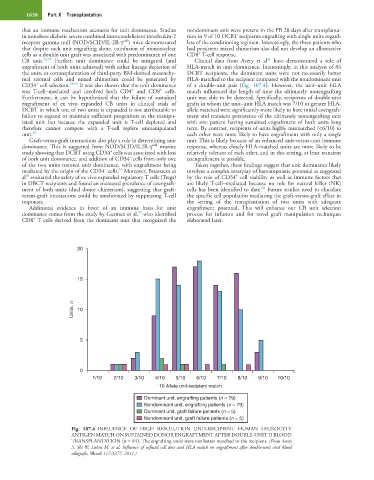
        CB  unit. 54,55   Further,  unit  dominance  could  be  mitigated  (and   Clinical  data  from  Avery  et  al   have  demonstrated  a  role  of
        engraftment of both units achieved) with either lineage depletion of   HLA-match in unit dominance. Interestingly, in this analysis of 84
        the units or cotransplantation of third-party BM-derived mesenchy-  DCBT  recipients,  the  dominant  units  were  not  necessarily  better
        mal  stromal  cells  and  mixed  chimerism  could  be  generated  by   HLA-matched to the recipient compared with the nondominant unit
             +
        CD34  cell selection. 54,55  It was also shown that the unit dominance   of  a  double-unit  pair  (Fig.  107.4).  However,  the  unit–unit  HLA
                                                     +
                                            +
        was  T-cell–mediated  and  involved  both  CD4   and  CD8   cells.   match  influenced  the  length  of  time  the  ultimately  nonengrafting
        Furthermore,  it  can  be  hypothesized  that  the  failure  of  sustained   unit was able to be detected. Specifically, recipients of double-unit
        engraftment  of  ex  vivo  expanded  CB  units  in  clinical  trials  of   grafts in whom the unit–unit HLA match was 7/10 or greater HLA-
        DCBT in which one of two units is expanded is not attributable to   allele matched were significantly more likely to have initial coengraft-
        failure to expand or maintain sufficient progenitors in the manipu-  ment and transient persistence of the ultimately nonengrafting unit
        lated  unit  but  because  the  expanded  unit  is  T-cell  depleted  and   with  one  patient  having  sustained  engraftment  of  both  units  long
        therefore  cannot  compete  with  a  T-cell  replete  unmanipulated   term. By contrast, recipients of units highly mismatched (<6/10) to
        unit. 56                                              each other were more likely to have engraftment with only a single
           Graft-versus-graft interactions also play a role in determining unit   unit. This is likely because of an enhanced unit-versus-unit immune
                                                   null
        dominance. This is suggested from NOD/SCID/IL2R-γ  murine   response, whereas closely HLA-matched units are more likely to be
                                     +
        study showing that DCBT using CD34  cells was associated with loss   relatively tolerant of each other, and in this setting, at least transient
                                           −
        of both unit dominance, and addition of CD34  cells from only one   coengraftment is possible.
        of the two units restored unit dominance, with engraftment being   Taken together, these findings suggest that unit dominance likely
                                   −
                                        51
        mediated by the origin of the CD34  cells.  Moreover, Brunstein et   involves a complex interplay of hematopoietic potential as suggested
                                                                              +
         58
        al  evaluated the safety of ex vivo expanded regulatory T cells (Tregs)   by the role of CD34  cell viability as well as immune factors that
        in DBCT recipients and found an increased prevalence of coengraft-  are  likely T-cell–mediated  because  no  role  for  natural  killer  (NK)
                                                                                       62
        ment of both units (dual donor chimerism), suggesting that graft-  cells has been identified to date.  Future studies need to elucidate
        versus-graft interactions could be ameliorated by suppressing T-cell   the specific cell population mediating the graft-versus-graft effect in
        responses.                                            the  setting  of  the  transplantation  of  two  units  with  adequate
           Additional  evidence  in  favor  of  an  immune  basis  for  unit   engraftment  potential.  This  will  enhance  our  CB  unit  selection
                                              57
        dominance comes from the study by Gutman et al,  who identified   process  for  infusion  and  for  novel  graft  manipulation  techniques
            +
        CD8  T cells derived from the dominant unit that recognized the   elaborated later.
                          20
                          15


                         Units, n  10


                           5


                           0
                               1/10   2/10   3/10   4/10   5/10  6/10   7/10   8/10   9/10  10/10
                                                     10 Allele unit-recipient match
                                                Dominant unit, engrafting patients (n = 79)
                                                Nondominant unit, engrafting patients (n = 79)
                                                Dominant unit, graft failure patients (n = 5)
                                                Nondominant unit, graft failure patients (n = 5)
                        Fig.  107.4  INFLUENCE  OF  HIGH  RESOLUTION  UNIT-RECIPIENT  HUMAN  LEUKOCYTE
                        ANTIGEN MATCH ON SUSTAINED DONOR ENGRAFTMENT AFTER DOUBLE-UNIT D BLOOD
                        TRANSPLANTATION (n = 84). The engrafting units were not better matched to the recipient. (From Avery
                        S, Shi W, Lubin M, et al: Influence of infused cell dose and HLA match on engraftment after double-unit cord blood
                        allografts. Blood 117:3277, 2011.)

