


Page 1843 - Hematology_ Basic Principles and Practice ( PDFDrive )
P. 1843
Chapter 107  Unrelated Donor Cord Blood Transplantation for Hematologic Malignancies  1639

            CORD BLOOD UNIT SELECTION                             double-unit graft selection, a minimum threshold for each unit of a
                                                                                                                  41
                                                                  double-unit graft is needed. Based on the analysis by Avery et al  a
                                                                                                        7
            Efficient search and selection of CB units requires decision making   minimum TNC dose threshold of at least 2.0 × 10 /kg is currently
            as to what banks to consider and what factors to prioritize in unit   recommended in DCBT. The age of cryopreserved CB units should
            selection. The unit selection algorithm currently used at the Memo-  not be criteria when selecting CB units. A study showed that units
            rial  Sloan-Kettering  Cancer  Center  (MSKCC)  is  shown  in  Fig.   cryopreserved  for  up  to  11  years  before  transplantation  had  no
                 63
            107.5.   The  M.D.  Anderson  Cancer  Center  (MDACC)  uses  a   impact on postthaw TNC recovery or neutrophil or platelet engraft-
            similar  approach.  Primary  unit  selection  criteria  are  based  on  the   ment in 288 single CBT recipients. 64
            prethaw  cryopreserved  TNC/kg,  the  unit-recipient  HLA  match   Recent analyses have highlighted new factors to be considered in
            (4-6/6 of HLA-A, HLA-B antigen, and HLA-DRB1 allele), and the   unit selection. The 2009 NYBC analysis evaluated the impact of fetal
            bank of origin based on the authors’ experience with the bank and   exposure to noninherited maternal antigens (NIMAs) on the outcome
                                                                        65
            their accreditation. Other factors such as the availability of confirma-  of  CBT.   The  79  single-unit  CBT  recipients  that  had  an  HLA-
            tory HLA typing on an attached segment and the completeness of   mismatched antigen that was identical to a donor NIMA engrafted
            maternal infectious disease marker and hemoglobinopathy testing are   earlier and had lower TRM and overall mortality. There was also a
            also taken into account.                              lower tendency toward relapse among patients with myeloid malig-
              The exact threshold for acceptable TNC/kg has yet to be estab-  nancies.  Subsequently,  in  2011,  the  NYBC  analyzed  the  effect  of
                                                                                                               66
            lished and varies with HLA match. For example, the 2010 NYBC   HLA-mismatch vector in 1202 single-unit CBT recipients.  They
            analysis  of  single-unit  CBT  demonstrated  that  recipients  of  units   identified  98  donor–recipient  pairs  with  only  unidirectional  mis-
            with  a  6/6  HLA  match  had  the  best  transplantation  outcomes   matches (58 in the graft-versus-host direction and 40 in the rejection
            regardless of the cryopreserved TNC dose. By contrast, recipients of   direction). The graft-versus-host vector group had faster engraftment
                                            7
            4/6 units required a TNC dose of 5.0 × 10 /kg or greater to achieve   and decreased TRM and overall mortality compared with the one-
            similar TRM and DFS to that of recipients of 5/6 units with TNC   bidirectional  mismatch  reference  group,  but  recipients  of rejection
                           12
                        7
            of 2.5–4.9 × 10 /kg.  Although the numbers of DCBT recipients   only mismatched units had slower engraftment, a higher incidence
                                                                                                                   27
            available  do  not  yet  permit  such  analysis,  it  is  likely  that  similar   of graft failure, and higher relapse rates. Also in 2011, Eapen et al
            principles  will  be  found  associated  with  the  engrafting  unit  in   reported that HLA-C matching is important in addition to HLA-A,
                                        41
            DBCT recipients. Indeed, Avery et al  have reported that a higher   HLA-B, and HLA-DRB1, although how to balance this against TNC
                               +
            infused  TNC  and  CD34   cell  dose  in  the  engrafting  unit  of  a   dose needs to be further investigated. Finally, the potential impor-
            double-unit pair was strongly associated with the speed and success   tance  of  antigens  in  the  patients  that  are  shared  with  inherited
            of  neutrophil  engraftment.  However,  because  it  is  not  currently   paternal antigens in the CB donor that could be a target for maternal
            possible  to  predict  which  unit  will  predominate  at  the  time  of   T cells has recently been reported as a potential mechanism of reduced
                                                                  relapse after CBT. 67
                                                                    The findings concerning the importance of HLA-mismatch vector
                                                                  and HLA-C can be immediately incorporated into CB unit selection
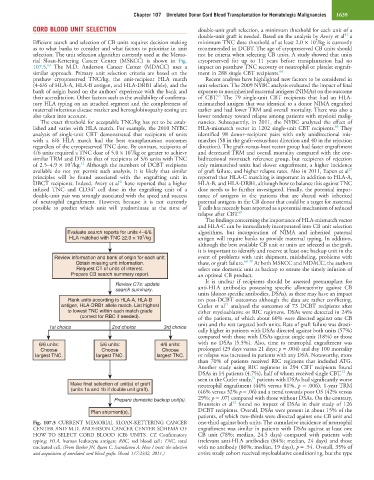
                       Evaluate search reports for units 4−6/6.   algorithms,  but  incorporation  of  NIMA  and  inherited  paternal
                                                7
                        HLA matched with TNC ≥2.0 × 10 /kg        antigen will require banks to provide maternal typing. In addition,
                                                                  although the best available CB unit or units are selected as the graft,
                                                                  it is important to identify and reserve at least one backup unit in the
                   Review information and bank of origin for each unit.  event of problems with unit shipment, mislabeling, problems with
                          Obtain missing unit information.        thaw, or graft failure. 68–70  At both MSKCC and MDACC, the authors
                          Request CT of units of interest.        select one domestic unit as backup to ensure the timely infusion of
                        Prepare CB search summary report.         an optimal CB product.
                                                                    It  is  unclear  if  recipients  should  be  assessed  pretransplant  for
                                       Review CTs: update
                                       search summary.            anti-HLA  antibodies  possessing  specific  alloreactivity  against  CB
                                                                  units (donor specific antibodies, DSAs), as these may have an impact
                       Rank units according to HLA-A, HLA-B       on post-DCBT outcomes although the data are rather conflicting.
                                                                           71
                     antigen, HLA-DRB1 allele match. List highest  Cutler et al  analyzed the outcomes of 73 DCBT recipients after
                       to lowest TNC within each match grade      either myeloablative or RIC regimens. DSAs were detected in 24%
                           (correct for RBC if needed).           of the patients, of which about 60% were directed against one CB
                                                                  unit and the rest targeted both units. Rate of graft failure was drasti-
                 1st choice           2nd choice       3rd choice
                                                                  cally higher in patients with DSAs directed against both units (57%)
                                                                  compared with those with DSAs against single unit (18%) or those
              6/6 units:          5/6 units:          4/6 units:  with  no  DSAs  (5.5%).  Also,  time  to  neutrophil  engraftment  was
              Choose              Choose              Choose      prolonged (29 days versus 21 days; p = .004) and day 100 mortality
             largest TNC.        largest TNC.       largest TNC.  or relapse was increased in patients with any DSA. Noteworthy, more
                                                                  than  70%  of  patients  received  RIC  regimens  that  included  ATG.
                                                                  Another  study  using  RIC  regimens  in  294  CBT  recipients  found
                                                                                                                 72
                                                                  DSAs in 14 patients (4.7%), half of whom received single CBT.  As
                                                                                   71
                                                                  seen in the Cutler study,  patients with DSAs had significantly worse
                        Make final selection of unit(s) of graft  neutrophil engraftment (44% versus 81%, p = .006), 1-year TRM
                        (units 1a and 1b if double unit graft).   (46% versus 32% p = .06) and a trend towards poor OS (42% versus
                                      Prepare domestic backup unit(s).  29%; p = .07) compared with those without DSAs. On the contrary,
                                                                             52
                                                                  Brunstein  et  al   found  no  impact  of  DSAs  in  their  study  of  126
                               Plan shipment(s).                  DCBT recipients. Overall, DSAs were present in about 15% of the
                                                                  patients, of which two-thirds were directed against one CB unit and
            Fig.  107.5  CURRENT  MEMORIAL  SLOAN-KETTERING  CANCER   one-third against both units. The cumulative incidence of neutrophil
            CENTER AND M.D. ANDERSON CANCER CENTER SCHEMA OF      engraftment was similar in patients with DSAs against at least one
            HOW  TO  SELECT  CORD  BLOOD  (CB)  UNITS.  CT,  Confirmatory   CB  unit  (78%;  median,  24.5  days)  compared  with  patients  with
            typing;  HLA,  human  leukocyte  antigen;  RBC,  red  blood  cell;  TNC,  total   irrelevant anti-HLA antibodies (84%; median, 24 days) and those
            nucleated cell. (From Barker JN, Byam C, Scaradavou A: How I treat: the selection   with no antibody (86%; median, 19 days), p = .54. Overall, 35% of
            and acquisition of unrelated cord blood grafts. Blood 117:2332, 2011.)  entire study cohort received myeloablative conditioning, but the type

