


Page 1839 - Hematology_ Basic Principles and Practice ( PDFDrive )
P. 1839
Chapter 107  Unrelated Donor Cord Blood Transplantation for Hematologic Malignancies  1635

            Transplant-Related Mortality and Survival             units (HR ranging from 2.8 to 4.6 for 1 to 5 allele mismatches).
                                                                                                                   28
                                                                  The author recommended avoiding CB units with greater than three
            Early series of single-unit CBT demonstrated high transplant-related   allele mismatches. Of note, only 7% of the units in their study were
            mortality  (TRM)  and  consequently  poor  survival  after  single-unit   complete allele matched and 90% of the 4/6 matched patients by
            CBT. This likely related to the high-risk nature of the patient popula-  current standard were reported to have greater than or equal to three
            tion and standards of supportive care as well as the characteristics of   allele-level  mismatches. Therefore,  if  greater  than  three  allele  mis-
            the transplanted units. Factors such as disease status and recipient   matches are to be avoided, that would require massive addition of
                                                                                                       30
            cytomegalovirus (CMV) positivity are strong determinants of survival   high-quality  CB  units  to  the  global  inventory.   Therefore,  the
                            23
            after single-unit CBT.  From the standpoint of the graft, both TNC   application  of  the  study  results,  which  are  highly  informative,  is
            dose and HLA-match influence TRM and survival. In addition to   impractical for current clinical practice.
            low TNC dose being associated with increased TRM and decreased
                                                          16
            survival, 12,15,18,19  the 68 adult patient analysis of Laughlin et al  and
                                                              +
                        19
            the Wagner et al   102 patient analysis demonstrated a higher CD34    Comparison of Single-Unit Cord Blood Transplantation
            cell dose (>1.2 and 1.7, respectively) were associated with significantly   and Adult Donor Allografts
            improved disease-free survival (DFS). Also, increasing HLA-mismatch
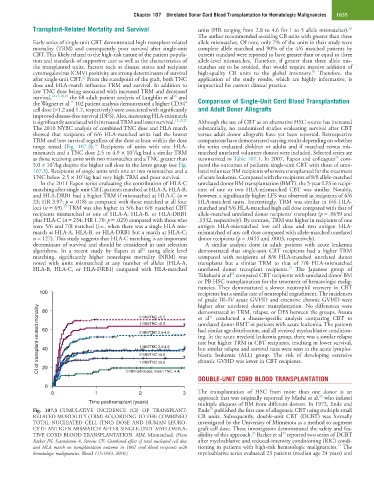
            is significantly associated with increased TRM and lower survival. 12,19,27    Although the use of CBT as an alternative HSC source has increased
            The 2010 NYBC analysis of combined TNC dose and HLA match   substantially,  no  randomized  studies  evaluating  survival after CBT
            showed  that  recipients  of  6/6  HLA-matched  units  had  the  lowest   versus adult donor allografts have yet been reported. Retrospective
            TRM and best survival regardless of the dose at least within the dose   comparisons have demonstrated varying results depending on whether
                                12
            range  tested  (Fig.  107.3).   Recipients  of  units  with  one  HLA-  the  series  evaluated  children  or  adults  and  if  matched  versus  mis-
                                            7
            mismatch and a TNC dose 2.5 to 4.9 × 10 /kg had a similar TRM   matched unrelated volunteer donors were included. Selected series are
                                                                                                               26
            as those receiving units with two mismatches and a TNC greater than   summarized in Table 107.1. In 2007, Eapen and colleagues  com-
                  7
            5.0 × 10 /kg despite the higher cell dose in the latter group (see Fig.   pared the outcomes of pediatric single-unit CBT with those of unre-
            107.3). Recipients of single units with one or two mismatches and a   lated volunteer BM recipients who were transplanted for the treatment
                            7
            TNC below 2.5 × 10 /kg had very high TRM and poor survival.  of acute leukemia. Compared with the recipients of 8/8 allele-matched
              In the 2011 Eapen series evaluating the contribution of HLA-C   unrelated donor BM transplantation (BMT), the 5-year LFS in recipi-
            matching after single unit CBT, patients matched at HLA-A, HLA-B,   ents  of  one  or  two  HLA-mismatched  CBT  was  similar.  Notably,
            and HLA-DRB1 had a higher TRM if mismatched at HLA-C (n =   however, a significantly higher LFS was observed in recipients of 6/6
            23; HR 3.97; p = .018) as compared with those matched at all four   HLA-matched units. Interestingly, TRM was similar in 6/6 HLA-
                      27
            loci (n = 69).  TRM was also higher in 5/6 but 6/8 matched CBT   matched and 5/6 HLA-matched high cell dose compared with that of
            recipients  mismatched  at  one  of  HLA-A,  HLA-B,  or  HLA-DRB1   allele-matched unrelated donor recipients’ transplant (p = .0659 and
            plus HLA-C (n = 234; HR 1.70; p = .029) compared with those who   .1332, respectively). By contrast, TRM was higher in recipients of one
            were 5/6 and 7/8 matched (i.e., when there was a single HLA mis-  antigen  HLA-mismatched  low  cell  dose  and  two  antigen  HLA-
            match at HLA-A, HLA-B, or HLA-DRB1 but a match at HLA-C;   mismatched of any cell dose compared with allele-matched unrelated
            n = 127). This study suggests that HLA-C matching is an important   donor recipients (p = .0455 and .0003, respectively).
            determinant of survival and should be considered in unit selection   A  similar  analysis  done  in  adult  patients  with  acute  leukemia
                                               28
            algorithms.  In  a  recent  study  by  Eapen  et  al   using  allele  level   demonstrated  that  single-unit  CBT  recipients  had  a  higher TRM
            matching,  significantly  higher  nonrelapse  mortality  (NRM)  was   compared  with  recipients  of  8/8  HLA-matched  unrelated  donor
            noted  with  units  mismatched  at  any  number  of  alleles  (HLA-A,   transplants  but  a  similar  TRM  to  that  of  7/8  HLA-mismatched
                                                                                               22
            HLA-B,  HLA-C,  or  HLA-DRB1)  compared  with  HLA-matched   unrelated  donor  transplant  recipients.   The  Japanese  group  of
                                                                             25
                                                                  Takahashi et al  compared CBT recipients with unrelated donor BM
                                                                  or PB HSC transplantation for the treatment of hematologic malig-
                                                                  nancies. They  demonstrated  a  slower  neutrophil  recovery  in  CBT
              100                                                 recipients but a similar rate of neutrophil engraftment. The incidences
                                                                  of grade III–IV acute GVHD and extensive chronic GVHD were
                                                                  higher  after  unrelated  donor  transplantation.  No  differences  were
             CI of transplant-related mortality  60  + + + ++ + + + + + + + +  + + +  + + ++ + + + + + +  + + + + + + + + +  + + + + +  + + + + +  + + + + + + + + + + +  + ++ +  + +  +  + + + + + + + + + + + + + +  1 MM/TNC <2.5 +++ +  + + ++ + +  unrelated donor BMT in patients with acute leukemia. The patients
               80
                                                                  demonstrated in TRM, relapse, or DFS between the groups. Atsuta
                                                                     31
                                                                  et  al   conducted  a  disease-specific  analysis  comparing  CBT  to
                                               2 MM/TNC <2.5
                                + +
                                                             +
                                                   +
                         +
                     +
                                                                  had similar age distribution, and all received myeloablative condition-
                                               2 MM/TNC 2.5-4.9
                                                  +
                                                +
                                               +
                                                                  ing. In the acute myeloid leukemia group, there was a similar relapse
                      +
                          + + + +
                                                                  rate but higher TRM in CBT recipients, resulting in lower survival,
                                                             +
                                               1 MM/TNC 2.5-4.9
                                                                  but similar relapse and survival rates were seen in the acute lympho-
                                                             + +
               40
                                                       + +
                                                + + + + +
                                                     + +
                                                   +
                                                    +
                            +
                          +
                         +
                                                                  blastic  leukemia  (ALL)  group.  The  risk  of  developing  extensive
                                               2 MM/TNC ≥5.0
                                                             +
                                                +
                                                + +
                           +
                                               1 MM/TNC ≥5.0
                                           + + ++ ++
               20
                                                                  DOUBLE-UNIT CORD BLOOD TRANSPLANTATION
                   + + + + +  + + + + + ++ +  +  ++  ++  ++  ++ +  0 MM (all doses; mean TNC, 4.4) ++  chronic GVHD was lower in CBT recipients.
                0
                  0             1              2             3    The  transplantation  of  HSC  from  more  than  one  donor  is  an
                                                                                                         32
                                                                  approach that was originally reported by Mathé et al,  who infused
                              Time posttransplant (years)         multiple aliquots of BM from different donors. In 1972, Ende and
                                                                      33
            Fig.  107.3  CUMULATIVE  INCIDENCE  (CI)  OF  TRANSPLANT-  Ende  published the first case of allogeneic CBT using multiple small
            RELATED MORTALITY (TRM) ACCORDING TO THE COMBINED     CB  units.  Subsequently,  double-unit  CBT  (DCBT)  was  formally
            TOTAL  NUCLEATED  CELL  (TNC)  DOSE  AND  HUMAN  LEUKO-  investigated by the University of Minnesota as a method to augment
            CYTE ANTIGEN MISMATCH AFTER SINGLE-UNIT MYELOABLA-    graft cell dose. These investigators demonstrated the safety and fea-
                                                                                             34
                                                                                   33
            TIVE CORD BLOOD TRANSPLANTATION. MM, Mismatched. (From   sibility of this approach.  Barker et al  reported two series of DCBT
            Barker JN, Scaradavou A, Stevens CE: Combined effect of total nucleated cell dose   after myeloablative and reduced-intensity conditioning (RIC) condi-
                                                                                                               35
            and  HLA  match  on  transplantation  outcome  in  1061  cord  blood  recipients  with   tioning in patients with high-risk hematologic malignancies.  The
            hematologic malignancies. Blood 115:1843, 2010.)      myeloablative series evaluated 23 patients (median age 24 years) and

