


Page 1849 - Hematology_ Basic Principles and Practice ( PDFDrive )
P. 1849
Chapter 107  Unrelated Donor Cord Blood Transplantation for Hematologic Malignancies  1645


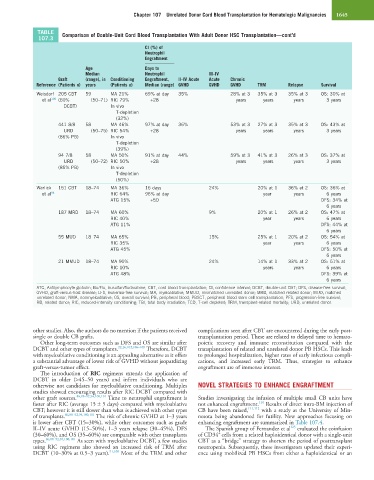
             TABLE   Comparison of Double-Unit Cord Blood Transplantation With Adult Donor HSC Transplantation—cont’d
              107.3
                                                CI (%) of
                                                Neutrophil
                                                Engraftment
                             Age                Days to
                             Median             Neutrophil           III–IV
                    Graft    (range), in  Conditioning   Engraftment,   II–IV Acute   Acute   Chronic
             Reference (Patients n)  years  (Patients n)  Median (range)  GVHD  GVHD  GVHD  TRM  Relapse  Survival
             Weisdorf  205 CBT  59   MA 21%     69% at day   35%            28% at 3   35% at 3   35% at 3   OS: 30% at
               et al 100  (60%   (50–71) RIC 79%  +28                         years    years     years      3 years
                      DCBT)          In vivo
                                       T-depletion
                                       (32%)
                    441 8/8   58     MA 46%     97% at day   36%            53% at 3   27% at 3   35% at 3   OS: 43% at
                      URD      (50–75) RIC 54%    +28                         years    years     years      3 years
                    (86% PB)         In vivo
                                       T-depletion
                                       (39%)
                    94 7/8   58      MA 50%     91% at day   44%            59% at 3   41% at 3   26% at 3   OS: 37% at
                      URD      (50–72) RIC 50%    +28                         years    years     years      3 years
                    (85% PB)         In vivo
                                       T-depletion
                                       (50%)
             Warlick   151 CBT  18–74  MA 36%   16 days              24%             20% at 1   36% at 2   OS: 36% at
               et al 94              RIC 64%    96% at day                             year      years      6 years
                                     ATG 15%      +50                                                     DFS: 34% at
                                                                                                            6 years
                    187 MRD  18–74   MA 60%                          9%              20% at 1   26% at 2   OS: 47% at
                                     RIC 40%                                           year      years      6 years
                                     ATG 11%                                                              DFS: 44% at
                                                                                                            6 years
                    55 MUD   18–74   MA 65%                          15%             25% at 1   20% at 2   OS: 54% at
                                     RIC 35%                                           year      years      6 years
                                     ATG 45%                                                              DFS: 50% at
                                                                                                            6 years
                    21 MMUD  18–74   MA 90%                          24%             14% at 1   33% at 2   OS: 51% at
                                     RIC 10%                                           years     years      6 years
                                     ATG 48%                                                              DFS: 39% at
                                                                                                            6 years
             ATG, Antilymphocyte globulin; Bu/Flu, busulfan/fludarabine; CBT, cord blood transplantation; CI, confidence interval; DCBT, double-unit CBT; DFS, disease-free survival;
             GVHD, graft-versus-host disease; LFS, leukemia-free survival; MA, myeloablative; MMUD, mismatched unrelated donor; MRD, matched related donor; MUD, matched
             unrelated donor; NMA, nonmyeloablative; OS, overall survival; PB, peripheral blood; PBSCT, peripheral blood stem cell transplantation; PFS, progression-free survival;
             RD, related donor; RIC, reduced-intensity conditioning; TBI, total body irradiation; TCD, T-cell depleted; TRM, transplant-related mortality; URD, unrelated donor.


            other studies. Also, the authors do no mention if the patients received   complications seen after CBT are encountered during the early post-
            single or double CB grafts.                           transplantation period. These are related to delayed time to hemato-
              Other long-term outcomes such as DFS and OS are similar after   poietic  recovery  and  immune  reconstitution  compared  with  the
            DCBT and other types of transplants. 22,26,102,106–109  Therefore, DCBT   transplantation of related and unrelated donor PB HSCs. This leads
            with myeloablative conditioning is an appealing alternative as it offers   to prolonged hospitalization, higher rates of early infectious compli-
            a substantial advantage of lower risk of GVHD without jeopardizing   cations,  and  increased  early  TRM.  Thus,  strategies  to  enhance
            graft-versus-tumor effect.                            engraftment are of immense interest.
              The  introduction  of  RIC  regimens  extends  the  application  of
            DCBT  in  older  (>45–50  years)  and  infirm  individuals  who  are
            otherwise not candidates for myeloablative conditioning. Multiples   NOVEL STRATEGIES TO ENHANCE ENGRAFTMENT
            studies showed encouraging results after RIC DCBT compared with
            other graft sources. 86,88–92,94,100,101  Time to neutrophil engraftment is   Studies investigating the infusion of multiple small CB units have
                                                                                      110
            faster after RIC (average 15 ± 5 days) compared with myeloablative   not enhanced engraftment.  Results of direct intra-BM injection of
            CBT; however it is still slower than what is achieved with other types   CB have been mixed, 111,112  with a study at the University of Min-
            of transplants. 86,88–92,94,100,101  The risk of chronic GVHD at 1–3 years   nesota  being  abandoned  for  futility.  New  approaches  focusing  on
            is lower after CBT (15–30%), while other outcomes such as grade   enhancing engraftment are summarized in Table 107.4.
                                                                                                125
            II–IV acute GVHD (15–50%), 1–3 years relapse (30–45%), DFS   The Spanish group of Fernandez et al  evaluated the coinfusion
                                                                        +
            (30–60%), and OS (35–60%) are comparable with other transplants   of CD34  cells from a related haploidentical donor with a single-unit
            types. 86,88–92,94,100,101  As seen with myeloablative DCBT, a few studies   CBT as a “bridge” strategy to shorten the period of posttransplant
            using  RIC  regimens  also  showed  an  increased  risk  of  TRM  after   neutropenia. Subsequently, these investigators updated their experi-
            DCBT (10–30% at 0.5–3 years). 91,100  Most of the TRM and other   ence using mobilized PB HSCs from either a haploidentical or an

