


Page 1846 - Hematology_ Basic Principles and Practice ( PDFDrive )
P. 1846
1642   Part X  Transplantation

                                                                                 107
                                                 78
        patients  dying  in  the  first  6  months  after  transplant.   In  another   shown by Brunstein et al,  5-year NRM was 41% in DCBT patients
        study, the median time to TRM was 3 months; few deaths occurred   who engrafted beyond 26 days compared with 16% in patients who
        after 1-year posttransplantation which resulted in 1- and 3-year OS   achieved neutrophil engraftment within 26 days, which was similar
                                     38
        rates  of  57%  and  52%  respectively.   Steady  immune  recovery   to NRM seen with other donor types. The risk of relapse at 3–5 years
        observed after 6 months of transplantation likely contributes to this   is about 12% to 22% after DCBT. Various studies comparing DCBT
        protection against late mortality. 98                 with other types of transplants showed inconsistent findings. A study
                                                                           106
                                                              by Gutman et al  in 31 CBT patients (87% DCBT) showed sig-
        Comparison of Double-Unit Cord Blood Transplantation   nificantly lower cumulative incidence of relapse at 2-years after CBT
                                                              (3.2%) compared with matched unrelated donors (MUD; 23%) and
        With Adult Donor Allografts                           mismatched unrelated donors (MMUD; 26%). A subsequent larger
                                                                                 107
                                                              study  by  Brunstein  et  al   similarly  showed  marked  reduction  in
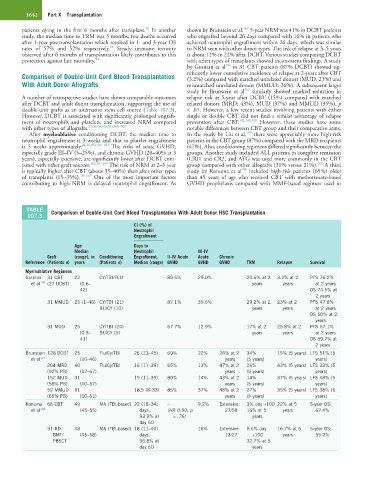
        A number of retrospective studies have shown comparable outcomes   relapse  risk  at  5-year  after  DCBT  (15%)  compared  with  matched
        after DCBT and adult donor transplantation, supporting the use of   related donors (MRD; 43%), MUD (37%) and MMUD (35%), p
        double-unit grafts as an alternative stem cell source (Table 107.3).   < .01. However, a few recent studies involving patients with either
        However, DCBT is associated with significantly prolonged engraft-  single  or  double  CBT  did  not  find  a  similar  advantage  of  relapse
        ment  of  neutrophils  and  platelets,  and  increased  NRM  compared   prevention  after  CBT. 102,108,109   However,  these  studies  have  some
        with other types of allografts. 22,26,94,100,102,106–109  notable differences between CBT group and their comparative arms.
                                                                                  109
           After  myeloablative  conditioning  DCBT,  the  median  time  to   In the study by Liu et al,  there were appreciably more high-risk
        neutrophil engraftment is 3 weeks and that to platelet engraftment   patients in the CBT group (87%) compared with the MRD recipients
        is  5  weeks  approximately. 22,26,102,106–109   The  risks  of  acute  GVHD,   (47%). Also, conditioning regimens differed significantly between the
        especially grade III–IV (5–25%), and chronic GVHD (20–40% at 3   groups. Another study included ALL patients in complete remission
        years), especially extensive, are significantly lower after DCBT com-  (CR)1 and CR2, and ATG was used more commonly in the CBT
                                                                                                         102
        pared with other graft sources. 102,107,109  The risk of NRM at 2–5 year   group compared with other allografts (31% versus 21%).  A third
                                                                                108
        is typically higher after CBT (about 35–40%) than after other types   study  by  Konuma  et  al   included  high-risk  patients (65%) older
        of  transplants  (15–35%). 107,109   One  of  the  most  important  factors   than  45  years  of  age  who  received  CBT  with  methotrexate-based
        contributing  to  high  NRM  is  delayed  neutrophil  engraftment.  As   GVHD  prophylaxis  compared  with  MMF-based  regimen  used  in


          TABLE   Comparison of Double-Unit Cord Blood Transplantation With Adult Donor HSC Transplantation
          107.3
                                             CI (%) of
                                             Neutrophil
                                             Engraftment
                         Age                 Days to
                         Median              Neutrophil           III–IV
                 Graft   (range), in  Conditioning   Engraftment,   II–IV Acute   Acute   Chronic
         Reference (Patients n)  years  (Patients n)  Median (range)  GVHD  GVHD  GVHD  TRM  Relapse  Survival
         Myeloablative Regimens
         Gutman  31 CBT  22       CY/TBI/FLU            80.6%     29.0%           20.6% at 2   3.2% at 2   PFS 76.2%
           et al 106  (27 DCBT)  (0.6–                                              years     years     at 2 years
                           42)                                                                        OS 74.5% at
                                                                                                        2 years
                 31 MMUD  25 (1–48) CY/TBI (21)         87.1%     35.5%           29.2% at 2   23% at 2   PFS 47.8%
                                  BU/CY (10)                                        years     years     at 2 years
                                                                                                      OS 50% at 2
                                                                                                        years
                31 MUD   25       CY/TBI (24)           67.7%     12.9%           17% at 2   25.8% at 2   PFS 57.1%
                           (0.9–  BU/CY (5)                                         years    years      at 2 years
                           41)                                                                        OS 59.7% at
                                                                                                        2 years
         Brunstein  128 DCBT  25   Flu/Cy/TBI  26 (13–45)  60%    22%    26% at 2   34%     15% (5 years) LFS 51% (5
           et al 107       (10–46)                                         years  (5 years)             years)
                 204 MRD  40      Flu/Cy/TBI  16 (11–39)  65%     13%    47% at 2   24%     43% (5 years) LFS 33% (5
                 (92% PB)  (12–67)                                         years  (5 years)             years)
                152 MUD  31                  19 (11–39)  80%      14%    43% at 2   14%     37% (5 years) LFS 48% (5
                (58% PB)   (10–57)                                         years  (5 years)             years)
                52 MMUD  31                  18.5 (8–33)  85%     37%    48% at 2   27%     35% (5 years) LFS 38% (5
                (65% PB)   (10–51)                                         years  (5 years)             years)
         Konuma  66 CBT  49       MA (TBI-based) 22 (18–34)   –   9.2%   Extensive:   3% day +100 22% at 5   5-year OS:
           et al 108       (45–55)             days,    (HR 0.90; p        27/58  16% at 5    years     67.4%
                                               93.9% at   = .76)                    years
                                               day 60
                 31 RD   48       MA (TBI-based) 18 (11–40)       16%    Extensive:   6.5% day   16.7% at 5   5-year OS:
                  BMT/     (45–58)             days,                       13/27    +100      years     55.2%
                  PBSCT                        96.8% at                           32.7% at 5
                                               day 60                               years

