


Page 1852 - Hematology_ Basic Principles and Practice ( PDFDrive )
P. 1852
1648   Part X  Transplantation


        Further, in addition to delayed quantitative immune reconstitution   lymphocytic   leukemia   [ClinicalTrials.gov:   NCT01619761,
        after DCBT, 86,134,135  there are delays in functional recovery of viral-  NCT02280525] and other high-risk myeloid malignancies [Clinical-
                                                136
        specific  T-cells  for  the  first  year  posttransplantation.   Therefore,   Trials.gov:  NCT01823198],  and  in  conjunction  with  autologous
        strategies to enhance immune recovery after CBT are critically needed.  SCT  for  patients  with  multiple  myeloma  [ClinicalTrials.gov:
                                                              NCT01729091].
                                                                 Adoptive immunotherapy using ex vivo expanded Tregs is another
        ADOPTIVE IMMUNOTHERAPY                                area  of  investigation  to  prevent  or  treat  GVHD.  Brunstein  et  al
                                                                                                               58
                                                              reported the results of a phase I clinical trial of CB derived ex vivo
        Adoptive immunotherapy is an attractive strategy not only to enhance   expanded Tregs from a third CB unit, which were infused in addition
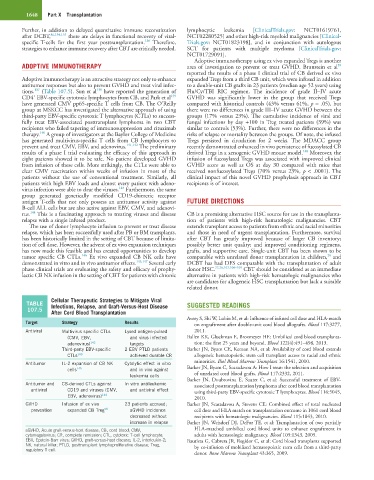
        antitumor responses but also to prevent GVHD and treat viral infec-  to a double-unit CB grafts in 23 patients (median age 52 years) using
            137
                                 138
        tions.  (Table 107.5). Sun et al  have reported the generation of   Flu/Cy/TBI  RIC  regimen.  The  incidence  of  grade  II–IV  acute
            +
                                                         139
        CD4  EBV-specific cytotoxic lymphocytes from CB, and Park et al    GVHD  was  significantly  lower  in  the  group  that  received  Tregs
        have generated CMV pp65-specific T cells from CB. The O’Reilly   compared with historical controls (43% versus 61%, p = .05), but
        group at MSKCC has investigated the alternative approach of using   there were no differences in grade III–IV acute GVHD between the
        third-party EBV-specific cytotoxic T lymphocytes (CTLs) to success-  groups  (17%  versus  23%). The  cumulative  incidence  of  viral  and
        fully  treat  EBV-associated  posttransplant  lymphoma  in  two  CBT   fungal  infections  by  day  +100  in Treg  treated  patients  (39%)  was
        recipients who failed tapering of immunosuppression and rituximab   similar to controls (53%). Further, there were no differences in the
              140
        therapy.  A group of investigators at the Baylor College of Medicine   risks of relapse or mortality between the groups. Of note, the infused
        has  generated  multivirus-specific T  cells  from  CB  lymphocytes  to   Tregs  persisted  in  circulation  for  2  weeks.  The  MDACC  group
        prevent and treat CMV, EBV, and adenovirus. 141,142  The preliminary   recently demonstrated enhanced in vivo persistence of fucosylated CB
                                                                                                    148
        results of a phase I trial evaluating the efficacy of this approach in   derived Tregs in a xenogenic GVHD mouse model.  Moreover, the
        eight patients showed it to be safe. No patient developed GVHD   infusion of fucosylated Tregs was associated with improved clinical
        from infusion of these cells. More strikingly, the CTLs were able to   GVHD  score  as  well  as  OS  at  day  30  compared  with  mice  that
        clear  CMV  reactivation  within  weeks  of  infusion  in  most  of  the   received  nonfucosylated Tregs  (70%  versus  23%,  p  <  .0001). The
        patients  without  the  use  of  conventional  treatment.  Similarly,  all   clinical impact of this novel GVHD prophylaxis approach in CBT
        patients with high EBV loads and almost every patient with adeno-  recipients is of interest.
                                        143
        virus infection were able to clear the viruses.  Furthermore, the same
        group  generated  genetically  modified  CD19-chimeric  receptor
        antigen T-cells  that  not  only  possess  an  antitumor  activity  against   FUTURE DIRECTIONS
        B-cell ALL cells but are also active against EBV, CMV, and adenovi-
           144
        rus.  This is a fascinating approach to treating viruses and disease   CB is a promising alternative HSC source for use in the transplanta-
        relapse with a single infused product.                tion  of  patients  with  high-risk  hematologic  malignancies.  CBT
           The use of donor lymphocyte infusion to prevent or treat disease   extends transplant access to patients from ethnic and racial minorities
        relapse, which has been successfully used after PB or BM transplants,   and those in need of urgent transplantation. Furthermore, survival
        has been historically limited in the setting of CBT because of limita-  after  CBT  has  greatly  improved  because  of  larger  CB  inventory;
        tion of cell dose. However, the advent of ex vivo expansion techniques   possibly  better  unit  quality;  and  improved  conditioning  regimens,
        has now made this feasible and has created opportunities to develop   grafts, and supportive care. Single-unit CBT has been shown to be
                                                                                                            26
                            146
        tumor  specific  CB  CTLs.   Ex  vivo  expanded  CB  NK  cells  have   comparable with unrelated donor transplantation in children,  and
        demonstrated in vitro and in vivo antitumor effects. 145,147  Several early   DCBT has had DFS comparable with the transplantation of adult
        phase clinical trials are evaluating the safety and efficacy of prophy-  donor HSC. 22,26,102,106–109  CBT should be considered as an immediate
        lactic CB NK infusion in the setting of CBT for patients with chronic   alternative in patients with high-risk hematologic malignancies who
                                                              are candidates for allogeneic HSC transplantation but lack a suitable
                                                              related donor.
                  Cellular Therapeutic Strategies to Mitigate Viral
          TABLE   Infections, Relapse, and Graft-Versus-Host Disease   SUGGESTED READINGS
          107.5
                  After Cord Blood Transplantation
                                                              Avery S, Shi W, Lubin M, et al: Influence of infused cell dose and HLA-match
         Target      Strategy             Results                on engraftment after double-unit cord blood allografts. Blood 117:3277,
         Antiviral   Multivirus specific CTLs   Lysed antigen-pulsed   2011.
                       (CMV, EBV,           and virus infected   Ballen KK, Gluckman E, Broxmeyer HE: Umbilical cord blood transplanta-
                       adenovirus) 142      targets              tion: the first 25 years and beyond. Blood 122(4):491–498, 2013.
                     Third-party EBV-specific   2 EBV PTLD patients   Barker JN, Byam CE, Kernan NA, et al: Availability of cord blood extends
                       CTLs 140             achieved durable CR  allogeneic hematopoietic stem cell transplant access to racial and ethnic
         Antitumor   IL-2 expansion of CB NK   Cytolytic effect in vitro   minorities. Biol Blood Marrow Transplant 16:1541, 2010.
                       cells 145            and in vivo against   Barker JN, Byam C, Scaradavou A: How I treat: the selection and acquisition
                                            leukemia cells       of unrelated cord blood grafts. Blood 117:2332, 2011.
                                                              Barker  JN,  Doubrovina  E,  Sauter  C,  et al:  Successful  treatment  of  EBV-
         Antitumor and   CB-derived CTLs against   In vitro antileukemic   associated posttransplantation lymphoma after cord blood transplantation
           antiviral   CD19 and viruses (CMV,   and antiviral effect  using third-party EBV-specific cytotoxic T lymphocytes. Blood 116:5045,
                       EBV, adenovirus) 144                      2010.
         GVHD        Infusion of ex vivo   23 patients accrued;   Barker JN, Scaradavou A, Stevens CE: Combined effect of total nucleated
           prevention  expanded CB Treg 58  aGVHD incidence      cell dose and HLA match on transplantation outcome in 1061 cord blood
                                            decreased without    recipients with hematologic malignancies. Blood 115:1843, 2010.
                                            increase in relapse  Barker JN, Weisdorf DJ, DeFor TE, et al: Transplantation of two partially
         aGVHD, Acute graft-versus-host disease; CB, cord blood; CMV,   HLA-matched  umbilical  cord  blood  units  to  enhance  engraftment  in
         cytomegalovirus; CR, complete remission; CTL, cytotoxic T-cell lymphocyte;   adults with hematologic malignancy. Blood 105:1343, 2005.
         EBV, Epstein-Barr virus; GVHD, graft-versus-host disease; IL-2, interleukin-2;   Bautista G, Cabrera JR, Regidor C, et al: Cord blood transplants supported
         NK, natural killer; PTLD, posttransplant lymphoproliferative disease; Treg,   by co-infusion of mobilized hematopoietic stem cells from a third-party
         regulatory T cell.
                                                                 donor. Bone Marrow Transplant 43:365, 2009.

